
PHP and JavaScript
PHP and JavaScript are two of the most widely used programming languages on the web. PHP is a server-side scripting language that is used to create dynamic web pages, while JavaScript is a client-side scripting language that is used to create interactive web pages. Both languages have their strengths and weaknesses, and when used together, they can create powerful and dynamic web applications. Join Best PHP Course in Gurgaon
Using PHP with JavaScript
PHP is a server-side language, which means that it runs on the server before the web page is sent to the client's browser. This makes PHP a great choice for creating dynamic web pages, as it allows developers to generate HTML, CSS, and JavaScript code dynamically based on user input or other data.
One way to use PHP with JavaScript is to embed PHP code directly into JavaScript code. For example, let's say we have a PHP variable called $name, and we want to use it in a JavaScript alert box:
<script>
var name = "<?php echo $name; ?>";
alert("Hello, " + name + "!");
</script>
In this code, we embed the PHP variable $name directly into the JavaScript code using the <?php ?> tags. When the web page is loaded, the PHP code is executed on the server, and the resulting value of $name is inserted into the JavaScript code. Learn PHP training in gurgaon with Us
Another way to use PHP with JavaScript is to use AJAX (Asynchronous JavaScript and XML) to send and receive data between the client and the server. With AJAX, the client can make requests to the server and receive responses without reloading the entire web page. This allows for a more seamless and responsive user experience.
For example, let's say we have a form that allows users to search for products on our website. When the user enters a search query and clicks the "Search" button, we want to send the query to the server using AJAX and display the results on the page without reloading the entire page.
<form>
<input type="text" name="search" id="search">
<button type="button" onclick="searchProducts()">Search</button>
</form>
<div id="results"></div>
<script>
function searchProducts() {
var searchQuery = document.getElementById("search").value;
var xhr = new XMLHttpRequest();
xhr.onreadystatechange = function() {
if (xhr.readyState === 4 && xhr.status === 200) {
document.getElementById("results").innerHTML = xhr.responseText;
}
};
xhr.open("GET", "search.php?query=" + searchQuery, true);
xhr.send();
}
</script>
In this code, we have a form that contains a text input field and a button. When the user clicks the button, the searchProducts() function is called. This function retrieves the value of the search query from the input field and sends an AJAX request to the server using the XMLHttpRequest object.
The server-side script, search.php, receives the search query as a parameter and performs a search on the database. The script returns the search results as HTML code, which is then displayed on the page using the innerHTML property of the results div.
Using popular JavaScript libraries with PHP
There are many popular JavaScript libraries and frameworks that can be used with PHP to create dynamic and interactive web applications. Two of the most popular libraries are jQuery and React.
jQuery is a fast and lightweight JavaScript library that simplifies HTML document traversal and manipulation, event handling, and AJAX interactions. It provides a concise and easy-to-use API that allows developers to write less code and achieve more.
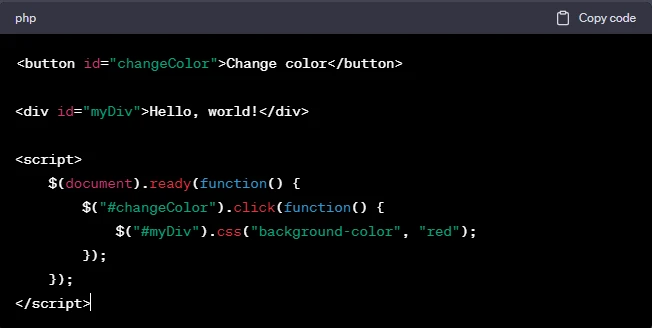
One of the main benefits of using jQuery with PHP is that it allows for easy manipulation of the DOM (Document Object Model) and CSS. For example, let's say we want to change the background color of a div with the ID myDiv when the user clicks a button:
<button id="changeColor">Change color</button>
<div id="myDiv">Hello, world!</div>
<script>
$(document).ready(function() {
$("#changeColor").click(function() {
$("#myDiv").css("background-color", "red");
});
});
</script>
In this code, we use jQuery to attach a click event handler to the changeColor button. When the button is clicked, the background color of the myDiv div is changed to red using the css() method.
React is a JavaScript library for building user interfaces. It provides a declarative and component-based approach to building UIs, which makes it easy to create complex and interactive applications.
One of the main benefits of using React with PHP is that it allows for easy integration of server-side rendering. Server-side rendering is the process of rendering a web page on the server before sending it to the client's browser. This can improve the initial load time of the page and improve search engine optimization (SEO).
To use React with PHP, we can create a PHP script that generates the initial HTML code for the web page, and then use React on the client side to render and update the UI. For example, let's say we have a React component called App that renders a list of products:
<div id="root"></div>
<script src="https://unpkg.com/react/umd/react.production.min.js"></script>
<script src="https://unpkg.com/react-dom/umd/react-dom.production.min.js"></script>
<script src="https://unpkg.com/babel-standalone/babel.min.js"></script>
<script type="text/babel">
class App extends React.Component {
constructor(props) {
super(props);
this.state = {
products: []
};
}
componentDidMount() {
fetch("products.php")
.then(response => response.json())
.then(data => {
this.setState({ products: data });
});
}
render() {
return (
<ul>
{this.state.products.map(product => (
<li key={product.id}>{product.name}</li>
))}
</ul>
);
}
}
ReactDOM.render(<App />, document.getElementById("root"));
</script>
In this code, we use the fetch() function to make an AJAX request to the server-side script, products.php, which returns a JSON array of products. We then update the state of the App component with the retrieved data, which triggers a re-rendering of the component. Learn Best React Js training in Gurgaon.
Conclusion
Using PHP with JavaScript and popular libraries like jQuery and React can create powerful and dynamic web applications. PHP allows for dynamic server-side processing, while JavaScript allows for interactive client-side behavior. By using popular JavaScript libraries and frameworks with PHP, developers can create complex and responsive user interfaces and provide a seamless user experience.



























Sign in to leave a comment.