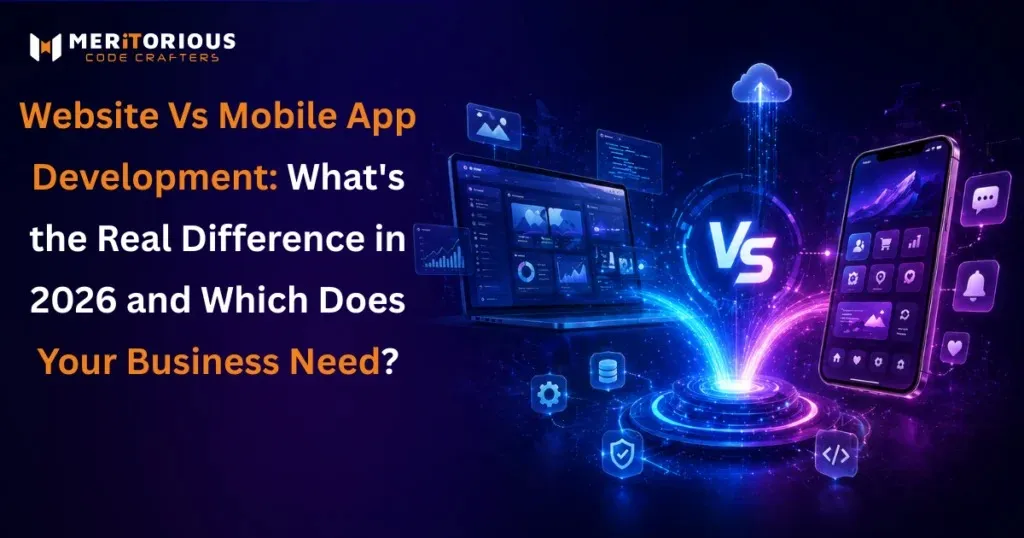

Two businesses launch in the same month, targeting the same market. One builds a website. One builds a mobile app. A year later, one of them has strong organic search traffic, a growing content library, and a steady stream of inbound leads. The other has 50,000 daily active users, industry-leading retention, and engagement metrics that justify their Series A.
Neither made a mistake. Both made a deliberate platform choice based on who their users are and how those users interact with products like theirs. That's the entire point of this discussion — not which platform is better in some abstract sense, but which one is better for a specific business with a specific user base and a specific growth model.
In 2026, the technology gap between websites and mobile apps has narrowed. Progressive Web Apps have pushed browser-based experiences closer to native territory. Cross-platform frameworks have made mobile development faster and more accessible. But the strategic question — which platform aligns with your users, your use case, and your business model — remains as important as ever. Let's work through it properly.
Websites: What They Are and Why They Matter
Think of a website as a permanently open front door. It exists at a URL, loads in any browser on any device anywhere in the world, and requires nothing of the user beyond the willingness to click a link. No download. No account creation before access. No storage consumed on the user's device. The experience begins the instant someone arrives.
That effortless entry point connects to one of the most powerful growth mechanisms in digital business: organic search. When a website is properly structured and technically built, every page becomes an asset that Google can index and serve as a search result. A user searching for something your business provides can find you at the precise moment of intent — the moment they're actively looking for what you offer. There's no advertising budget required for that discovery to happen. The traffic is free, it's high-intent, and it compounds as the site's authority grows over time.
This is why websites are not just a digital presence checkbox — they're a business development tool. A well-executed web and CMS development project, whether it's a WordPress-based content platform, a Laravel-powered application, a React-driven SaaS dashboard, or a full eCommerce storefront, is simultaneously a product and a growth engine. The two functions reinforce each other: better content earns better rankings, which brings in more users, which generates more data and feedback to improve the product.
Websites also have an operational advantage that compounds quietly over time: there is no deployment friction. Update a price, ship a new feature, fix a broken form — it goes live immediately, for every user in the world, with no intermediary review or approval. For fast-moving teams, this immediacy has real strategic value.
What falls under "website" is deliberately broad here. A single landing page for a pre-launch startup. A complex B2B SaaS dashboard. A publishing platform with thousands of articles. A digital storefront handling millions in annual revenue. A government portal handling citizen services. All of these are websites — browser-delivered, URL-accessible, instantly updatable. The variety of what's possible within that definition is enormous.
Mobile Apps: What They Are and Why They Matter
A mobile app is installed software. It lives on a user's device — downloaded from the App Store or Google Play, sitting on the home screen alongside their messaging apps and their photos. It runs on the native operating system. It knows when it's offline and can continue working regardless. It can reach the user's lock screen with a notification even when the app is closed. It interacts with the camera, the GPS, the fingerprint sensor, and the accelerometer as naturally as any other piece of software on the device.
The development landscape in 2026 is dominated by cross-platform frameworks for most business applications. Rather than building one codebase for iOS and a separate one for Android — doubling the development effort, the testing overhead, and the maintenance burden — cross-platform tools allow teams to write once and deploy to both. Flutter, developed by Google, compiles a single Dart codebase to native ARM code for both iOS and Android, delivering performance characteristics that are genuinely close to fully native for the vast majority of application types. The cost savings compared to two separate native builds typically land between 30 and 40 percent — meaningful for any budget. The development timeline is shorter. The ongoing maintenance is simpler. For businesses that don't require the very deepest OS-level integration or platform-exclusive features, cross-platform is the practical and economical default.
What a mobile app provides that a website fundamentally cannot is a different type of presence in the user's life. Consider what it means for your product to have a home screen icon. Every time the user unlocks their phone — dozens of times a day — your product is visible. That passive brand touchpoint costs nothing per impression once the app is installed. No ad spend. No re-targeting. No hoping the user remembers to come back. The app is simply there.
Now layer on push notifications. A well-timed, personalized notification sent to a user's lock screen generates engagement rates that email marketing and browser notifications cannot approach. For products that depend on consistent user interaction — fitness apps, financial tools, productivity systems, language learning platforms, social applications — the notification mechanism isn't a marketing feature. It's part of how the product delivers its core value.
Add offline functionality: the ability for the app to continue working without an internet connection, processing inputs locally and syncing when connectivity is restored. Add native hardware access: a camera integration that doesn't require browser permission dialogs on every session, GPS tracking that continues running in the background, biometric authentication that replaces a password with a fingerprint or a face.
These capabilities, taken together, enable a class of user experience that simply isn't achievable in a browser — not with current technology, not with Progressive Web Apps, not with any browser-based approach that exists today. That's not a criticism of web technology. It's a recognition that the two platforms are built to do different things.
Where the Two Platforms Diverge Most Meaningfully
Understanding the differences at a surface level — apps have push notifications, websites rank in Google — is easy. Understanding which differences actually matter for a given business requires going a level deeper.
Discovery and acquisition is where the structural differences between the two platforms hit hardest and earliest. Websites benefit from a discovery mechanism that has no equivalent in the mobile app ecosystem: organic search. A well-ranked page on Google generates traffic from users who are actively looking for exactly what the page offers. That traffic scales with content investment rather than ad spend, and it doesn't disappear when a campaign ends. Mobile apps are discovered through app store search, editorial features, paid install campaigns, and word of mouth. These are valid channels, but they operate differently and don't generate the same volume of high-intent, cost-efficient traffic that organic search does. Businesses whose growth models include organic acquisition from search cannot afford to skip a website.
Engagement mechanics diverge most sharply in the re-engagement layer — the mechanisms that bring users back after their first interaction. Websites rely on users choosing to return: typing the URL, clicking a bookmark, following a social media link, or responding to an email. Except for email marketing, none of these mechanisms are controlled by the product itself. Mobile apps have native re-engagement infrastructure: push notifications, scheduled reminders, in-app messaging, and badges on the app icon. These tools are part of the operating system — built in, reliable, and trusted by users in a way that browser notifications have never been. For products where regular use is part of the value proposition, this difference in re-engagement capability is one of the most commercially significant distinctions between the two platforms.
Offline capability matters more to more businesses than the typical website-versus-app comparison acknowledges. The standard assumption is that most users are connected most of the time — which is broadly true in urban environments. But it's not true for users in rural areas, users traveling internationally, users working in large buildings or underground, users at the gym, or users in any environment where connectivity is intermittent. For products serving those users or those scenarios, offline functionality is a genuine product requirement, and it's one that only mobile apps can meet at the level most users expect.
Hardware integration determines whether certain product categories are even viable on a given platform. A mobile app that accesses the device camera does so cleanly, with a permission granted once and remembered. It can process images in the background, apply machine learning models locally, and integrate with the operating system's photos library. A browser-based camera integration asks for permission in every new session in many browsers, has limited access to device capabilities, and operates with meaningful restrictions on what it can do with captured images. For any product where hardware interaction is central to the experience — a visual search tool, a field inspection app, a healthcare diagnostic tool, an augmented reality feature — the platform choice is effectively determined by this requirement alone.
Development and iteration speed favor websites clearly. Deploying a change to a website is immediate and universal. App updates require submission to the App Store and Play Store review queues — typically one to three business days — before they're approved and made available. Once available, update adoption among the existing user base is gradual rather than instant. Teams that need to iterate quickly on product changes, run A/B tests on a rapid schedule, or respond immediately to user feedback benefit meaningfully from the website's zero-latency deployment model.
Practical Guidance: Matching Platform to Business Model
For all the nuance in the comparison above, most businesses can identify their right starting platform quickly by looking honestly at a few specific characteristics of their situation.
A website is the right first investment when the business needs search presence to grow. This applies to almost every business in its earliest stage — the question is not whether to have a website, but whether a website is sufficient. It's also the definitive choice for businesses whose product is fundamentally content: media companies, educational platforms, knowledge bases, directories, and any business where the core product is information accessed by users who arrive through links and search. Standard eCommerce belongs here too, at least at launch: the discovery happens through search and social, the purchase experience is well-supported in modern browsers, and the incremental engagement benefit of a mobile app doesn't justify the investment until purchase frequency and repeat customer rates justify dedicated re-engagement infrastructure.
A mobile app is the right investment when daily engagement is the business model. This is the clearest signal: if users need to interact with the product regularly, and if the product's value is tied to that regularity, the engagement mechanics of a mobile app — notifications, home screen presence, habit formation features — are not a platform preference but a product requirement. Delivery and logistics platforms depend on continuous GPS and real-time communication. Fitness applications need background activity tracking and workout reminders. Financial tools need transaction alerts and scheduled check-ins. On-demand service platforms need location-based matching and instant notifications. For all of these, a website can handle the discovery and account management layer, but a mobile app is where the product actually lives.
The Unified Approach: Building Both Without Breaking the Budget
The assumption that web and mobile development must happen sequentially — website first, app later, two separate budgets, two separate timelines — is outdated and frequently more expensive than the alternative.
A shared API architecture allows a single backend to serve both the website and the mobile app. Authentication, data models, business logic, integrations — all designed once and consumed by both platforms. The design system — typography, color, component library, interaction patterns, spacing rules — is established once and applied consistently to both the web interface and the mobile app. A team working from this shared foundation doesn't duplicate effort. They build the backend once, they define the design language once, and they deploy to both surfaces in parallel.
The timeline and cost implications of this approach are significant. A mid-complexity product covering both web and mobile on shared infrastructure typically ships in 16 to 28 weeks. The same scope built sequentially by separate teams typically takes 9 to 14 months — and arrives with the kind of inconsistencies between platforms that only emerge when two teams are making independent decisions about the same product. The unified approach is not just faster. For products that genuinely need both platforms, it is often the lower total-cost path.
Maintaining visual and functional coherence across both platforms requires investment in design that treats both surfaces as expressions of the same product rather than two separate products. Thoughtful UI and UX design services establish that shared foundation from the beginning — ensuring that whether a user first encounters the product through a browser or through a home screen icon, the experience they have feels intentional, cohesive, and built with them in mind.
The Decision, Simplified
Platform selection comes down to three honest questions. Where do your users come from — search and links, or app stores and word of mouth? What does success look like for your product — traffic and leads, or retention and daily engagement? And does your product require capabilities that browsers cannot provide — offline access, push notifications, real-time hardware integration?
The answers to those questions will point to a website, a mobile app, or both. What they won't do is give you a reason to choose based on what seems most impressive, what a competitor built, or what someone in a meeting suggested without data to support it. In 2026, both platforms are excellent. The one that's right for your business is the one that's built for your users — and building for your users starts with being honest about how they behave.
Originally published on: https://meritorious.global/website-vs-mobile-app-development-2026/




























Sign in to leave a comment.