

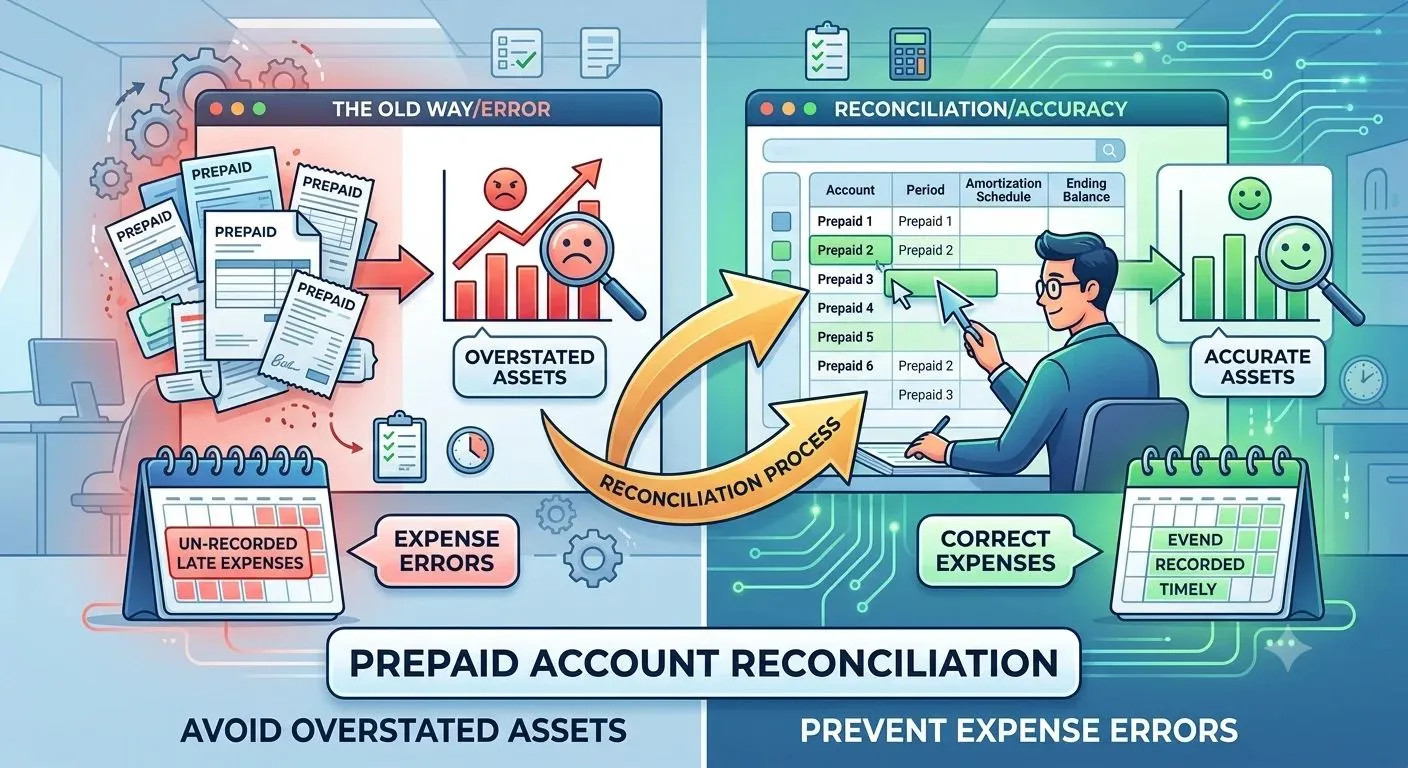
Prepaid balances can look harmless during month-end close. Yet a missed amortization entry, an expired contract, or an incorrect service period can leave assets overstated and expenses sitting in the wrong accounting period. As prepaid schedules grow across insurance, rent, software subscriptions, licenses, and service agreements, spreadsheet-based tracking becomes harder to control.
The problem becomes more serious when the general ledger still agrees mathematically while the underlying prepaid balance no longer represents a future economic benefit. Prepaid account reconciliation addresses this risk by validating the GL against schedules, contracts, invoices, amortization activity, and remaining service periods.
This guide explains how prepaid reconciliation works, what should be reconciled, where expense errors arise, and how finance teams can prevent stale or overstated prepaid assets.
What Is Prepaid Account Reconciliation?
Prepaid account reconciliation is the process of verifying that the prepaid asset balance in the general ledger agrees with the detailed prepaid schedule and the supporting records behind each balance. It confirms that amounts remaining as assets represent benefits that the organization has paid for but has not yet consumed.
Prepaid reconciliation is closely tied to how prepaid expenses are presented on the balance sheet, since the remaining asset should always represent a benefit that has not yet been consumed.
What Is a Prepaid Expense Account?
A prepaid expense account records payments made before the related goods or services are consumed. Typical examples include annual insurance premiums, software subscriptions, prepaid rent, maintenance agreements, and licensing fees.
The unconsumed portion remains an asset. As the organization receives the benefit, the appropriate amount is transferred from the prepaid account to the related expense account.
Why Are Prepaid Expenses Recorded as Assets Before Being Expensed?
Prepaid expenses are initially recorded as assets because the payment represents a future economic benefit at the payment date. The organization has paid cash, but it has not yet consumed the full service associated with that payment.
Expense recognition therefore occurs over the applicable benefit period rather than necessarily on the payment date. This treatment aligns the expense with the accounting periods in which the service is received.
What Is the Difference Between Prepaid Expense Reconciliation and Expense Reconciliation?
Prepaid expense reconciliation focuses on validating the remaining asset and confirming that amortization has reduced it correctly over time. Expense reconciliation focuses more broadly on verifying costs recorded in expense accounts against transactions, supporting records, policies, and accounting classifications.
The two processes are connected because an error in prepaid amortization normally affects both the balance sheet and the income statement.
Why Is Prepaid Account Reconciliation Important for Financial Reporting?
Prepaid reconciliation determines whether the amount reported as an asset is genuinely supported at the reporting date. It also confirms that the related expense has been recognized in the appropriate accounting period.
Because prepaid accounts form part of the broader balance sheet reconciliation process, unresolved prepaid differences can affect account certification and the reliability of period-end financial statements.
How Unreconciled Prepaids Can Overstate Assets and Understate Expenses
If scheduled amortization is missed, the prepaid account retains value that should already have been recognized as an expense. The balance sheet then reports an asset higher than the remaining economic benefit.
At the same time, the corresponding operating expense is understated. A recurring missed entry can allow this misstatement to accumulate across several reporting periods.
How Incorrect Expense Recognition Distorts the Income Statement
Recognizing too much prepaid expense in one month increases expenses and reduces reported profit for that period. Recognizing too little produces the opposite effect.
Even where the total contract value is correct, incorrect timing can distort monthly operating expenses, departmental results, budget comparisons, and management reporting.
How Prepaid Errors Affect Working Capital and Period-End Reporting
Prepaid expenses are commonly included in current assets, so an overstated balance can also overstate reported working capital. This can affect liquidity analysis and other financial measures derived from current assets.
At period end, unsupported prepaid balances can also create reconciliation exceptions, correcting journal entries, and additional review work before the account can be approved.
What Types of Prepaid Expenses Need to Be Reconciled?
Any material payment recorded as a prepaid asset should be supported by evidence of an unconsumed future benefit. The reconciliation method may differ depending on whether that benefit expires with time, usage, a contractual event, or another condition.
Prepaid Insurance, Rent, Software, Licenses, and Maintenance Contracts
Common prepaid accounts include insurance premiums, facility rent, annual software subscriptions, technology licenses, support agreements, and maintenance contracts.
These balances usually have identifiable coverage or service periods. Reconciliation should confirm the original payment, contract dates, expense already recognized, and value remaining at the reporting date.
Time-Based, Usage-Based, and Event-Based Prepaid Expenses
Time-based prepayments are recognized over a defined period, such as a 12-month insurance policy. Usage-based prepayments are recognized according to consumption, while event-based prepayments may remain as assets until a specified service, project stage, or event occurs.
Finance teams should therefore avoid assuming that every prepaid balance follows identical monthly amortization.
Deposits, Retainers, and Other Prepayments That Require Different Accounting Treatment
Deposits and retainers may resemble prepaid expenses but can require different treatment depending on their terms. A refundable security deposit, for example, does not follow the same expense recognition pattern as an annual subscription.
The reconciliation should determine whether the amount represents a future expense, refundable asset, supplier advance, or another balance sheet classification before applying an amortization schedule.
What Should a Prepaid Expense Reconciliation Include?
A prepaid reconciliation should show how the ending general ledger balance was derived and provide enough supporting evidence to validate every material component of that balance. The reviewer should be able to trace the amount from the GL back to individual prepaid items and their remaining benefit periods.
General Ledger Prepaid Account Balance
The reconciliation begins with the closing prepaid balance recorded in the general ledger for the relevant reporting period.
This amount becomes the control balance against which the detailed prepaid schedule is compared. Any difference between the two requires investigation before reconciliation approval.
Prepaid Expense Schedule or Subsidiary Ledger
The prepaid schedule should list each open prepaid item and show how its balance changes as expenses are recognized.
At minimum, the schedule should allow finance teams to determine the beginning balance, additions, amortization, adjustments, and ending unamortized amount for each item.
Original Amount, Vendor, Invoice, and Payment Details
Each prepaid item should retain identifying information such as the vendor, original payment amount, invoice reference, payment date, and relevant accounting classification.
These details allow reviewers to trace scheduled balances back to source transactions and determine whether duplicate, missing, or incorrectly classified entries exist.
Service Start Date, End Date, and Expense Recognition Period
Service dates determine when recognition should begin and when the prepaid asset should reach zero. Incorrect dates can cause expenses to start late, finish early, or continue after the contractual benefit has expired.
The reconciliation should therefore validate service dates against the underlying agreement rather than relying only on dates entered in the accounting schedule.
Periodic Amortization, Cumulative Expense, and Remaining Balance
The schedule should identify the expense recognized during the current period, the cumulative amount recognized to date, and the prepaid value remaining.
Together, these figures show whether the original prepaid amount has been allocated correctly and whether the closing asset corresponds to the unconsumed portion of the agreement.
Contracts, Invoices, Approvals, and Other Supporting Evidence
A reconciled balance should be supported by records such as contracts, invoices, purchase documentation, payment evidence, amendments, cancellation notices, and relevant approvals.
Supporting evidence becomes particularly important when a balance has changed because of a contract modification, refund, write-off, or manual journal adjustment.

























Sign in to leave a comment.