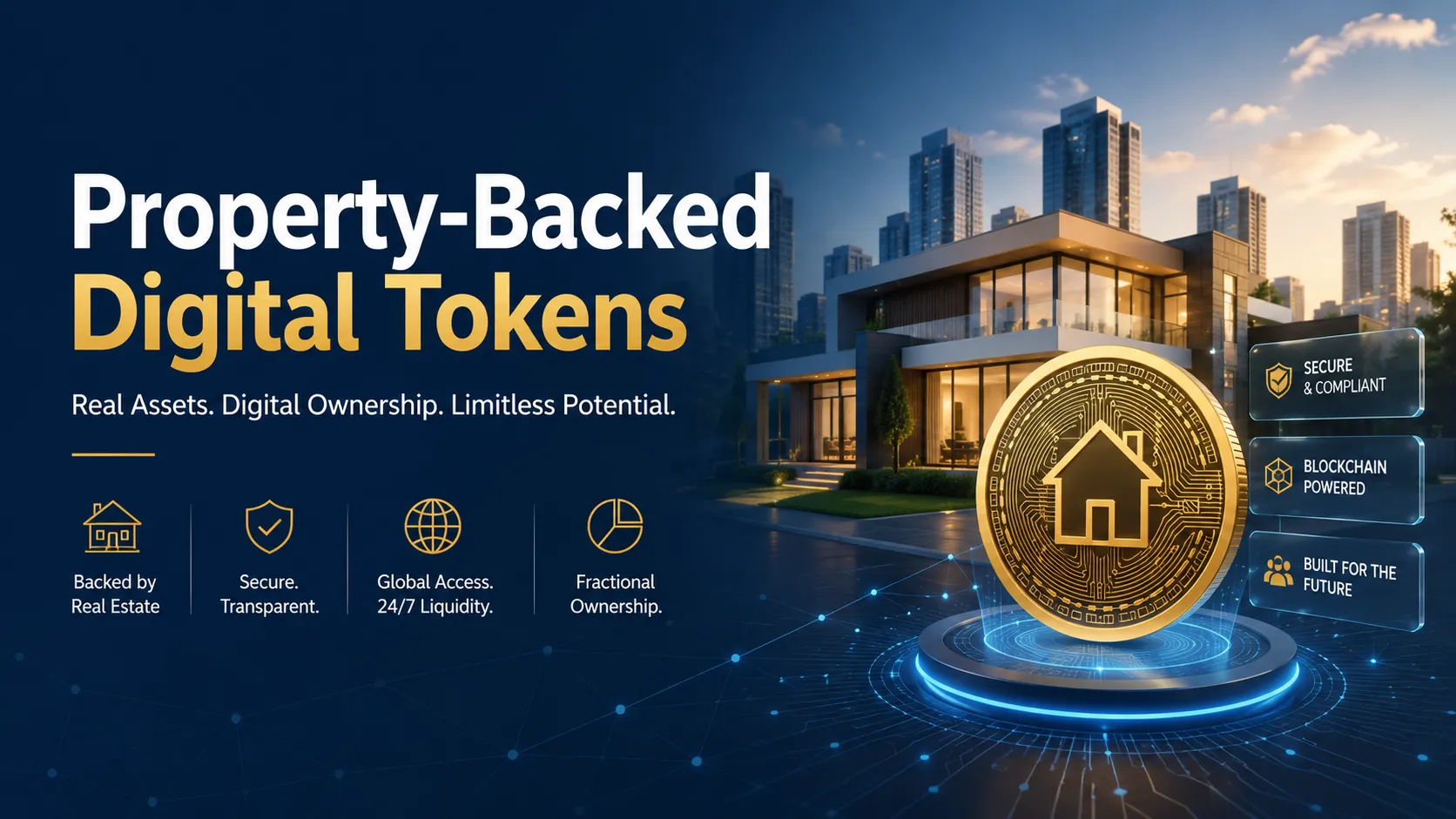

Property backed digital tokens are reshaping how real estate ownership and investment work in digital ecosystems. Instead of relying solely on traditional paperwork, deeds, and centralized registries, ownership rights or economic interests in real estate can now be represented as blockchain-based digital tokens.
These tokens are linked directly to underlying physical properties such as residential apartments, commercial buildings, land parcels, or mixed-use developments. Each token represents a defined portion of value, cash flow rights, or ownership rights tied to the property.
This model introduces a more flexible and programmable structure for real estate participation, allowing assets that were once illiquid and complex to become divisible, transferable, and easier to manage.
What Are Property-Backed Digital Tokens?
Property-backed digital tokens are blockchain-based digital representations of real-world real estate assets. Each token is linked to a specific property or a portfolio of properties and derives its value from that underlying asset.
These tokens can represent:
- Full or fractional ownership of a property
- Revenue rights (such as rental income)
- Equity stakes in real estate investment structures
- Debt-based claims secured by property assets
Unlike traditional ownership records, which are stored in centralized databases or physical documents, these tokens exist on decentralized blockchain networks, ensuring transparency and immutability.
How Property-Backed Tokens Work in Practice
The functioning of property-backed digital tokens involves several interconnected layers:
1. Asset Selection and Valuation
A real-world property is selected and professionally evaluated. Its market value, income potential, and legal ownership structure are analyzed to determine tokenization feasibility.
2. Legal Structuring
A legal framework is created to define how token holders relate to the underlying asset. This may involve trusts, special purpose vehicles (SPVs), or regulated securities structures depending on jurisdiction.
3. Token Creation on Blockchain
Digital tokens are created on a blockchain platform. Each token represents a fraction of the property’s value or cash flow rights.
4. Smart Contract Deployment
Smart contracts define how tokens behave, including:
- Ownership transfer rules
- Revenue distribution logic
- Compliance requirements
- Voting or governance rights (if applicable)
5. Distribution to Investors
Tokens are offered to investors through digital platforms, allowing them to purchase fractional interests in the property.
6. Secondary Trading and Lifecycle Management
Once issued, tokens can be traded on secondary markets (depending on regulatory permissions), enabling liquidity for previously illiquid assets.
Key Features of Property-Backed Digital Tokens
1. Fractional Ownership
One of the most important features is the ability to divide high-value properties into smaller, affordable units. This allows multiple investors to participate in a single asset.
2. Transparency and Traceability
Blockchain technology ensures that all transactions related to token ownership are recorded permanently and can be audited in real time.
3. Programmable Ownership
Ownership rights can be encoded into smart contracts, enabling automated processes such as rental income distribution or profit-sharing.
4. Global Accessibility
Investors from different regions can participate in real estate markets without being physically present, subject to regulatory compliance.
5. Enhanced Liquidity
Traditional real estate is difficult to sell quickly. Tokenization introduces the possibility of secondary trading, improving liquidity.
Types of Property-Backed Digital Tokens
1. Equity-Based Tokens
These represent ownership stakes in a property or real estate holding entity. Token holders benefit from capital appreciation and rental income.
2. Debt-Based Tokens
These represent loans secured by real estate. Investors earn fixed interest based on repayment structures.
3. Revenue-Sharing Tokens
Instead of ownership, these tokens provide rights to a portion of rental income or project revenue.
4. Hybrid Tokens
These combine multiple structures, offering both equity appreciation and income distribution mechanisms.
Benefits of Property-Backed Digital Tokens
1. Unlocking Illiquid Real Estate Value
Real estate is traditionally illiquid, requiring long selling cycles. Tokenization converts it into a more liquid digital asset class.
2. Lower Entry Barriers for Investors
High-value properties often exclude small investors. Tokenization allows participation with smaller capital amounts.
3. Improved Market Efficiency
By reducing intermediaries and manual processes, transactions become faster and more cost-efficient.
4. Better Portfolio Diversification
Investors can spread capital across multiple properties instead of concentrating on a single asset.
5. Automated Income Distribution
Smart contracts can automatically distribute rental income or profits without manual intervention.
Risks and Challenges
While property-backed tokens offer significant advantages, they also introduce new challenges.
1. Regulatory Uncertainty
Different countries treat tokenized assets differently. Some classify them as securities, while others lack clear frameworks.
2. Valuation Complexity
Determining accurate token value requires continuous property valuation updates and market analysis.
3. Legal Structuring Complexity
Ensuring that digital tokens correctly reflect legal ownership rights requires careful structuring using SPVs or trusts.
4. Market Adoption Barriers
Traditional real estate investors may be slow to adopt blockchain-based ownership models.
5. Technology Risks
Smart contract vulnerabilities, blockchain network issues, or platform failures can impact asset management.
Role of Blockchain in Property-Backed Tokens
Blockchain acts as the foundation for property-backed digital tokens. It provides:
- Decentralized record-keeping that eliminates reliance on central registries
- Immutability, ensuring records cannot be altered retroactively
- Transparency, allowing stakeholders to verify ownership history
- Automation, enabling smart contracts to execute predefined rules
This infrastructure reduces reliance on manual intermediaries and increases trust in digital ownership systems.
Use Cases of Property-Backed Digital Tokens
1. Residential Real Estate Investment
Individual apartments or housing units are tokenized to allow fractional investment from multiple buyers.
2. Commercial Real Estate Funding
Office buildings, malls, and co-working spaces are tokenized to raise capital from global investors.
3. Real Estate Development Projects
Developers tokenize future projects to secure early-stage funding before construction completion.
4. Rental Income Investment Models
Investors earn passive income through tokenized rental yield distribution systems.
5. Cross-Border Real Estate Investment
International investors participate in real estate markets without complex legal ownership transfers.
How Smart Contracts Power Property-Backed Tokens
Smart contracts are self-executing programs stored on blockchain networks. In property-backed token systems, they handle:
- Token issuance and distribution
- Ownership transfer validation
- Rental income splitting
- Compliance checks (KYC/AML)
- Voting or governance mechanisms
This automation reduces administrative overhead and ensures consistent execution of predefined rules.
Future of Property-Backed Digital Tokens
The future of property-backed tokens is closely linked to broader adoption of blockchain in financial systems and real estate markets.
Key emerging trends include:
1. Integration with Real Estate Marketplaces
Tokenized properties are expected to be traded on global digital marketplaces with real-time pricing and liquidity.
2. Institutional Adoption
Large financial institutions may increasingly adopt tokenized real estate as part of diversified investment portfolios.
3. Integration with DeFi Systems
Tokenized properties may be used as collateral in decentralized finance lending and borrowing systems.
4. AI-Driven Valuation Models
Artificial intelligence may play a role in real-time property valuation and risk assessment.
5. Expansion into Global Asset Classes
Beyond real estate, similar tokenization models may extend to infrastructure, energy assets, and natural resources.
Conclusion: A Structural Transformation of Real Estate Ownership
Property-backed digital tokens represent a significant evolution in how real estate assets are structured, managed, and traded. By combining blockchain technology with real-world property value, they create a system that is more transparent, divisible, and accessible.
While challenges such as regulation and adoption remain, the long-term direction of the market is clear: real estate is gradually shifting from a static, paper-based system into a dynamic, programmable digital asset class.
For investors, developers, and institutions, understanding property-backed tokens is no longer optional—it is becoming a foundational part of participating in the future of real estate finance.



















Sign in to leave a comment.