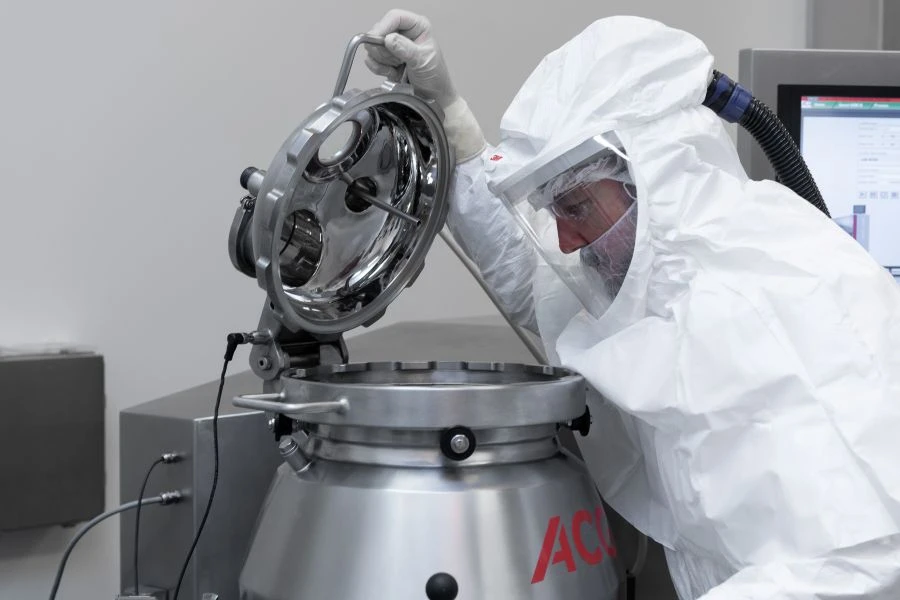

High-shear mixer (HSM) granulation dominates wet granulation in the pharmaceutical industry for producing tablets and capsules. While it reliably yields high-quality granules, precisely identifying when to stop the process is still a complex task. Manufacturers employ multiple detection strategies, each offering distinct pros and cons. This article examines these methods and reveals the most precise option.
The Importance of the Endpoint
With over 70% of global granulation being wet granulation, and HSM at its core, knowing the exact endpoint is essential for achieving the right granule size, density, strength, and flowability. These properties directly impact tablet compression and overall product performance.
Although predictive technologies exist, many facilities still depend on experience-based decisions, risking batch inconsistencies. Manual testing remains in use, but it introduces subjective errors. A dependable approach must deliver accuracy and repeatability while adapting to process parameters like mixer design, impeller speed, production size, and binder delivery method.
The process consists of dry mixing, binder addition, and wet mixing. The wet mixing stage plays the largest role in determining the endpoint, but binder addition also greatly influences granule nucleation and growth. Monitoring both stages is critical.
Motor current tracking, which measures impeller resistance, is a common solution but requires high precision given HSM’s wide particle size output.
Available Methods for Endpoint Detection
- Time-based wet mixing: Simple yet unreliable when material properties vary.
- Motor power usage tracking: Correlates load with granule consistency; affected by several variables.
- Calculated torque: Based on motor current but influenced by electrical fluctuations.
- Reaction torque measurement: Detects base tension; impacted by process instability.
- Torque rheometer: Offline rheology measurement; lacks in-process feedback.
- Acoustic sensors: Detect particle property changes; accurate but expensive.
- NIR spectroscopy: Tracks moisture content; endpoint accuracy varies.
- Focused beam reflectance measurement: Monitors particle size; effective but costly.
- Direct torque measurement: Reads impeller torque in Newton metres, delivering high precision without current-based errors.
Direct Torque Measurement Tools
- Contactless torque sensor on impeller drive shaft
- Pre-calibrated instrumentation
- HMI with live torque values
- Automated endpoint detection system
- Pre-set thresholds for process completion
Conclusion
In pharmaceutical manufacturing, endpoint precision in HSM granulation is non-negotiable. Direct torque measurement offers real-time, highly accurate monitoring, empowering manufacturers to achieve superior consistency and meet strict regulatory demands.





























Sign in to leave a comment.