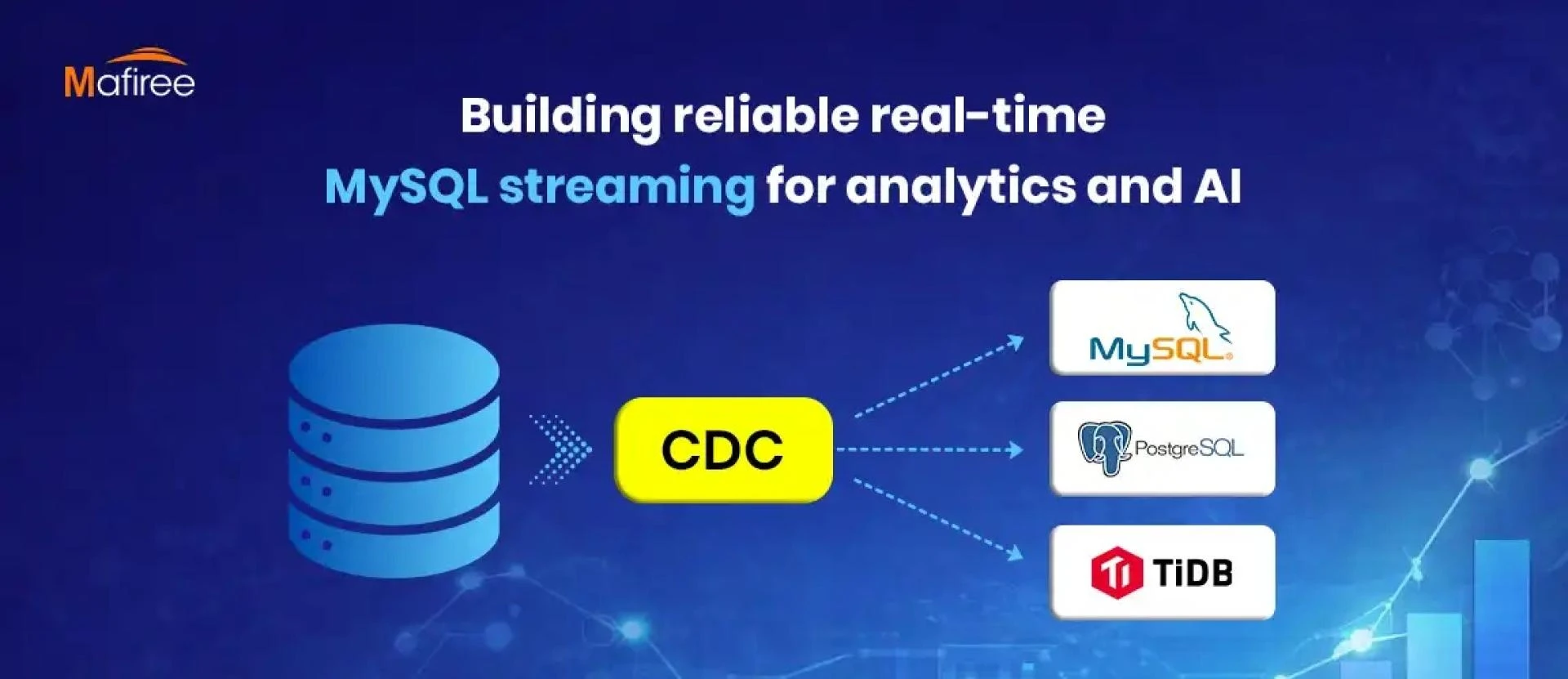

Real-time MySQL streaming has become essential for analytics and AI in today’s data-driven landscape. Change Data Capture (CDC) architectures provide a reliable foundation for scalable data pipelines, enabling organizations to access timely insights and make informed decisions. By capturing changes as they happen, CDC eliminates the delays associated with batch processing and ensures that downstream systems always work with fresh data.
A leading transportation company illustrates this need clearly. Operating in the logistics sector, it processes millions of transactions every hour. As operational complexity increased, the company struggled to efficiently manage, transform, and analyze its growing data volumes. Real-time processing became critical to maintaining responsiveness and operational efficiency.
To address these challenges, Xstreami was introduced as a purpose-built platform for real-time database streaming. It supports major databases such as MySQL, TiDB, ClickHouse, PostgreSQL, and MongoDB, and enables flexible ETL (Extract, Transform, Load) workflows. The platform accommodates multiple streaming patterns, including single-source to single-destination replication, single-source to multiple-destination broadcasting, multiple-sources to single-destination consolidation, and complex multiple-sources to multiple-destinations architectures. This flexibility allows organizations to design pipelines that match their operational and analytical requirements.
Xstreami’s CDC-based approach captures database changes instantly, reducing latency and delivering up-to-date data to analytics systems and AI models. Schema safety mechanisms protect pipelines from disruptions caused by evolving database structures. Built-in observability tools provide insight into data flows, performance metrics, and errors, enabling proactive monitoring. Horizontal scalability ensures the system can handle increasing transaction volumes without downtime.
The platform is designed for reliability, incorporating fault-tolerant recovery to prevent data loss and exactly-once delivery semantics to avoid duplication or omission. It adapts dynamically to schema evolution, including DDL changes such as adding columns or modifying data types. Real-time dashboards track lag, throughput, and error rates, supporting continuous optimization for mission-critical applications.
In the transportation use case, Xstreami streamed operational data from MySQL into analytics-ready systems. Continuous ingestion into data warehouses and lakes enabled immediate querying, while AI models leveraged live data for fleet tracking and demand forecasting. In-flight transformations cleansed and enriched data before delivering it to destinations like ClickHouse for high-speed OLAP queries, cutting analysis times from hours to seconds.
As data volumes grew, Xstreami scaled by adding streaming nodes, balancing loads while maintaining order and consistency. Multi-destination streaming distributed the same MySQL changes to dashboards, machine learning pipelines, and archival systems without redundant processing. Comprehensive monitoring, schema validation, Kubernetes-based deployments, YAML-driven configurations, and a modular, future-ready architecture further position Xstreami as a long-term solution for real-time analytics and AI.


























Sign in to leave a comment.