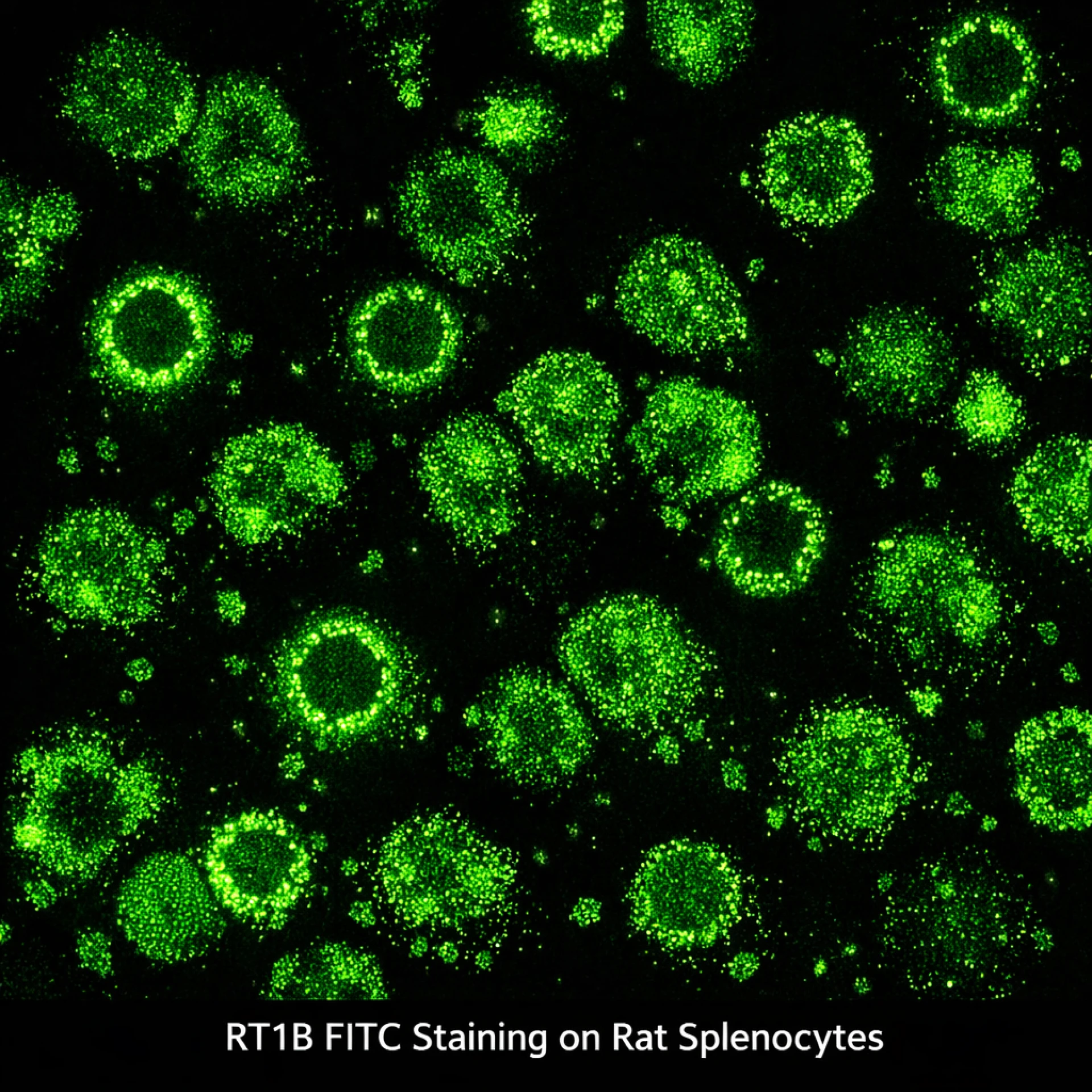

Major histocompatibility complex (MHC) class II molecules represent critical cell surface markers essential for antigen presentation to CD4+ T helper cells. In rats, this complex is designated as RT1, functionally equivalent to the H-2 region in mice and the HLA region in humans. The MOUSE ANTI RAT MHC CLASS II RT1B:FITC antibody, designated clone OX-6, enables precise identification and isolation of MHC class II-expressing immune cells through flow cytometric analysis.
Cellular Distribution and Immunological Significance"
MHC class II molecules are expressed on specialized antigen-presenting cells (APCs) responsible for initiating immune responses against extracellular pathogens. The RT1B monomorphic determinant recognized by clone OX-6 is present on B lymphocytes, dendritic cells, some macrophage subsets, and certain epithelial cells within the thymus and other lymphoid organs. This distribution pattern makes the antibody invaluable for comprehensive immunophenotyping of immune cell populations.
Dendritic cells, as the primary professional APCs, express high levels of RT1B and are efficiently identified through OX-6 staining. B lymphocytes constitutively express RT1B, enabling B cell enrichment or depletion through flow cytometric sorting. Activated macrophages upregulate RT1B expression in response to inflammatory stimuli, making the antibody useful for investigating innate immune activation and macrophage differentiation.
Clone OX-6: Historical Context and Validation
The OX-6 monoclonal antibody represents a classical immunological reagent developed specifically for mapping rat MHC class II. Analysis of recombinant mouse strains demonstrated that the OX-6 determinant maps to the H-2I-A region, confirming genetic conservation between rat RT1B and mouse H-2 molecules. This molecular conservation extends to human HLA-DR molecules, explaining the cross-species utility of this antibody in investigating MHC class II function across rodent models.
Importantly, clone OX-6 shows species strain specificity—it does not react with the rat BDIX strain due to a specific defect in RT1B expression, validating the antibody's specificity for native RT1B molecules. The antibody cross-reacts with polymorphic determinants on mouse H-2k and H-2s haplotypes, enabling use in mouse studies when investigating H-2I-A region molecules.
FITC Conjugation and Flow Cytometric Applications
The fluorescein isothiocyanate (FITC) conjugation provides optimal spectral properties for standard benchtop flow cytometers equipped with 488 nm argon lasers. FITC-conjugated antibodies produce bright green fluorescence when properly excited, permitting clear discrimination of positive and negative populations in single-color staining protocols. The antibody is provided in liquid form at approximately 0.1 mg/ml IgG concentration (varies by lot), requiring empirical optimization for specific flow cytometric platforms.
Standard flow cytometric protocols employ working dilutions ranging from neat (undiluted) to 1:10 dilution. Typical staining procedures utilize 10 μl of working dilution to label 10^6 cells in 100 μl incubation volume, followed by washing and acquisition on flow cytometric instrumentation. The short incubation period (15–20 minutes at 4°C) minimizes spontaneous antibody internalization and preserves surface antigen detection.
Multi-Parameter Analysis and Cell Sorting Applications
Modern flow cytometric analysis employs multi-parameter approaches, utilizing FITC-conjugated RT1B antibody in combination with phycoerythrin-conjugated, allophycocyanin-conjugated, or other spectrally distinct fluorophores. This multiplex capability enables simultaneous identification of MHC class II-expressing cells while assessing additional surface markers (CD4, CD8, CD25, etc.) or intracellular markers of activation and differentiation.
Fluorescence-activated cell sorting (FACS) applications utilize the OX-6 antibody for high-purity isolation of RT1B+ antigen-presenting cells from lymphoid organs. Dendritic cell research frequently employs this antibody for enrichment of professional APCs prior to functional assays investigating antigen presentation, cytokine production, or metabolic function.
Applications in Immunological and Translational Research
The antibody facilitates investigation of immune cell populations across diverse experimental contexts. In infection models, RT1B staining reveals changes in dendritic cell frequency and activation status following pathogen exposure. Vaccine research employs RT1B staining to evaluate dendritic cell targeting and activation following immunization with candidate vaccines. Autoimmune and inflammatory disease models utilize RT1B analysis to characterize APC populations and assess correlations between APC frequency and disease severity.
Transplant immunology applications employ the antibody to monitor APC responses to allogeneic tissues, while cancer immunotherapy research uses RT1B staining to assess dendritic cell activation and intratumoral APC infiltration as markers of immunogenicity.
Preservatives and Storage Considerations
The antibody preparation contains 0.09% sodium azide as a preservative and 1% bovine serum albumin as a stabilizer. Sodium azide prevents bacterial and fungal contamination during storage, though investigators should note that sodium azide can interfere with certain downstream applications requiring viable cells. Standard storage at 2–8°C maintains antibody activity for extended periods, with typical shelf-life of 12–24 months depending on storage conditions and manufacturer specifications.
Conclusion
MOUSE ANTI RAT MHC CLASS II RT1B: FITC (clone OX-6) remains an essential immunological reagent for researchers investigating immune cell populations, antigen-presenting cell function, and immune responses in rat models. The antibody's well-characterized specificity, FITC-based optical properties suitable for standard flow cytometry, and broad applicability across immunological research domains make it invaluable for immunophenotyping, cell sorting, and investigation of immune cell responses in health and disease.



























Sign in to leave a comment.