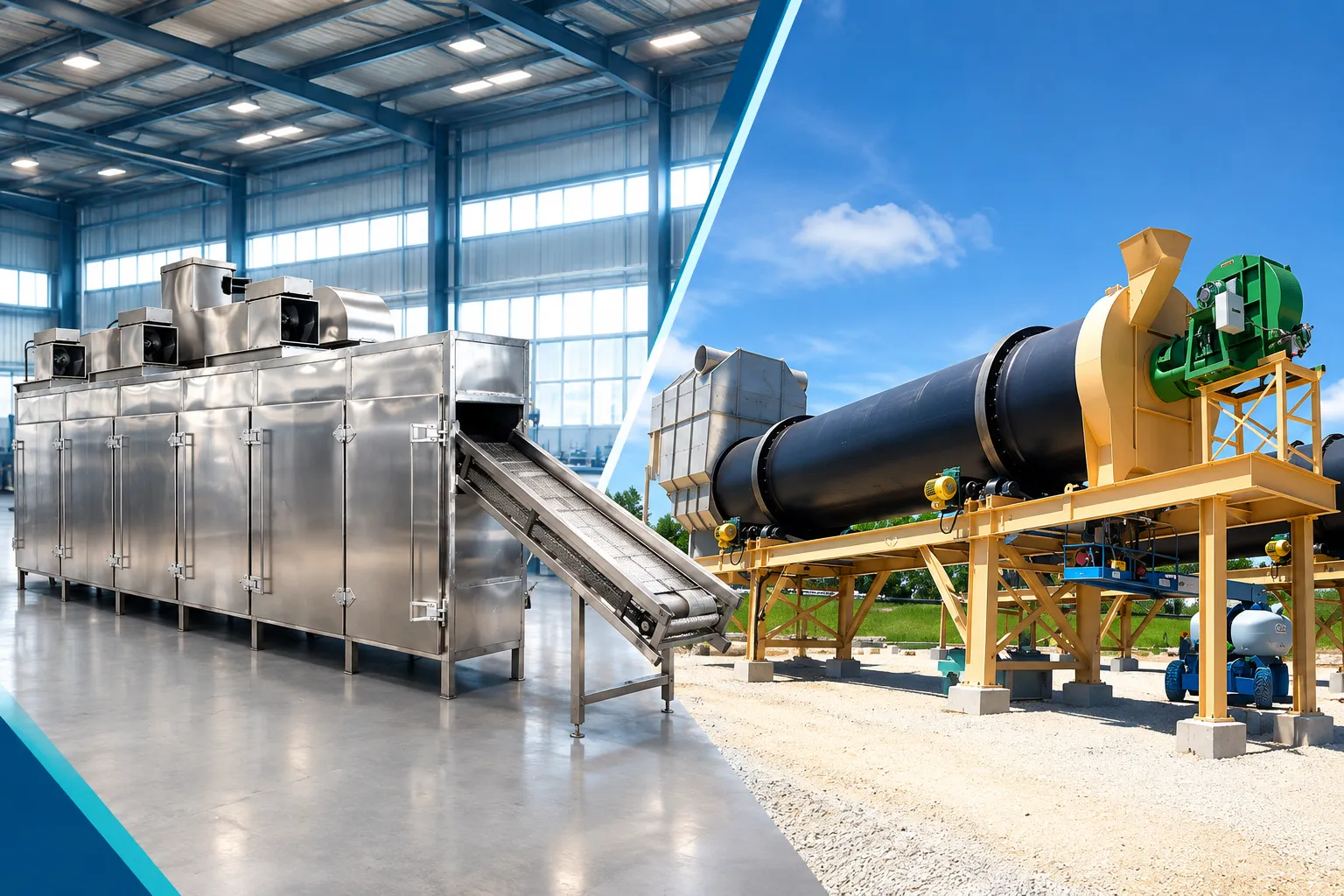

A biomass drying system can look perfectly suitable on paper and still struggle the moment real feedstock reaches the plant.
The reason is simple: "biomass" isn't one material.
Wood chips, sawdust, grass, bagasse, crop residues and mixed organic waste can differ wildly in particle size, bulk density, moisture distribution and general behaviour. A dryer that handles one of them beautifully might be overkill, inefficient, or genuinely awkward to run with another.
That's why choosing between a rotary dryer and a belt dryer shouldn't start with "Which dryer is better?" A more useful question is, what is this material actually going to do once it's inside the machine?
Rotary systems work by tumbling material through a stream of heated gas. Belt systems form a bed of material and pull drying air through it. That difference in mechanism is what makes the two technologies respond so differently to feedstock, moisture and production demands.
The dryer follows the material
In practical plant design, equipment selection usually starts with the material, not the machine.
A granular, free-flowing feed that can tolerate mechanical movement behaves very differently from a fibrous or fragile feed that needs gentle handling. Moisture adds another layer. Two materials can arrive at a similar moisture reading and still release that water at completely different rates. Throughput then decides how much of that behaviour the system has to manage continuously, hour after hour.
This is why a rotary dryer can be the right call for one biomass operation and a poor one for the next, while a belt dryer does the opposite.
The difference isn't really about how each machine is built. It's about how heat reaches the material, how the material moves, how moisture leaves it, and what happens to the product while all of that is going on.
What a rotary dryer does differently
A rotary dryer uses a rotating cylindrical drum. Internal flights lift the material and let it fall through the drying gas, exposing fresh surfaces to the heat over and over. That constant tumbling creates strong contact between the wet biomass and the drying medium, which is one reason rotary systems suit tough, granular biomass so well. Wood chips are the obvious example.
Wood chips can tolerate the tumbling action while still presenting plenty of surface area to the drying stream. Screened sawdust can work too, when its particle characteristics allow it to move properly through the drum.
The same mechanical action becomes a disadvantage with fragile materials, though. A feed that breaks easily generates more fines. A fibrous feed can behave unpredictably if it doesn't separate cleanly. The worst of all is a sticky feed, instead of cascading through the drum, it sticks to the internal surfaces and interferes with normal operation.
That's a point generic dryer comparisons tend to miss: a dryer doesn't just see moisture. It sees moisture combined with how the material physically behaves.
When high moisture makes the decision harder
High inlet moisture increases the thermal load, obviously, because there's simply more water to remove.
Rotary dryers are often attractive in high-moisture, high-throughput biomass applications because the tumbling action and high-temperature drying gas can strip surface moisture fast. Rotary systems are continuous bulk-handling equipment by design, and they scale to very high production rates when the application calls for it.
But high moisture alone doesn't make rotary the right choice. The physical condition of the wet feed still matters.
Take a sticky or poorly dewatered material. A rotary drum might have plenty of thermal capacity to evaporate the water, but if the feed sticks to the flights or the drum wall, the mechanical side of the process becomes the bottleneck, not the thermal side.
That's why, for genuinely difficult wet materials, mechanical dewatering sometimes becomes part of the drying solution instead of asking the thermal dryer to do everything on its own. Wet digestate and brewery-type waste streams are good examples of this, pre-dewatering them first can make the entire drying step far more workable.
In other words, the best dryer selection isn't always a choice between two machines. Sometimes it's a choice about the whole moisture-removal sequence.
Why a belt dryer behaves differently
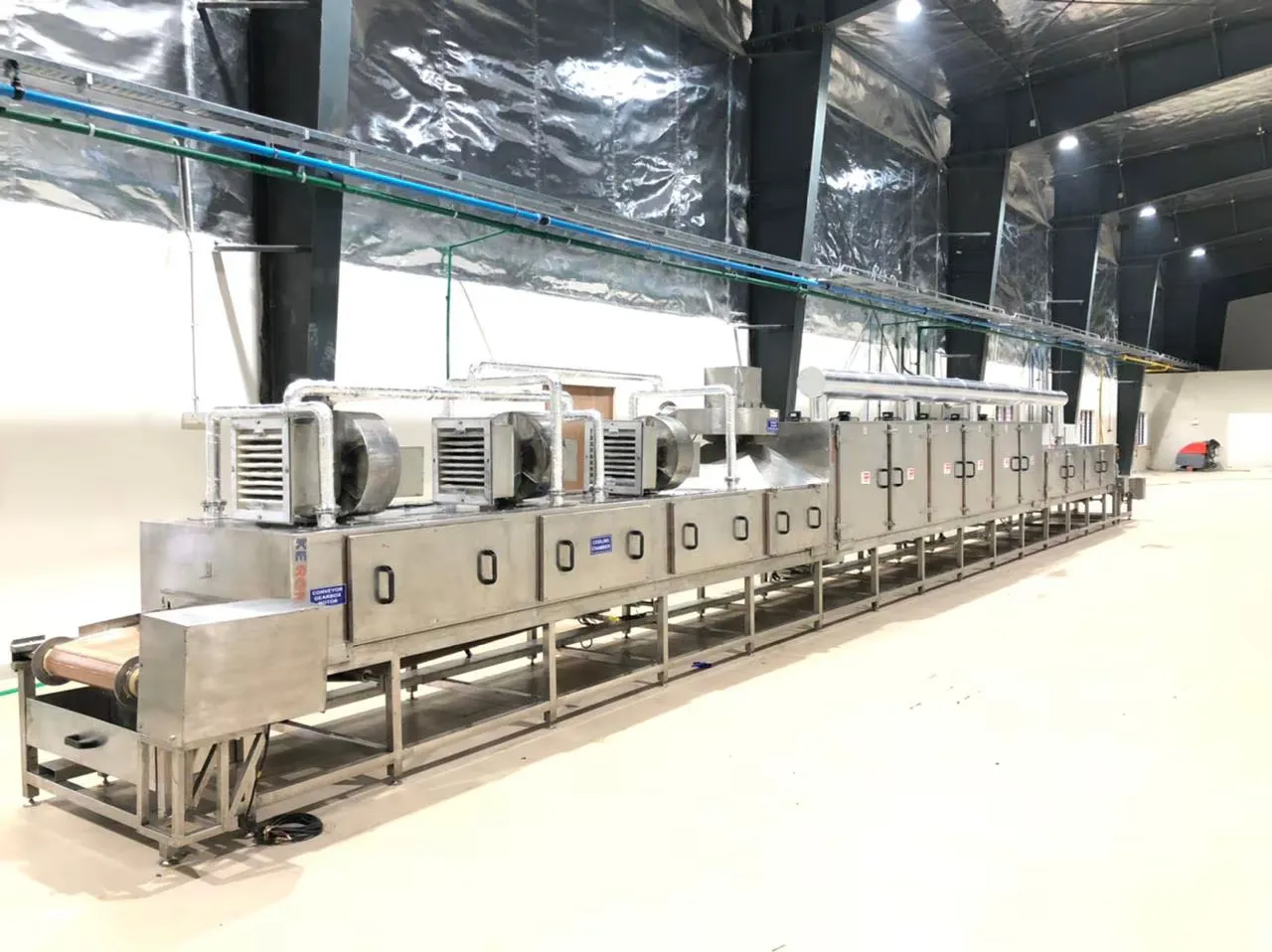
A belt dryer takes a different approach entirely. Instead of repeatedly lifting and dropping the material, it spreads the feed over a perforated moving belt and passes heated air through the bed. The material stays comparatively undisturbed the whole time it's drying.
That changes the priorities. A belt dryer earns its place where product integrity matters, or where the material is fragile, fibrous or awkward to handle mechanically, grass, hay and certain fibrous wastes being typical examples where keeping the physical structure intact actually counts.
It also opens the door to lower-temperature drying. Rather than leaning on aggressive heat and constant mixing, belt systems can rely on longer residence times and controlled airflow instead. That's particularly useful when the goal isn't just removing water as fast as possible but removing it without damaging what's underneath.
For some applications, that distinction matters more than raw drying speed ever will.
Moisture percentage is not the whole story
One of the easiest mistakes in dryer selection is describing the feed as just "50% moisture" or "30% moisture" and leaving it there.
That number matters, but it doesn't tell the whole story. Engineers also need to know how the water is actually held within the material, how easily air moves through it, how particle size is distributed, and whether the material changes shape as it dries.
A deep bed of biomass on a belt, for instance, can develop a moisture gradient if air doesn't move evenly through it, the top layer dries faster while wetter material sits underneath. Bed depth and permeability become real design considerations because of this. The opposite problem shows up in a rotary dryer, where very fine particles can get carried off in the exhaust stream, which raises the importance of dust collection and downstream air-pollution control.
So when someone asks, "How wet is the biomass?" the better engineering answer is usually another question: how wet, what particle size, what bulk density, what structure, and what happens to it while it's drying?
Throughput changes the decision
Capacity is another major dividing line.
Rotary dryers suit continuous bulk processing naturally, and rotary drying systems commonly span a huge range, anywhere from around 5 TPH up to more than 200 TPH on a wet-fuel basis, depending on how the plant is configured. That kind of capacity changes the economics of the whole operation. When a facility needs to process large tonnages continuously, the compactness and bulk-handling nature of a rotary system becomes genuinely important; the rotating drum moves a lot of material through the drying zone without needing a very long footprint.
A belt dryer approaches capacity differently. Residence time is controlled through belt speed, while belt width, bed depth and dryer length decide how much material can be processed. Push capacity up on a belt system, and the footprint tends to grow with it.
None of this makes belt dryers unsuitable for high production. It just means capacity has to be weighed alongside available space, heat source and material characteristics together, not in isolation.
A useful way to compare the two
Rather than asking which dryer wins overall, it's more useful to look at the actual conditions.
A rotary dryer becomes attractive when the material is granular and tough enough to withstand tumbling, and moisture removal plus throughput are the main priorities, wood chips and suitable sawdust being the textbook case. A belt dryer becomes more attractive when gentle handling, controlled low-temperature drying, or preserving product structure matters more than speed. Fibrous or sensitive materials often benefit from sitting still while drying air passes through the bed instead.
Heat availability plays into this too. Belt systems running at lower temperatures pair well with low-grade or recovered heat sources, while rotary systems are usually built around higher-temperature drying gas where the process demands rapid moisture removal.
The point isn't that one technology wins. The point is that process conditions decide which one makes sense.
What happens when the feedstock changes?
This is where dryer selection gets genuinely interesting.
Picture a plant processing wood chips at one stage and a more fibrous agricultural residue at another. Both get called "biomass", but their behaviour inside a dryer can be completely different. Wood chips tolerate tumbling well and benefit from the high heat-transfer conditions created by the falling material. A fibrous feed usually needs tighter control over airflow and residence time instead.
Even within the same feedstock category, moisture can flip the answer. A relatively dry material with moisture locked inside its structure may need more residence time to reach the required final condition. A very wet, free-flowing material often responds better to a more intensive initial drying stage.
Wood chips and sawdust sit at one end of this range; Napier grass, forest residues and general organic waste sit closer to the other. The right dryer genuinely does change depending on end use and the physical make-up of the feed, which is exactly why "biomass dryer" is too broad a specification for serious equipment selection.
The information an engineer should have before selecting a dryer
A useful dryer enquiry needs more than a material name and a target capacity.
At minimum, the engineering team needs the feedstock type, initial moisture, required final moisture and production rate. Particle size distribution and bulk density matter too. Then come the questions. That usually reveals more than the basics: Is the material abrasive?
Is it sticky?
Does it form fibres or mats?
Is some product degradation acceptable?
Is there waste heat available on site?
Does the feed vary significantly through the day?
How much floor space is actually there?
And what happens to the dried product once it leaves the dryer?
These questions matter because the dryer is only ever one part of the wider production process.
The right selection is the one that works with the material and the downstream process, not automatically the one with the biggest number on the spec sheet.
What this means for biomass plants
There's no reliable rule that says every high-moisture biomass application needs a rotary dryer, or that every sensitive biomass application needs a belt dryer.
In one operation, the priority might be stripping moisture fast from large volumes of tough wood residue. In another, it might be protecting a fibrous product while running on recovered heat at a relatively low temperature. The same company can genuinely need two different drying arrangements for two different materials, which is also why pilot testing and process-specific engineering still matter. A dryer should be chosen from actual material behaviour and process requirements, not lifted off a generic comparison chart.
Kerone works with both rotary and belt drying technologies for exactly this reason, building the configuration around the feedstock, moisture profile, throughput and end-use requirement rather than forcing every project into the same equipment category.
A good biomass drying system isn't simply the one that removes water. It's the one that removes the right amount, at the required rate, without creating a new problem somewhere else in the process.
Frequently Asked Questions
- Which is better for biomass, a rotary dryer or a belt dryer?
Neither wins outright. A rotary dryer generally suits tough, granular biomass where high throughput and intensive drying matter most. A belt dryer tends to suit fragile, fibrous or heat-sensitive materials where gentle handling and controlled drying take priority.
- Can a rotary dryer handle high-moisture biomass?
Yes- rotary dryers are commonly used for high-moisture, continuous biomass drying because of their strong material movement and high heat-transfer conditions. The feed still needs to be reasonably free-flowing; sticky material causes real operational problems inside the drum.
- Why would a belt dryer be preferred for fibrous biomass?
A belt dryer doesn't rely on repeated tumbling. The material sits on the belt while drying air passes through the bed, which reduces mechanical degradation and helps preserve the structure of fibrous material.
- Does higher moisture always mean a rotary dryer is the right choice?
No. Moisture load is only one part of the decision. Feed consistency, stickiness, particle size, bulk density, required final moisture and product sensitivity all factor in too. Some difficult wet feeds need mechanical dewatering before thermal drying even starts
. - Which dryer suits wood chips and sawdust best?
Wood chips generally suit rotary drying well because they tolerate tumbling and give good contact with the drying gas. Screened sawdust can also run through rotary systems when its physical characteristics allow it.
- Can a belt dryer use waste heat?
Yes. Lower-temperature belt drying configurations can make use of low-grade or recovered heat, which makes them relevant wherever a plant already has a usable waste-heat source.
- Why does bulk density matter when selecting a biomass dryer?
Bulk density affects how much material fits into a given volume and how the feed behaves during conveying and drying. It influences bed depth, airflow, residence time and overall equipment sizing, so it needs to be considered alongside moisture and particle characteristics, not on its own.
- Can the same biomass dryer process different feedstocks?
Possibly, but not necessarily under identical settings. Different materials release moisture differently and handle differently, so changing the feedstock can mean changing airflow, temperature, residence time, feed rate or dryer configuration.
- Is a rotary dryer suitable for sticky biomass?
Sticky biomass can be genuinely difficult for a rotary dryer, since material tends to stick to the flights or drum surfaces instead of cascading normally. Upstream dewatering, or a different drying arrangement altogether, is often the better route.
- What information should go into a biomass dryer enquiry?
A useful enquiry should cover the biomass type, feed moisture, required final moisture, throughput, particle size, bulk density where known, temperature limitations, available heat source and intended use of the dried product. That level of detail lets the dryer be evaluated as part of a process, not just as a standalone machine.
Frequently Asked Questions
What is the main difference between a rotary dryer and a belt dryer for biomass?
The primary difference lies in how each dryer processes the material. A rotary dryer tumbles biomass through heated gas, making it ideal for tough, granular materials, while a belt dryer moves material through a bed with controlled airflow, suitable for fragile or fibrous materials.
Can rotary dryers effectively handle high-moisture biomass?
Yes, rotary dryers are well-suited for high-moisture biomass applications due to their ability to rapidly strip surface moisture and handle continuous bulk processing. However, the material must be reasonably free-flowing; sticky biomass can cause operational issues.
Why is a belt dryer preferred for drying fibrous biomass?
Belt dryers maintain the integrity of fibrous materials by allowing them to sit undisturbed on a moving belt while drying air passes through. This reduces mechanical degradation and preserves the physical structure of the material.
Does higher moisture content always mean a rotary dryer is the best option?
Not necessarily. While higher moisture can make rotary dryers appealing, factors like feed consistency, stickiness, particle size, and required final moisture must also be considered. Some materials may require pre-dewatering before thermal drying.
Are wood chips and sawdust better suited for rotary or belt drying?
Wood chips generally perform well in rotary dryers because they can tolerate tumbling and provide good contact with the drying gas. Screened sawdust can also be dried effectively in rotary systems, depending on its physical characteristics.
Can belt dryers utilize waste heat for drying?
Yes, belt dryers can be designed to operate at lower temperatures, making them suitable for using low-grade or recovered heat, which can enhance energy efficiency in facilities with available waste heat sources.
How does bulk density affect the selection of a biomass dryer?
Bulk density impacts how material behaves during drying, influencing factors like airflow, residence time, and overall equipment sizing. It should be evaluated alongside moisture content and particle characteristics to ensure optimal dryer performance.
Can the same biomass dryer be used for different feedstocks?
Possibly, but adjustments may be necessary. Different feedstocks release moisture at varying rates and have distinct handling characteristics, requiring potential changes in airflow, temperature, and dryer configuration to achieve effective drying.


























Sign in to leave a comment.