

ByteDance released Seedance 2.0 in February 2026, introducing a multimodal approach to AI video generation that centers on one innovation: the @ reference system. This article covers every aspect — specifications, the reference architecture, prompting methodology, practical workflows, pricing, and competitive positioning.
Full details available at Seedance 2.0.
Technical Specifications
Output: up to 4K resolution, 10-bit encoding, 24fps, 4-15 second clips with video extension available. Native stereo audio generates sound effects, lip synchronization, and ambient sound in the same inference pass. Architecture: Unified Multimodal Diffusion Transformer, developed by 170+ researchers, technical paper published on arXiv April 15, 2026.
Input: up to 12 reference files per generation — 9 images, 3 video clips (each 2-15 seconds, total under 15 seconds), 3 audio clips (MP3, each under 15 seconds). Audio cannot be submitted alone. Reported success rate: 90%+.
The @ Reference System
Each uploaded file receives a role designation in the prompt using @ tags. This is the architectural core of the model.
@Image1 might serve as character identity (face and appearance lock). @Image2 through @Image6 might be wardrobe references. @Video1 could supply camera movement to replicate. @Audio1 could set background music for beat synchronization.
The same image produces fundamentally different output depending on its assigned role. "Character identity" versus "background" versus "style reference" are different instructions to the model, even with identical source material.
Available image roles: identity, wardrobe, style, environment. Video roles: motion, camera, edit target. Audio roles: music, voice, ambience.
This role-based system provides compositional control that text-only prompting cannot achieve. Visual concepts that resist verbal description — exact color temperature, specific camera movement quality, vocal characteristics — can be communicated through reference files.
Nine Core Capabilities
Character consistency: maintains identity across long sequences. Motion replication: copies complex camera moves and choreography from reference video. Native audio: generates SFX, lip sync, and ambient sound automatically. Video extension: naturally expands existing clips. Video editing: adds, removes, or replaces elements. Music sync: matches visuals to audio beat structure. Creative templates: reproduces transition and particle effects. One-take generation: creates continuous scenes from multiple references. Plot completion: builds narrative from minimal input.
Prompting Methodology
The five-element structure produces the most reliable results. Subject provides specific description of who or what appears. Action describes what changes during the clip. Scene establishes location, time, and weather. Camera specifies angle and movement using English cinematography terminology. Mood sets style keywords and sound direction.
For image-to-video generation, preservation instructions lead the prompt. "Preserve exact product shape, label text, colors, and proportions" prevents the model from reinterpreting elements that must stay fixed.
Sound direction requires specificity. "Footsteps on concrete, rain on metal awning, distant traffic, no music" produces layered audio. "Appropriate background sounds" produces generic results.
Character consistency uses dual anchoring: identity image plus text description of appearance in every generation. Image alone allows drift across separate generations.
Benchmark Performance
Launch scores: Text-to-Video ELO 1,269, Image-to-Video ELO 1,351. These exceeded Kling 3.0, Veo 3, and Runway Gen-4.5 at evaluation time. The 90%+ success rate means most generations produce usable output without retrying, reducing effective cost per usable clip.
Pricing Structure
Free tier: registration credits, commercial use permitted, no watermarks. Paid: Basic $8.33/month (annual billing). All tiers include commercial usage rights. Cost optimization: Mini/Fast mode for prompt testing, full mode for final renders.
Practical Workflows
E-commerce: product photo with preservation constraints, camera orbit, professional lighting. Fashion: identity-locked outfit swap sequences. Music: beat-synced visual transitions from audio reference. Short-form: complete social-ready clips with native audio. Motion transfer: choreography replication across different characters and settings.
Competitive Position
At launch, Seedance 2.0 led benchmarks against major competitors. The @ reference system provides compositional control unavailable in text-only tools. Free commercial licensing differentiates from competitors requiring paid tiers for commercial use. The 90%+ success rate reduces effective cost versus models requiring multiple regenerations.
Limitations
Clip length caps at 15 seconds per generation. 12-file reference limit constrains complex scenes. Audio requires visual accompaniment.
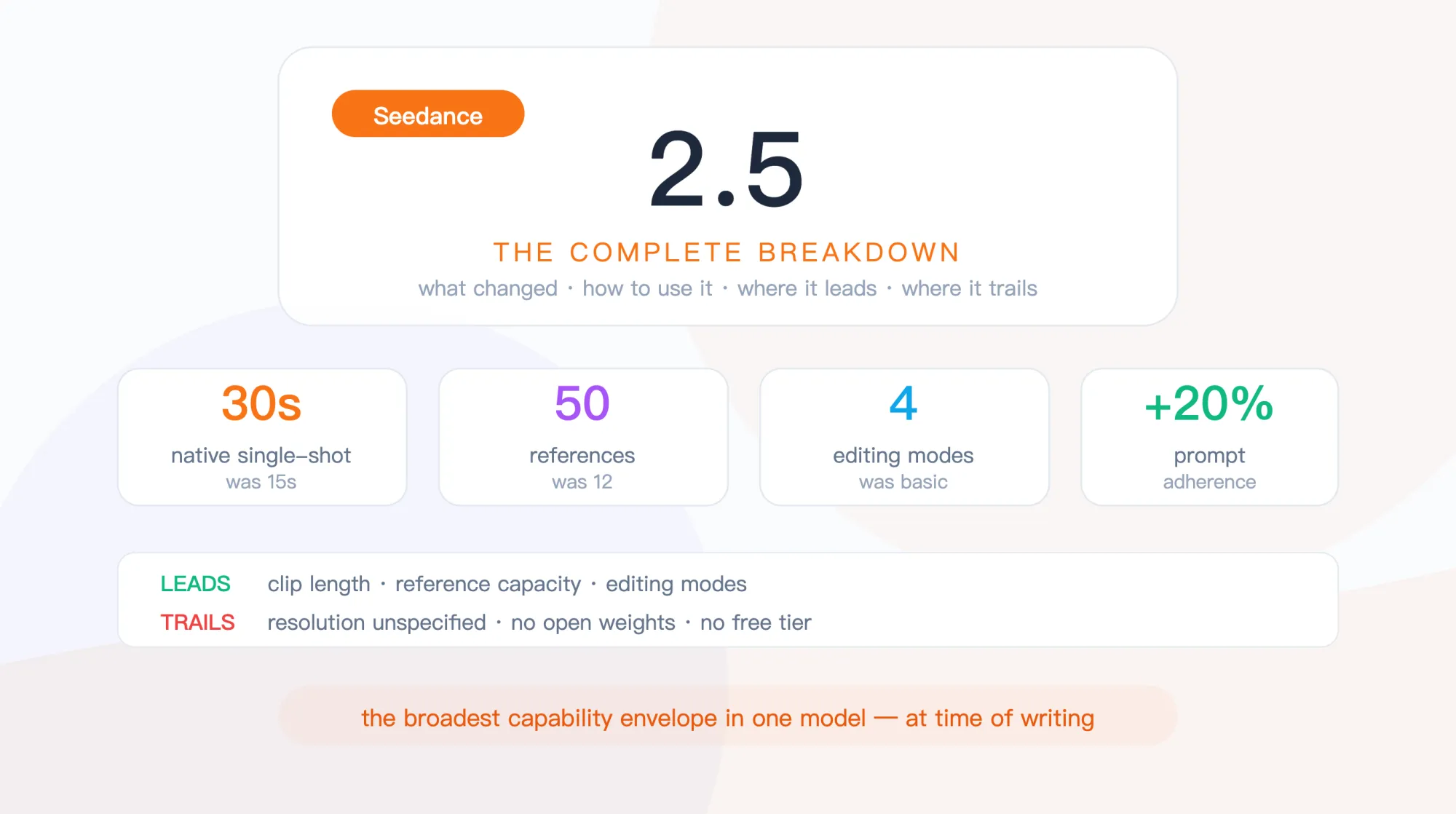
Seedance 2.5 (July 2026) extends to 30 seconds, 50 references, and four-mode editing. Both versions remain available.




























Sign in to leave a comment.