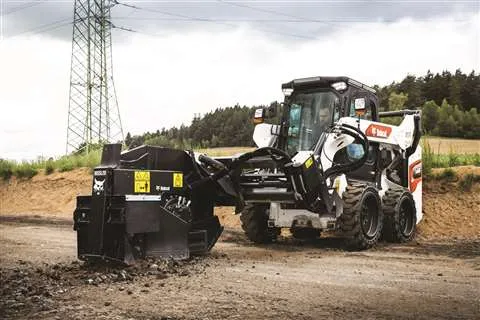

A landscaping contractor in Dubai picked up a commercial project that involved working inside a partially completed building — shaping the internal courtyard, moving material through narrow corridors, grading around existing structural columns that couldn't be touched. The excavator they'd used on previous jobs wouldn't fit. The wheel loader was too wide for the corridor access. What eventually got the job done was a compact machine with enough intelligence built into its controls to work precisely in a space that larger equipment simply couldn't enter.
That scenario plays out more often than the equipment catalogues acknowledge. Construction in dense urban environments, retrofit work inside existing structures, landscaping around completed infrastructure — these are jobs where the working envelope is the constraint, and getting the right machine into a tight space is worth more than raw power or bucket capacity.
What Makes The Current Generation Different
The skid steer loader has been a job site fixture for decades, but the machines being built now carry a different level of operator support than earlier versions. Load management systems that prevent tipping under uneven loads, electro-hydraulic controls that respond to operator input with more precision than mechanical linkages allowed, telematics that track utilisation and flag maintenance requirements before they become failures — these aren't premium features on high-end models anymore. They're showing up across mid-range machines in a way that changes what an average operator can achieve.
The practical effect is that a skidsteer loader in the hands of a competent but not highly experienced operator now performs more consistently than it would have on a previous generation machine. The technology compensates for the kind of errors that used to result in tipped loads, damaged attachments, or uneven grading.
The Attachment Ecosystem Is Where The Real Versatility Lives
Any contractor seriously evaluating a skidsteer for sale should spend as much time on the attachment interface as on the base machine specification. A skid steer that can run a full range of attachments — buckets, augers, breakers, cold planers, trenchers, sweepers — from a properly standardised hydraulic coupler system is a different asset from one that's nominally compatible but requires adapter plates, pressure adjustments, and extra setup time for every switch.
On a job where the crew is switching between tasks multiple times in a day, that friction compounds. A coupler system that lets an operator change attachments without leaving the cab versus one that requires a ground crew and twenty minutes of setup changes how the daily programme runs in ways that don't get captured on the spec sheet.
Where The Skid Steer And The Backhoe Overlap — And Where They Don't
The comparison between a backhoe wheel loader and a skid steer comes up regularly in procurement conversations, and the honest answer is that they serve overlapping but distinct purposes. The backhoe's reach advantage and digging depth make it better suited to trenching and foundation work. Its wheel configuration gives it better travel speed across open ground between tasks.
What backhoe wheel loaders give up is manoeuvrability in confined spaces. Turning radius, working clearance, the ability to operate in a corridor or against an existing wall — these are the parameters where the skid steer holds its ground regardless of how capable the backhoe has become in other respects. The sites that get the most from both machines are the ones that have thought clearly about which task belongs to which platform rather than trying to stretch one machine across everything.
Buying Versus Hiring And What The Decision Actually Depends On
For contractors running consistent volumes of the kind of confined-space work where skid steers genuinely excel, ownership makes sense. For those who need one for a specific project phase — an interior fit-out, a landscaping scope within a larger civil project — the hire market is deep enough that a well-specified machine is accessible without the capital commitment.
The skid steer loader market in the UAE has expanded enough that the choice of machine, attachment availability, and local service support are all meaningful considerations before any purchase decision gets finalised. A machine that performs well in temperate conditions but hasn't been tested against sustained operation in peak summer heat is a different risk profile from one with a proven track record in comparable environments. That question deserves more attention than it typically gets in the procurement process.
























Sign in to leave a comment.