
A conversation that comes up on almost every commercial solar project eventually sounds something like this:
"Can we make the installation faster?"
The answer is usually yes.
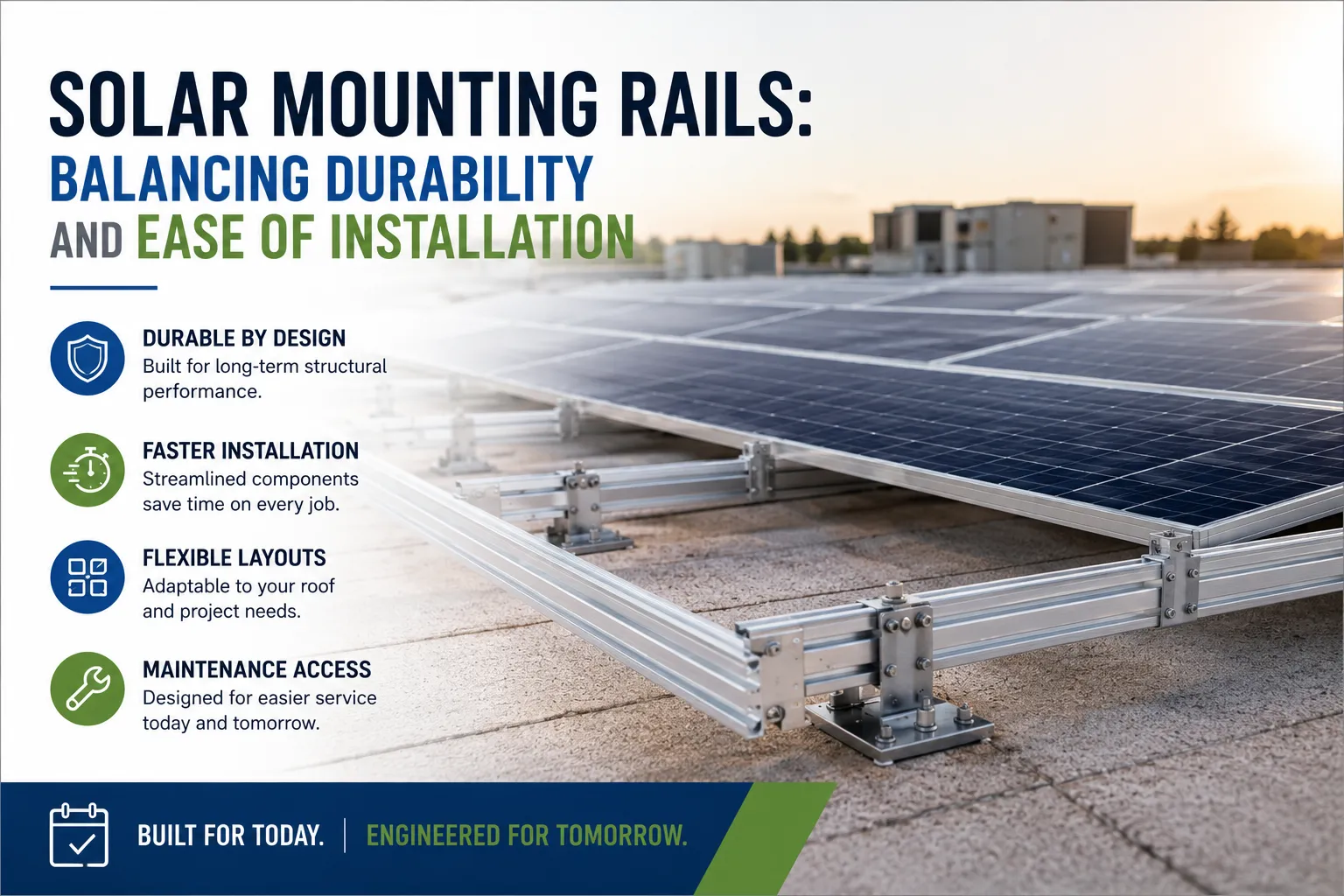
The better question is whether faster installation comes at the expense of long-term performance. Contractors, EPC firms, and project managers constantly balance two competing priorities when evaluating solar mounting rails. They want systems that install efficiently without creating maintenance, durability, or serviceability challenges years later.
The reality is that the strongest system isn't always the easiest to install, and the fastest system isn't always the best long-term investment. Understanding where those tradeoffs exist can help project teams make better decisions before construction begins.
The Debate Usually Starts With Labor
On large commercial projects, labor often represents a significant portion of installation costs.
As a result, rail systems are frequently evaluated based on:
- Installation speed
- Component count
- Crew efficiency
- Material handling
- Layout flexibility
These are legitimate considerations.
However, experienced contractors know that installation speed is only one piece of the equation. A rail system may save hours during construction but create additional maintenance challenges over the next twenty years. That tradeoff deserves attention.
Durability and Installation Efficiency Are Not Always Opposites
One common misconception is that durability automatically means complexity.
That's not always true.
Well-designed solar mounting rails can often improve both structural performance and installation workflows when engineering and field realities are considered together.
The goal isn't necessarily choosing between strength and speed. The goal is to find a balance that supports both.
A Practical Comparison
| Consideration | Installation-Focused Approach | Long-Term Performance Approach |
| Rail Selection | Prioritizes speed | Prioritizes durability |
| Layout Design | Faster deployment | Future maintenance considered |
| Expansion Planning | Minimal consideration | Long-term movement addressed |
| Service Access | Secondary concern | Included during design |
| Roof Compatibility | Basic review | Detailed evaluation |
| Lifecycle Costs | Lower upfront focus | Long-term ownership focus |
The most successful commercial projects usually fall somewhere between these two extremes.
What Contractors Notice Years Later
Installation crews experience the project differently from maintenance teams. During construction, the focus is naturally on productivity and schedules. Five years later, priorities often change.
Maintenance personnel tend to notice:
- Accessibility issues
- Rail spacing limitations
- Cable routing complications
- Roof service challenges
- Future reroofing constraints
Those observations don't necessarily indicate poor installation. They simply highlight the fact that decisions made during construction continue to influence operations long after commissioning. A rail system that saves time on day one should also support efficiency on day 3,650.
Why Commercial Projects Require a Broader Perspective
Commercial rooftops introduce variables that don't always exist on smaller installations.
- Roof-mounted equipment.
- Drainage systems.
- Maintenance pathways.
- Multiple roof elevations.
- Future building modifications.
- A rail system has to function within all of those conditions.
This is one reason project teams increasingly evaluate flexible rail-based solar layouts during planning. Adaptable layouts often help accommodate rooftop obstacles while preserving maintenance access and long-term serviceability.
The objective isn't simply fitting more modules onto the roof. It's creating an installation that remains practical throughout its operational life.
The Hidden Cost of Over-Optimizing for Speed
Every contractor appreciates efficiency. The problem arises when installation speed becomes the only metric used to drive decisions.
Consider two hypothetical projects:
- Project A reduces installation time by several days but limits future roof access.
- Project B requires slightly more planning but simplifies maintenance, inspections, and future reroofing work.
The initial labor savings on Project A may look attractive.
Over the system's lifespan, the operational costs may tell a different story. That's why experienced project teams often evaluate lifecycle implications alongside installation metrics.
What Roofing Professionals Continue to Emphasize
Roofing professionals have long stressed that rooftop photovoltaic systems should be evaluated as part of the overall roof assembly rather than as isolated equipment. Structural compatibility, maintenance access, attachment planning, and long-term roof performance all influence project success.
This perspective becomes increasingly important as commercial solar systems age. The decisions that seem minor during installation often become much more significant during inspections, repairs, and reroofing.
Final Thoughts
The conversation around solar mounting rails is often framed as a choice between durability and installation efficiency.
In practice, the best systems are rarely optimized for only one objective. Successful commercial projects balance structural performance, maintenance access, roof compatibility, and installation efficiency from the beginning.
Before selecting a rail system based solely on speed, it's worth considering how that decision will affect the roof, the maintenance team, and the project years after installation. That's often where the real value becomes visible.
Frequently Asked Questions
1. Why are solar mounting rails important?
Solar mounting rails support modules, distribute structural loads, and connect the array to the roof structure.
2. Do durable rail systems take longer to install?
Not necessarily. Many modern rail systems are designed to balance structural performance with installation efficiency.
3. What should contractors prioritize when selecting solar mounting rails?
Contractors typically evaluate durability, installation speed, maintenance access, roof compatibility, and long-term serviceability.
4. Why does maintenance access matter?
Solar systems remain on rooftops for decades. Poor access can increase labor costs for inspections, repairs, and future roof work.
5. How do rail systems affect reroofing projects?
Rail layout and attachment planning can significantly influence how easily future roof replacements and maintenance activities are performed.
6. Are lifecycle costs more important than installation costs?
Both matter. Many commercial project teams evaluate total ownership costs rather than focusing exclusively on upfront installation savings.



















Sign in to leave a comment.