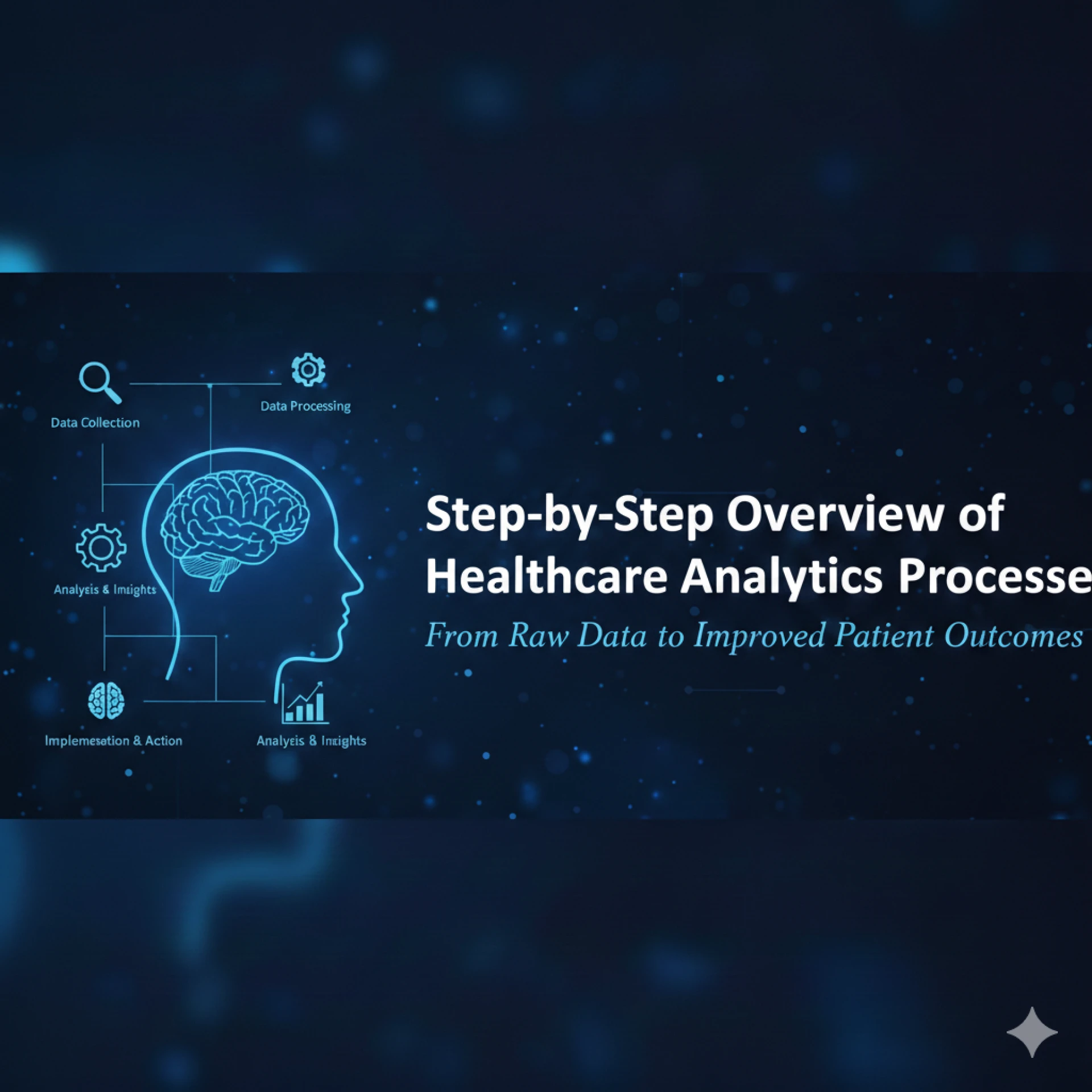

Healthcare analytics is not a single tool or dashboard it’s a structured, multi-stage process that turns raw healthcare data into clinical, operational, and financial insights. Organizations that invest in advanced data analytics services gain a repeatable framework for improving outcomes, accuracy, and decision-making across the healthcare ecosystem.
Below is a step-by-step breakdown of how healthcare analytics actually works in practice.
Step 1: Data Collection from Multiple Healthcare Sources
The process begins with collecting data from diverse healthcare systems, including:
- Electronic Health Records (EHRs)
- Medical coding and billing systems
- Claims and payer data
- Wearables and remote monitoring devices
- Laboratory and imaging systems
IBM outlines how integrating structured and unstructured healthcare data is the foundation of effective analytics IBM Healthcare Data & Analytics Blog.
At this stage, data completeness and interoperability are critical poor inputs limit downstream insights.
Step 2: Data Cleaning, Validation, and Standardization
Raw healthcare data is often inconsistent, duplicated, or incomplete. Analytics teams clean and standardize data to ensure accuracy, compliance, and usability.
This step includes:
- Removing duplicate patient records
- Validating diagnosis and procedure codes
- Normalizing formats across systems
Analytics plays a key role in improving documentation and reimbursement accuracy, especially in medical coding workflows. A detailed use case is covered in data analytics in medical coding, where analytics reduces errors, denials, and compliance risks.
Step 3: Data Integration and Warehousing
Once cleaned, data is integrated into centralized repositories such as data warehouses or cloud-based healthcare data lakes.
This enables:
- Cross-departmental analysis
- Longitudinal patient tracking
- Secure access to analytics-ready datasets
Step 4: Descriptive and Diagnostic Analytics
At this stage, analytics answers foundational questions:
- What happened?
- Why did it happen?
Healthcare organizations use dashboards, reports, and KPIs to analyze:
- Patient outcomes
- Readmission rates
- Length of stay
- Coding accuracy and claim performance
Tableau shows how healthcare providers use visual analytics to uncover operational and clinical patterns.
This step supports transparency and performance benchmarking across care teams.
Step 5: Predictive Analytics and Risk Modeling
Predictive analytics uses historical data and machine learning models to forecast future events, such as:
- Patient deterioration
- Hospital readmissions
- Disease progression
- Resource demand
Step 6: Prescriptive Analytics and Decision Support
Prescriptive analytics goes beyond prediction by recommending actions. Clinical decision support systems use analytics to suggest:
- Optimal treatment pathways
- Care prioritization
- Staffing and resource allocation
Step 7: Continuous Monitoring and Outcome Optimization
Healthcare analytics is not a one-time effort. Continuous monitoring ensures that outcomes improve over time through:
- Real-time dashboards
- Outcome tracking
- Model refinement
- Feedback loops
Population-level insights and value-based care initiatives depend on this continuous analytics cycle.
Organizations looking to build or scale this end-to-end analytics process often evaluate specialized partners. A comparative overview is available in top data analytics companies in India, which highlights providers with healthcare analytics expertise.
Healthcare analytics follows a structured process: data collection, cleaning, integration, descriptive analysis, predictive modeling, prescriptive decision support, and continuous monitoring — enabling better clinical, operational, and financial outcomes.
Why This Process Matters
When executed correctly, healthcare analytics:
- Improves patient outcomes
- Reduces operational inefficiencies
- Enhances medical coding accuracy
- Supports regulatory compliance
- Enables data-driven clinical decisions
This step-by-step approach ensures analytics delivers measurable, real-world impact — not just reports.





























Sign in to leave a comment.