
The architecture and construction sector is one of the evolving landscapes where technology and innovation have transformed the approach. With an ever-growing state, AEC has adopted a new process integrated with the latest technology that allows professionals to make informed decisions and maintain precision in every construction project. Over the years, efficiency, safety, reliability, and accuracy in the architecture design have been key factors of success.
Regardless of project type, these key factors remain the same as a measure of the project's success. Eliminating traditional workflows and manual processes, the AEC sector has been revolutionized by the adoption of Building Information Modeling (BIM), which has been a game-changer. The adoption of BIM technology has offered a plethora of benefits to architects, engineers, designers, and other professionals to enhance the overall outcome of the project.
As a matter of fact, there are a variety of stages in any construction project that demand precision, efficiency, and reliability in the overall infrastructure completion. With BIM implementation, every stage of the project has become easier, more time-efficient, and more precise, as per the design. While an infrastructure project is more than just constructing floors, it involves various stages, including structural, architectural, MEP, interior, and more. Every stage of the construction is crucial, where precision is key to success. While being vital, the structural stage of the architecture is the skeleton of every infrastructure.
As BIM is a vital technology for every complex modern project, integrating into the structural stage can be a comprehensive approach. Moreover, the infrastructure's structural stage is the backbone that enables any building to withstand environmental factors and other issues. Structural BIM services play a vital role in construction projects, enabling AEC experts to understand complex structural designs, ensure structural integrity, and minimize the scope of errors. Project at the design stage: BIM for construction planning includes a variety of aspects, such as structural planning, architectural design, MEP coordination, and more.
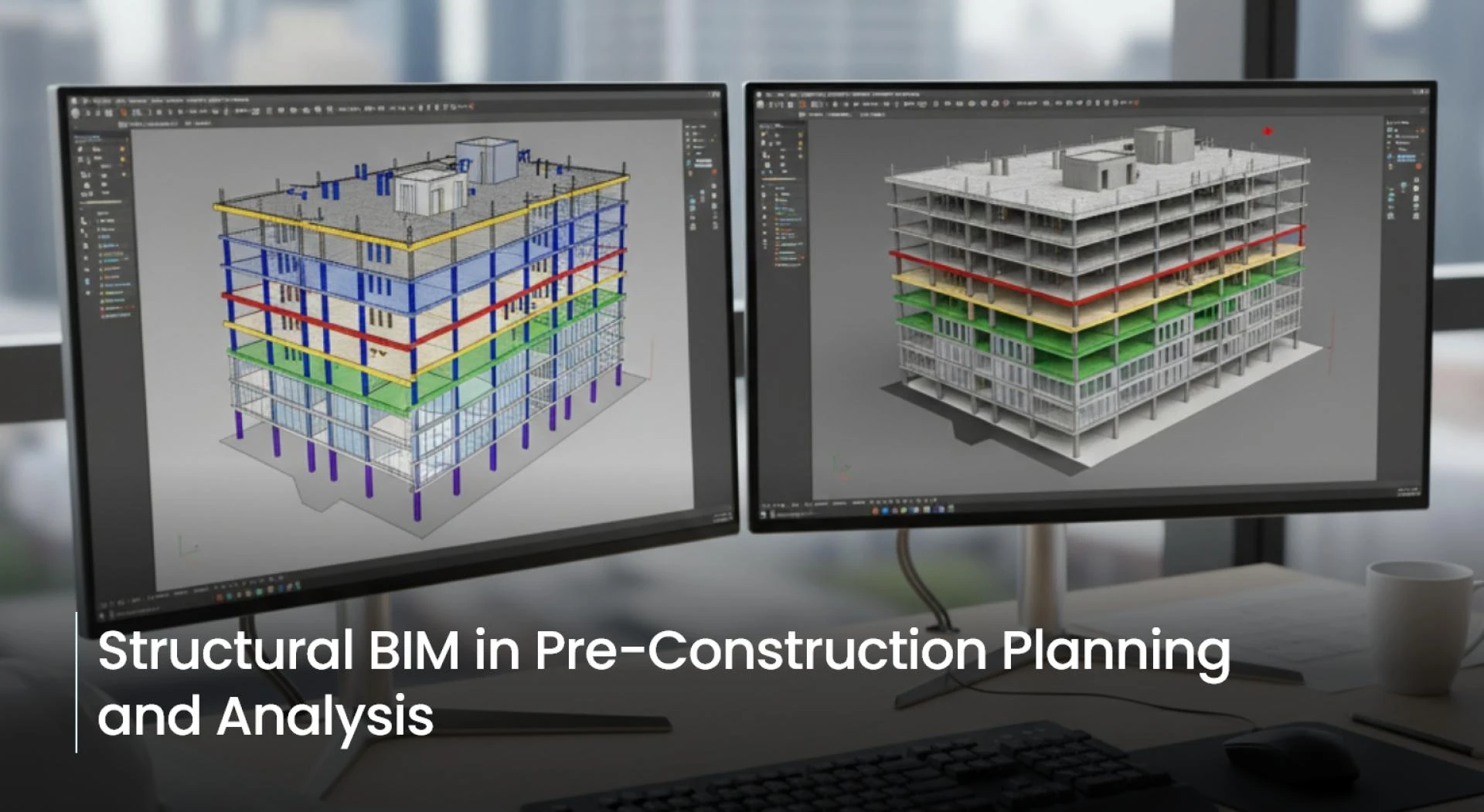
With the help of BIM modeling services, AEC professionals can streamline the complex structural stage, which demands efficiency and precision. Structural BIM modeling is a comprehensive approach, as it helps in pre-construction for planning and analysis. Explore in detail the concept of structural BIM and its importance in the AEC.
Understanding Structural BIM Modeling
In the evolving field of AEC, it is vital to maintain precision and efficiency in every stage of the construction process. Every infrastructure project involves complex modern design, where precision and efficiency are paramount for successful project completion. In every construction project, the structural component plays a vital role, ensuring the structure is strong and can withstand environmental calamities. Here, structural BIM services serve as a transformative approach that enables AEC professionals to ensure accuracy in structural design at the pre-planning stage. Moreover, using structural analysis with BIM technology results in reduced errors, accurate quantity takeoff, scheduled time, and more.
Using structural BIM modeling for intelligent 3D structural modeling combines all the structural aspects of the building, such as beams, columns, foundations, slabs, and more. With BIM modeling, AEC professionals have access to data-rich models in real time, enabling collaboration among architects, engineers, and contractors. As a matter of fact, integration of building information modeling in the structural aspect of the construction brings best practices, better design, enhanced accuracy, fewer errors, constraints to budget, and more.
Above all, BIM clash detection is one of the greatest benefits, ensuring precision, fewer errors, and faster project delivery. Building information modeling is a digital representation of the functional and physical characteristics of the infrastructure. It serves as a common data-sharing platform, enabling coordinated communication. Structural BIM modeling involves creating data-rich, intelligent 3D models that visualize structural components and elements of the infrastructure.
This data-rich model included information on materials, dimensions, and properties for each element. Furthermore, BIM modeling in structural aspects also demonstrates LOD in structural BIM, allowing AEC professionals to understand at what level of detail construction is completed, including time, cost, and materials. Nonetheless, structural analysis using BIM brings a plethora of benefits, explored in detail.
Benefits of Structural Coordination in BIM
As briefly discussed, the sheer importance of structural BIM in AEC is evident from the benefits it offers. Without BIM for construction planning and analysis, AEC professionals are inefficient at managing complex modern designs while ensuring the building's strength. The structural part of the infrastructure is primarily for managing strength and resilience against environmental factors such as rain, heatwaves, humidity, earthquakes, and other natural disasters. This aspect includes columns, beams, slabs, and more, for which the integration of BIM modeling services is crucial. Not only this, but structural coordination in BIM brings a variety of benefits, including;
- Fewer errors and accuracy: As 2D drawings can be miscommunicated or misinterpreted during on-site construction, a 3D BIM model helps in clarity. From design to execution, structural BIM modeling ensures every aspect of the structure is accurately designed and installed, without clashes or errors. This enhances architectural, MEP coordination, and related processes, resulting in time savings, increased productivity, and on-time project delivery.
- Enhanced collaboration and communication: Building information modeling is not just a technology but an approach that enables AEC experts to ensure accuracy and efficiency. With the help of LOD in structural BIM, professionals can improve communication, coordination, and more, resulting in more streamlined outcomes and greater project success.
- Cost and resource optimization: Design mistakes, material wastage, inefficient planning, and more are common in any architecture and construction project. However, with the implementation of structural BIM services in the construction workflow, it is possible to save costs by leveraging LOD in structural BIM, providing detailed material quantities, project completion time, and more. This helps save time and money, avoid resource misallocation, and ensure on-time project delivery.
- Energy efficiency and sustainability: BIM modeling is one of the game changers for AEC professionals, as it goes beyond offering 3D visualization. Structural BIM offers key components for sustainable construction practices that are rapidly becoming industry trends and standards. BIM models ensure the structural components support sustainable, energy-efficient design for accurate construction.
- Structural integrity and safety: Safety is the primary concern of every AEC construction project. A strong infrastructure means it is resilient to different natural calamities and can withstand certain forces. Therefore, BIM for construction planning and structural components helps ensure the safety of infrastructure, optimize structural design, and increase seismic resilience.
These are some of the key benefits of structural BIM services in pre-planning and analysis of the construction. With a data-driven BIM model, the structural aspect of the architecture project is completed seamlessly, with no risk or added cost.
Ending Note
The AEC industry adopts a digital approach to the structural stage of construction through BIM integration. Structural BIM modeling transforms while adding efficiency, accuracy, and collaboration.






















Sign in to leave a comment.