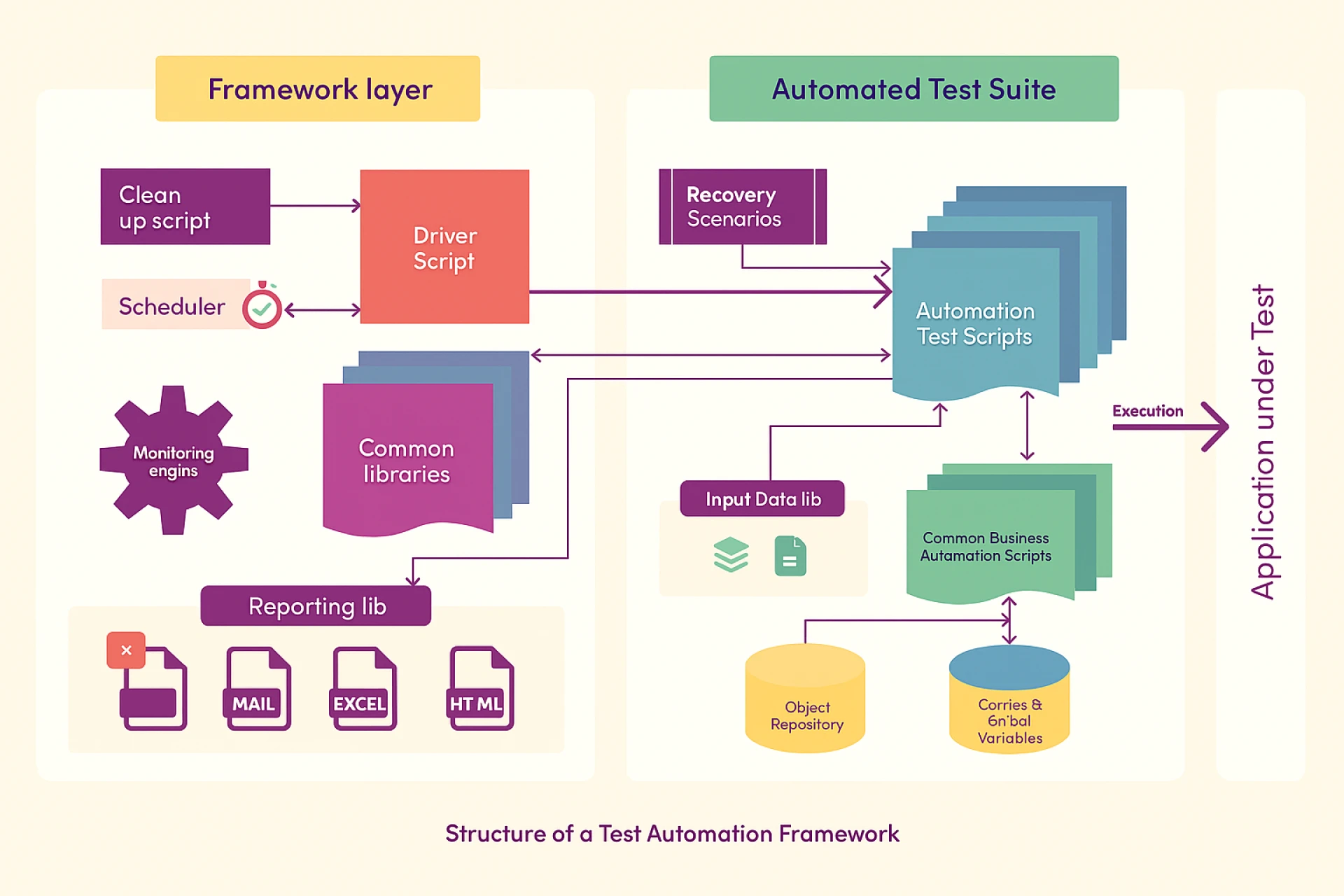

A test automation framework is an organized set of rules, tools, and best practices that allows QA teams to create and execute automated tests in a consistent and efficient way. In other words, it offers a structured environment where testers can create automated test scripts with already pre-built libraries and components.
By creating tests under a framework, teams allow tests to be maintained and reused more consistently, all while being included in the development pipeline.
Why QA Teams Need a Test Automation Framework
A test automation framework empowers QA teams to streamline testing, improve accuracy, and deliver software at speed.
Faster, Larger Scaled Testing
With automated tests, you are running them quickly, over and over again, catching more bugs. With increased automation, maturity comes “higher product quality” and shorter time to production.
Consistent and Collaborative
Frameworks enforce standards (naming, data handling, logging) across the tests. They “create the rules and definitions we want to conduct our tests” creating software of high quality.
Cost and Time Savings
Reusing the test scripts and reducing manual work reduces the amount of time for testing, allowing QA to spend their time conceptualizing the design of more complex tests.
Core Components of a Test Automation Framework
A robust test automation framework is built on key components that work together to ensure scalable, maintainable, and efficient testing.
- Test Data Management: Separates input data from test scripts. In a data-driven framework, test cases are intended to be parameterized, and test data is stored externally, so a single test can run against many different data sets.
- Test Libraries: Groups of reusable code (utilities, APIs, and helper functions) that tests will call on to perform common actions efficiently.
- Object Repository: Centralized storage of all the locators for UI elements. For instance, one framework explains that the object repository “stores all the locators of web page elements,” thus simplifying maintenance (tests use the repository to reference the elements instead of hardcoding the elements).
- Test Scripts: This is the actual automated testing code (for example, Selenium or Appium scripts) that runs steps and assertions using the libraries and data referenced above.
- Reporting Module: The reporting module generates detailed reports and logs of the test (pass/fail results, error message, screenshot, etc.). The reports can be customized and emailed to QA and development teams.
- Integration Layer: The integration layer connects the framework to external tools and pipelines (continuous integration servers, version control, issue trackers). The integration layer automates the triggering of tests every time a build is run, and sends feedback of the results back into development workflows.
Popular Frameworks and Tools
- vStellar: A commercial low-code automation platform for web, mobile accessibility testing, and API testing.
- Selenium: Open-source framework for web testing. Contains WebDriver API to interface with multiple programming languages and browser types so it is the de facto cross-browser UI testing standard today.
- Appium: Open-source framework for mobile accessibility testing (iOS/Android) and desktop apps, which uses WebDriver protocol to automate native and hybrid applications from many platforms.
- Cypress: JavaScript-based web testing tool. Runs directly in the browser, allowing testers to get fast feedback. Cypress runs directly in the browser, enabling a more simple and efficient testing experience which helps its popularity with modern-day web applications.
When to Use a Test Automation Framework
Automation frameworks are most useful where tests are repeatable and persistent. They are especially good for regression suites, data-driven tests, or any cases that will be run many times (e.g. nightly builds or CI pipelines).
Manual testing is, however, more practical for cases of very early development (where requirements are constantly changing) or for one-off exploratory tests. The take home here is to use a framework when you think lessening manual effort is worth the initial setup cost, which should typically be the case in stable project phases or larger projects.
Conclusion
Test automation frameworks provide a standardized approach to testing and enable QA teams to deliver superior software in less time. Software testing can be time consuming and utilize 40%-50% of resources in manual testing without using any automation tool, these are major problems in software development.
In practice, a good framework should be general enough to provide functions that help a tester create automated tests for all the different components of the delivered software system.
By selecting and implementing the right framework and tools, QA teams can achieve greater testing coverage, identify defects sooner, and contribute to the overall quality of the product.


























Sign in to leave a comment.