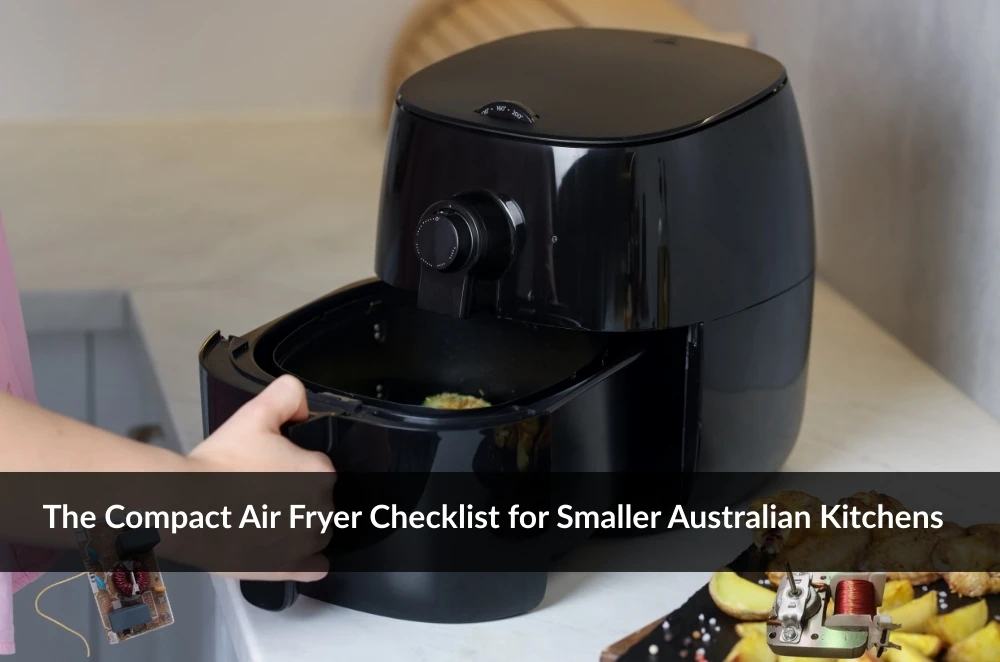

In a smaller Australian kitchen, “compact” can’t just mean “not huge”. It has to mean: fits your bench depth without overhang, leaves breathing room for ventilation, doesn’t dominate your limited storage, and still cooks enough food to be genuinely useful on weeknights.
The tricky part is that air fryer sizing is rarely described the same way across brands. One model might be “slim” but tall, another might be “compact” yet wide, and capacity (litres) doesn’t always reflect how much you can cook in a single layer. If you’re trying to make an air fryer work in a tight footprint—apartment galley kitchen, older unit with shallow benches, share house setup—here’s how to shortlist compact air fryer options without guessing.
Start with the space you actually have
Before comparing features, measure three things:
- Bench depth (front edge to wall/splashback). This is where many people get caught—some units look small online but need more depth once you include the handle and cord bend.
- Overhead clearance (underside of cabinets/rangehood). Air fryers vent hot air; cramped vertical space can mean heat and steam hitting cabinetry.
- “Breathing room” zone around the unit. Plan for a small buffer on the sides and behind so vents aren’t blocked.
A useful rule in small kitchens: prioritise compact air fryer options for smaller Australian kitchens that fit comfortably in their “home position” rather than choosing one you need to drag forward every time you cook. If you’ll only use it when it’s easy, it should live where it works.
Capacity: litres matter, but basket shape matters more
Capacity is often listed in litres, but for everyday cooking in a compact kitchen, the usable cooking area is what you feel.
- Singles or snack-focused households: smaller baskets can work well if you’re mainly doing chips, a couple of portions of veg, or reheating.
- Two people: mid-range capacity can be the sweet spot—big enough for dinner, still manageable on the bench.
- Families (even in small kitchens): you may still want capacity, but consider whether a larger unit will become “bench clutter” you resent.
If you frequently cook foods that need to be spread out (chips, crumbed items, roasted veg), look for a basket design that gives you good surface area. If you mostly cook stacked items (wings, drumsticks), vertical space can matter more.
Compact styles that suit tight layouts
Not all “small” air fryers are small in the same direction. In a narrow kitchen, width can be a bigger issue than height; in a kitchen with shallow benches, depth becomes the deal-breaker.
Slim/tall profiles
These can be easier to fit on a narrow bench, but check overhead clearance and where the hot air vents.
Squat/wide profiles
Sometimes more stable, sometimes easier to load, but they can crowd the bench area you need for chopping and plating.
Drawer vs oven-style
Drawer-style designs are common for compact setups. Oven-style air fryer ovens can add versatility, but they’re often deeper, and their door swing can be awkward in a tight walkway.
Controls that make sense in a small kitchen
In smaller kitchens, you’re often cooking while sharing space—someone else is passing behind you, the sink is nearby, the bench is busy. Controls that reduce fuss help.
- Clear, readable display (especially if the unit is tucked under cabinets).
- Simple presets you’ll actually use (chips, chicken, veg), not a dozen niche modes.
- Easy temperature and time adjustments mid-cook.
CHOICE lab tests a wide range of air fryers and compares performance, ease of use/cleaning, and running costs—useful context if you want to sanity-check marketing claims against independent testing.
Noise and heat: the hidden “small kitchen” problems
In an open-plan apartment or compact unit, noise can feel louder and heat can feel more intense.
- Fan noise: Some models are noticeably louder; if you work from home or cook late, this matters.
- Exhaust direction: Vents that blow hot air straight back into a wall or up into cabinetry can be annoying (and messy over time).
- Smell management: If your kitchen has limited ventilation, strong-smelling foods can linger.
Practical tip: keep a small “landing zone” nearby (heatproof mat or board) so you can safely rest the hot basket without juggling space.
Cleaning: choose the option you’ll keep clean
In a small kitchen, a hard-to-clean appliance tends to become a “special occasion” gadget. Prioritise:
- Basket and tray parts that are easy to remove and rinse.
- Non-stick surfaces you can clean gently (abrasives can shorten lifespan).
- Minimal crevices where grease builds up.
If you regularly cook marinated foods, crumbed items, or anything fatty, cleaning convenience becomes a deciding feature—not an afterthought.
Energy use: think in terms of “right size for the job”
Air fryers are often chosen for speed and convenience, but in a cost-conscious household, “right-sized” appliances matter. Australia’s energy guidance for households stresses choosing appliances that fit your needs and considering running costs, because appliances make up a meaningful share of home energy use.
In practice, that means:
- Avoid buying larger capacity than you’ll regularly use (you’ll heat more space than necessary).
- Use the air fryer for tasks it’s good at (small batches, quick roasts, crisping) and keep other appliances for jobs they do more efficiently.
Food safety in compact cooking
Because air fryers cook quickly and can brown the outside fast, it’s worth remembering that colour isn’t the same as doneness. For higher-risk foods like poultry and minced/rolled meats, FSANZ guidance commonly references cooking to safe internal temperatures (for example, poultry to at least 75°C in the centre) and avoiding the “danger zone” where bacteria multiply quickly.
In a small kitchen, a basic food thermometer can be a surprisingly good companion—especially if you’re experimenting with new models, new baskets, or thicker cuts of meat.
A simple shortlisting method for compact air fryer options
If you want a quick, practical way to narrow choices, use a three-pass filter:
- Fit filter (non-negotiable): bench depth + overhead clearance + ventilation space.
- Lifestyle filter: what you cook most (chips/veg, chicken, frozen snacks, roasting), and how many people you cook for most nights.
- Friction filter: how annoying it is to clean, to store, and to operate when the bench is crowded.
Once you’ve done that, comparing models becomes much easier because you’re not trying to make “a good air fryer” fit a space it was never meant to fit.
If you’d like to browse what’s currently listed in one place, you can start with a general category view of air fryers online via this air fryer range.
Key Takeaways
- In smaller kitchens, bench depth and ventilation clearance matter as much as capacity.
- Litres can be misleading—basket shape and usable surface area often decide real-world usefulness.
- Choose a form factor (slim/tall vs squat/wide; drawer vs oven-style) that suits your layout, not just your cooking goals.
- Independent testing and guidance can help balance marketing claims—look for evidence on performance and running costs.
- For poultry and minced/rolled meats, rely on safe internal temperature, not just browning.



























Sign in to leave a comment.