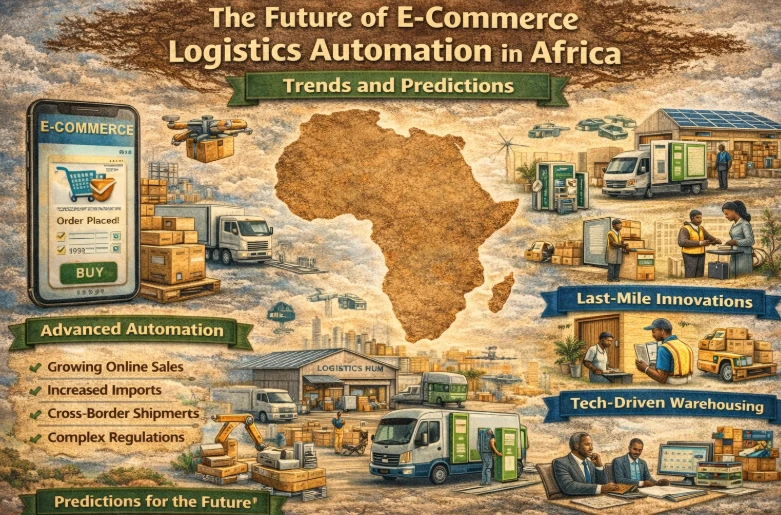

According to the Ken research, the sector is valued at USD 1.3 billion, primarily driven by the rapid expansion of online shopping platforms, increasing internet penetration, and growing demand for more efficient supply chain systems. Automation has become critical, particularly for automated warehousing and last‑mile delivery, as companies seek to improve speed, accuracy, and transparency in fulfillment. The Africa e‑commerce logistics automation market analysis shows that e‑commerce hubs such as Nigeria, South Africa, and Kenya lead this adoption due to significant investment in digital infrastructure and supportive regulatory environments, creating a competitive landscape for technology‑enabled logistics solutions.
Market Segmentation in Africa’s E‑Commerce Logistics Automation Sector
The Africa e-commerce logistics automation market is segmented by system type and end-user industry, reflecting the key technologies adopted and the major sectors driving demand. This structure highlights how automation solutions address efficiency and delivery challenges across logistics operations.
- By System Type:
The market covers automated warehousing, last-mile delivery automation, inventory and fleet management, robotics, and real-time tracking systems. Automated warehousing and last-mile solutions are growing fastest due to their direct impact on efficiency, speed, and cost optimization. - By End-User:
Major end-users include retail & e-commerce, 3PLs, manufacturers, food & beverage, healthcare, and automotive sectors. Retail & e-commerce leads demand, supported by rising online sales and increasing logistics complexity.
Growth Drivers and Africa E‑Commerce Logistics Automation Market
Several structural and technology-driven factors underpin Africa e-commerce logistics automation market growth, shaping investment decisions and accelerating digital transformation across supply chains.
- Rapid Online Adoption: Africa’s e‑commerce market is expected to grow strongly over the next decade, with digital retail expanding alongside broader regional internet penetration rates projected to approach 43%, driving logistics requirements.
- Demand for Speed and Reliability: Automated technologies help reduce manual processes, shorten delivery cycles, and increase fulfillment accuracy, which are essential in competitive markets where consumers demand faster delivery and real‑time shipment visibility.
- Investment in Digital Infrastructure: Enhanced connectivity and cloud‑based supply chain tools allow businesses to scale automated logistics systems, integrate with e‑commerce platforms, and support agile operations.
Together, these factors contribute to evolving Africa e‑commerce logistics automation market trends that prioritize digital transformation and seamless delivery experiences.
Competitive Landscape in Africa’s E‑Commerce Logistics Automation Market
The Africa e‑commerce logistics automation market report identifies a dynamic and competitive environment with both regional innovators and international logistics technology companies. Key players include:
- Jumia Logistics: As Africa's largest e‑commerce platform, Jumia handles over 2 million orders per month across its operations in 11 African countries, leveraging automation to streamline warehousing and last‑mile delivery services.
- DHL Supply Chain: DHL continues to invest in cutting-edge logistics solutions, committing USD 2.6 billion globally for digital infrastructure and automation technologies to support e‑commerce and retail businesses, including substantial investments in Africa.
- Kuehne + Nagel: The company operates more than 4.6 million square feet of warehouse space in Africa and has integrated automation systems to optimise storage, order fulfilment, and last‑mile delivery services, particularly in key markets like South Africa and Kenya.
- Aramex: Aramex has grown its African operations by 40% in the past two years, investing in technology to enhance real‑time tracking and automate sorting and last‑mile delivery processes.
- UPS: With a strong focus on automation, UPS has expanded its automated package sorting systems across 7 African countries, aiming to improve delivery speed by 25% through the use of robotics and AI.
These companies are investing in advanced automation, real-time tracking, and scalable fulfillment solutions to strengthen market position amid rising online demand. With e-commerce logistics automation projected to grow by around 14% annually, their role remains critical in shaping the sector’s expansion.
Strategic Challenges in Africa’s Logistics Automation Space
Despite promising expansion opportunities, the Africa e-commerce logistics automation market faces infrastructure gaps, high implementation costs, limited technical expertise, and fragmented regulatory environments that can slow adoption and scale-up.
- Infrastructure Gaps: Inconsistent transport and logistics infrastructure, especially outside major urban centers, hindering the seamless deployment of high‑technology automation systems.
- Skills and Technology Adoption: Limited availability of specialized talent and slower uptake of advanced robotics and AI tools can delay the implementation of comprehensive automation solutions.
- Cost Barriers: High initial investments in automation technology and integration costs can be a deterrent for smaller logistics providers and startups.
Addressing these challenges will be crucial to unlocking the full potential of e‑commerce logistics automation across diverse African markets.
Market Forecast & Africa E‑Commerce Logistics Automation Outlook
Looking ahead, the logistics automation segment in Africa is expected to sustain strong momentum. Broader logistics data for the Africa logistics automation market which includes the Africa e‑commerce logistics automation ecosystem, show growth from approximately USD 2.4 billion in 2022 to nearly USD 4.9 billion by 2030, implying continued adoption of automated tools like robotics, AI‑based route optimization, and warehouse management systems.
Conclusion: Africa E‑Commerce Logistics Automation Market Outlook
In conclusion, the Africa e‑commerce logistics automation market outlook remains bullish, driven by the rapid expansion of online retail, ongoing digital transformation, and demand for faster, more reliable fulfillment solutions. As automation technologies become more accessible and e‑commerce penetration deepens, the logistics ecosystem across Africa is poised to evolve rapidly, supporting broader digital trade and economic integration while offering substantial opportunities for technology innovators and logistics service providers alike.
Read In‑Depth
For comprehensive insights, detailed segmentation, competitive positioning, and forecast analysis in the Africa e‑commerce logistics automation market.



























Sign in to leave a comment.