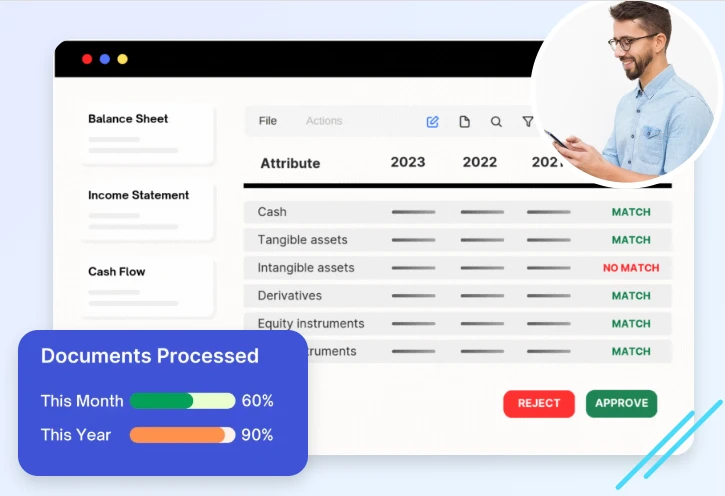

Are finance professionals still spending hours manually extracting numbers from income statements and balance sheets? With the growing demand for speed and accuracy in credit analysis, lending, and financial modeling, traditional spreadsheet workflows are proving inefficient.
This blog explores how modern tools are transforming financial statement spreading, making the process faster, more reliable, and easier to manage. It covers automation, artificial intelligence, and reconciliation technologies that reduce manual work and increase efficiency in the financial sector.
What Is Financial Statement Spreading?
Financial statement spreading is extracting and organizing financial data from balance sheets, income statements, and cash flow reports. The objective is to convert this information into a consistent format so analysts can evaluate trends, assess risk, and calculate financial ratios.
Effective financial statement spreading allows professionals to compare performance over time and across entities. It supports strategic decision-making in credit evaluation, forecasting, and investment analysis.
The Limitations of Manual Processes
Manual spreading requires professionals to copy data line by line into spreadsheets, verify totals, and reconcile figures across statements. This approach is slow and highly prone to human error. Delays in processing financials can lead to slower decision-making and increased risk, especially in lending and underwriting.
Manually handled financial statement spreading is also inefficient when statements come in scanned or non-standard formats. Professionals must adjust for inconsistent layouts, abbreviations, and reporting styles, which add complexity and increase the likelihood of data entry mistakes.
How Automation Improves Efficiency
Modern software tools use artificial intelligence to automate financial data extraction. These tools can recognize line items from scanned documents and native PDFs and automatically map them into structured, digital formats.
Automation reduces the time needed for financial statement spreading from hours to minutes. It also increases accuracy by removing the risk of standard data entry errors. Financial analysts can then focus on interpretation and insight rather than manual formatting.
Ensuring Accuracy Through Reconciliation
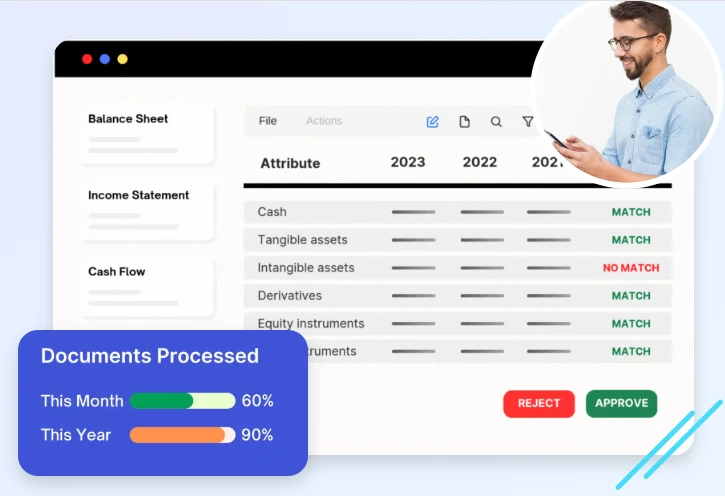
One key feature of advanced spreading tools is the ability to reconcile financial data across multiple statements. These systems check that the values in the balance sheet, income statement, and cash flow report align correctly.
Reconciliation tools support audit-readiness and compliance. They also help catch discrepancies early in the process. With automated reconciliation, analysts can trust that the figures they work with are consistent and reliable across all financial reports.
Key Features to Look For
Look for tools that offer several core capabilities to get the most from a spreading solution. The most important include:
- Ability to handle scanned documents, PDFs, and spreadsheets
- Intelligent tagging of line items such as revenue, gross margin, and net income
- Built-in financial ratio calculations, such as the current ratio or debt-to-equity ratio
- Trend and variance analysis tools for multi-year comparisons
- Export options that integrate with Excel or internal finance systems
A well-designed financial statement spreading tool should combine these features into a seamless workflow that saves time and increases visibility.
Who Benefits from Spreading Tools
Tools that simplify spreading benefits across the financial services industry. Commercial lenders use them to assess borrowers' creditworthiness, investment analysts use them to track portfolio performance, and corporate finance teams rely on them to create internal forecasts and models.
Whether analyzing a small business loan application or preparing a quarterly financial review, automated financial statement spreading tools allow users to work faster and more confidently.
Beyond Time Savings
Automation does more than save time. It also improves data quality, enables collaboration, and enhances risk management. Consistent formatting allows teams to compare financials more easily across different entities or time periods.
Digitized financial statement spreading also support historical analysis and trend visualization. This helps identify issues early, spot growth opportunities, and back decisions with data-driven insights.
Selecting the Right Tool
Not all tools offer the same functionality. Choose a solution that is flexible enough to handle a wide range of formats and scalable enough for high-volume use. Prioritize tools that use advanced data extraction and offer reconciliation features to improve reliability.
Cloud-based platforms provide additional benefits such as remote access, secure document storage, and integration with existing credit systems. These options are beneficial for teams working across departments or geographic locations.
Conclusion
As financial environments become more complex and time-sensitive, traditional data entry methods are no longer effective. The shift toward intelligent, automated financial statement spreading tools is helping organizations streamline operations, reduce errors, and improve outcomes.
By adopting the right technology, finance teams can eliminate workflow bottlenecks and focus on high-value activities such as risk analysis, strategy, and client engagement. Automation increases productivity and raises the standard of accuracy and consistency in financial reporting.
Efficiency and data quality are essential in a competitive financial landscape. Choosing the right tools for financial statement spreading can give organizations a strategic edge, reduce costs, and drive better financial decisions.
























Sign in to leave a comment.