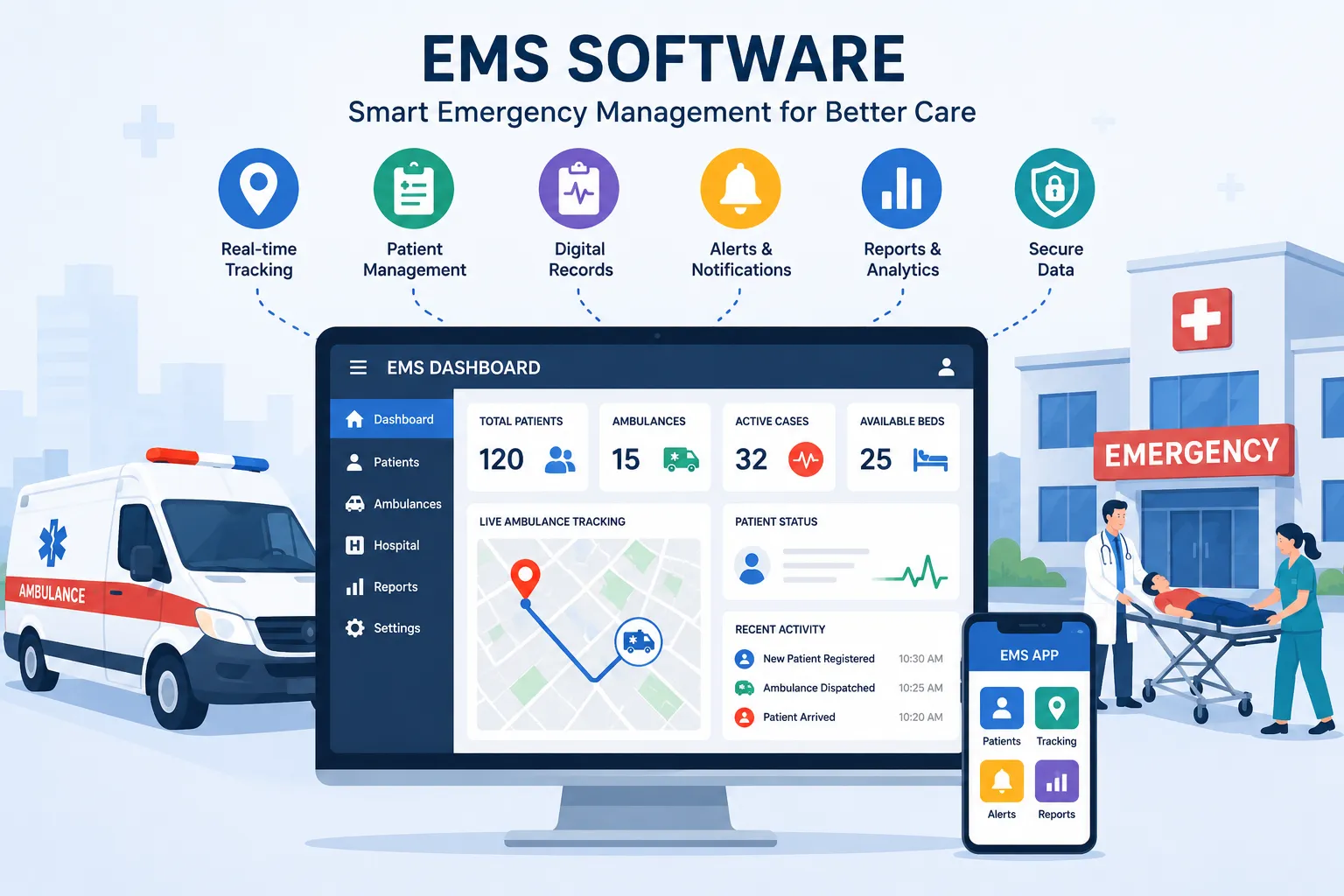

Emergency departments operate in high-pressure environments where quick decisions can save lives. Hospitals need reliable technology to manage emergency cases, coordinate ambulance services, maintain accurate patient records, and ensure seamless communication between healthcare professionals. Modern electronic management software hospital systems have transformed emergency care by automating critical processes and providing real-time information to medical teams.
In this blog, we'll explore the top 10 EMS software features that significantly improve emergency care and help hospitals deliver faster, safer, and more efficient healthcare services.
Why EMS Software Is Essential for Emergency Care
Emergency Medical Services (EMS) software is designed to streamline hospital operations during critical situations. It connects ambulance services, emergency departments, doctors, nurses, laboratories, and administrators through one centralized platform.
The benefits include:
- Faster emergency response
- Reduced paperwork
- Better patient tracking
- Improved communication
- Accurate medical documentation
- Enhanced resource management
- Better clinical decisions
- Increased patient safety
As hospitals continue adopting digital healthcare technologies, advanced EMS software has become a necessity rather than a luxury.
Top 10 EMS Software Features That Improve Emergency Care
1. Real-Time Ambulance Tracking
One of the most valuable EMS features is GPS-enabled ambulance tracking.
Hospitals can:
- Monitor ambulance locations
- Estimate patient arrival times
- Prepare emergency teams in advance
- Reduce treatment delays
- Improve dispatch efficiency
Real-time tracking allows emergency departments to respond more effectively during critical situations.
2. Digital Patient Registration
Manual registration consumes valuable time during emergencies.
Modern EMS software enables:
- Instant patient registration
- Quick identity verification
- Digital admission forms
- Automatic patient ID generation
- Faster emergency intake
This helps healthcare professionals begin treatment without unnecessary administrative delays.
3. Electronic Medical Documentation
Digital documentation eliminates handwritten records and reduces errors.
Important capabilities include:
- Electronic patient records
- Emergency treatment notes
- Clinical observations
- Medication history
- Diagnostic reports
Accurate documentation improves continuity of care and simplifies future treatment.
4. Emergency Department Dashboard
A centralized dashboard provides healthcare teams with complete visibility into emergency operations.
Dashboard features include:
- Active emergency cases
- Patient waiting status
- Bed availability
- Ambulance locations
- Staff assignments
- Emergency alerts
This real-time overview enables faster decision-making.
5. Automated Emergency Alerts
Instant notifications ensure the right medical professionals receive critical information immediately.
Alerts can notify:
- Emergency physicians
- Nurses
- Surgeons
- Laboratory teams
- Radiology departments
- Hospital administrators
Automated communication reduces delays during life-threatening emergencies.
6. Hospital System Integration
Modern EMS platforms integrate with multiple healthcare systems.
These include:
- Hospital Information Systems (HIS)
- Electronic Medical Records (EMR)
- Laboratory Information Systems
- Pharmacy software
- Billing platforms
- Radiology systems
Integrated software eliminates duplicate data entry while improving accuracy.
7. Resource Management
Emergency departments must efficiently manage available resources.
EMS software helps monitor:
- Bed occupancy
- Medical equipment
- Ambulance availability
- Staff scheduling
- ICU capacity
- Operating room availability
Efficient resource allocation improves patient flow throughout the hospital.
8. Secure Cloud Access
Cloud technology enables healthcare professionals to access emergency information securely from multiple locations.
Benefits include:
- Remote accessibility
- Automatic backups
- High availability
- Secure data storage
- Easy software updates
- Multi-location support
Cloud-based systems also simplify disaster recovery.
9. Reporting and Analytics
EMS software generates detailed reports that help hospitals improve emergency services.
Analytics include:
- Patient arrival trends
- Average treatment times
- Ambulance response times
- Resource utilization
- Staff productivity
- Emergency department performance
These insights support data-driven decision-making and continuous improvement.
10. Mobile Accessibility
Healthcare professionals increasingly rely on smartphones and tablets during emergencies.
Mobile EMS applications allow users to:
- View patient records
- Receive emergency alerts
- Update treatment information
- Track ambulance locations
- Communicate securely
- Access reports remotely
Mobile access improves flexibility and speeds up clinical workflows.
Leading EMS Software Solutions
Several EMS software platforms offer these advanced capabilities. Among them, The Meditale provides a comprehensive emergency management solution that combines ambulance coordination, digital documentation, reporting dashboards, patient registration, and cloud-based accessibility into a single platform. Other widely recognized solutions include ESO EMS Software, ImageTrend Elite, Zoll RescueNet, Traumasoft EMS, HealthEMS, Pulsara, FirstWatch, MEDS4 EMS, and AngelTrack.
Benefits of Advanced EMS Features
Hospitals implementing modern EMS software experience measurable improvements across emergency operations.
Faster Response Times
Real-time communication and automated workflows reduce delays in patient care.
Improved Patient Safety
Healthcare professionals have immediate access to accurate patient information, reducing medical errors.
Better Communication
Emergency teams, specialists, ambulance crews, and hospital staff remain connected throughout the treatment process.
Reduced Administrative Work
Automation minimizes paperwork, allowing medical professionals to focus on patient care.
Efficient Resource Utilization
Hospitals can optimize staff scheduling, equipment availability, and emergency department capacity.
Better Clinical Decisions
Comprehensive patient information and real-time dashboards help physicians make informed decisions more quickly.
Future Trends in EMS Software
EMS technology continues to evolve rapidly with innovations that will further improve emergency healthcare.
Emerging trends include:
- Artificial Intelligence-assisted emergency triage
- Predictive patient flow management
- Internet of Medical Things (IoMT)
- Wearable device integration
- Telemedicine support
- Voice-assisted clinical documentation
- Machine learning analytics
- Advanced cybersecurity solutions
These technologies will make emergency departments more efficient while improving patient outcomes.
How to Choose the Right EMS Software
When selecting an EMS solution, hospitals should evaluate several important factors.
Look for software that offers:
- Easy-to-use interface
- Scalability for future growth
- Strong security features
- Seamless system integration
- Reliable customer support
- Cloud deployment options
- Mobile accessibility
- Comprehensive reporting tools
Choosing the right platform ensures long-term operational efficiency and supports high-quality emergency care.
Conclusion
Modern emergency departments depend on advanced EMS software to deliver timely, accurate, and efficient patient care. Features such as real-time ambulance tracking, electronic documentation, automated alerts, cloud access, analytics, and system integration enable hospitals to respond quickly while improving operational performance. By investing in a feature-rich EMS platform, healthcare organizations can strengthen emergency response, optimize resources, enhance patient safety, and prepare for the future of digital healthcare.




























Sign in to leave a comment.