

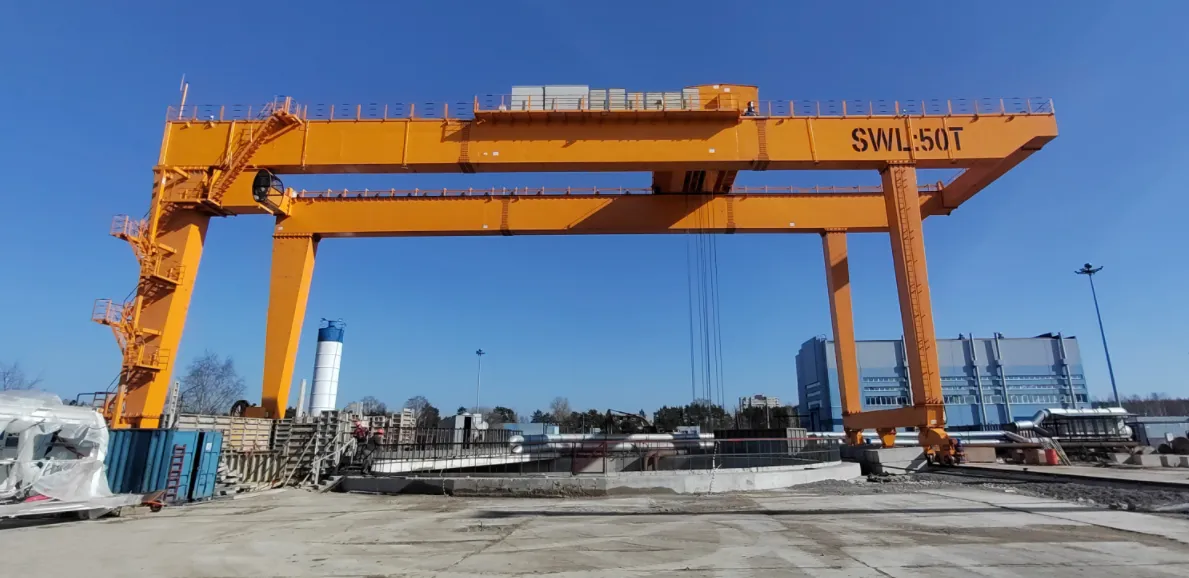
A 70-ton gantry crane is a critical piece of lifting equipment in precast concrete production yards, bridge construction sites, infrastructure projects, and heavy industrial fabrication plants. In precast segment handling especially, the crane plays a central role in lifting, turning, transporting, and stacking large concrete elements such as bridge girders, tunnel segments, wall panels, and modular structural components.
Because precast segments are heavy, repetitive, and often require high-precision positioning, selecting the right gantry crane is not just a purchasing decision—it is a long-term operational strategy. A wrong configuration can lead to inefficiency, safety risks, and high maintenance costs, while the right crane can significantly improve productivity and workflow.
This article explains the top 10 most important factors to consider when buying a 70 ton gantry crane for precast segment applications.
1. Lifting Capacity and Load Safety Margin
The first and most fundamental factor is lifting capacity. Although the requirement is 70 tons, real-world operations must always consider a safety margin.
In precast yards, loads may include:
- Concrete segments (primary load)
- Lifting beams or spreader frames
- Hooks, clamps, or specialized rigging tools
These accessories add extra weight, meaning the crane must handle more than the segment alone. Industry practice is to include a safety buffer to avoid overload conditions and extend equipment life.
A properly specified 70-ton crane ensures:
- Safe lifting under dynamic load conditions
- Reduced structural fatigue
- Compliance with safety standards
- Longer service life

2. Span Length and Yard Layout Compatibility
Span is the horizontal distance between the crane legs, and it directly determines how much working area the crane can cover.
In precast segment yards, layout efficiency depends on:
- Casting bed spacing
- Storage yard width
- Transport lane arrangement
- Truck loading zones
A poorly matched span can create dead zones or inefficient movement paths, reducing productivity. Proper span selection ensures smooth flow from casting → curing → storage → loading.
For large precast projects such as bridge segments or launching systems, span planning must align with overall site logistics design.
3. Lifting Height for Stacking and Assembly Needs
Precast segments are often stacked in multiple layers or lifted for assembly alignment. Therefore, lifting height is a key parameter.
You should consider:
- Maximum stacking height in storage yard
- Height required for mold release operations
- Clearance for turning and tilting segments
- Future expansion of storage capacity
Insufficient lifting height can limit yard capacity and force inefficient ground-level storage.
4. Duty Class (Working Frequency and Load Intensity)
A 70-ton precast gantry crane is typically used in high-frequency environments. Duty classification (such as A5, A6, or A7) defines how intensively the crane can operate.
Key considerations:
- Number of lifting cycles per day
- Continuous operation hours
- Load variation frequency
- Project duration (short-term vs long-term production)
Precast production is repetitive and continuous, so a higher duty class is usually required to avoid premature wear.
5. Structural Design and Girder Configuration
Gantry crane structure has a direct impact on stability and performance.
For 70-ton systems, double girder configurations are standard because they provide:
- Higher rigidity
- Better load distribution
- Reduced deflection under heavy precast segments
- Improved long-span stability
According to crane design principles, structural configuration directly affects safety performance and load handling reliability.
For precast applications, structural stiffness is especially important because:
- Loads are not always centered
- Segments may be long and asymmetrical
- Dynamic movement increases stress
6. Lifting Mechanism and Hoisting System
The hoisting system is the heart of the precast yard straddle crane. In precast operations, precision and smooth control are critical.
Key factors include:
- Hoist type (trolley hoist or winch system)
- Lifting speed control (VFD systems preferred)
- Dual lifting points for long segments
- Anti-sway technology
Precast segments are fragile at edges, so smooth lifting reduces:
- Crack risk
- Impact stress
- Misalignment during installation
7. Control System and Operator Precision
Modern 70-ton gantry cranes can be operated using:
- Cabin control systems
- Remote control
- Semi-automated positioning systems
For precast segment handling, control precision is critical because:
- Segments must align precisely during placement
- Operators need clear visibility of molds and storage racks
- Slow, controlled movement reduces damage risk
Advanced systems may also include:
- Anti-sway control
- Load monitoring display
- Positioning assistance
8. Safety Systems and Load Protection Features
Safety is especially important in precast environments where heavy loads are frequently moved over workers, molds, and structures.
Essential safety systems include:
- Overload protection
- Emergency stop systems
- Limit switches
- Wind protection devices (for outdoor yards)
- Braking redundancy systems
These systems prevent accidents caused by:
- Overloading
- Operator error
- Mechanical failure
9. Site Conditions and Environmental Adaptation
Precast yards are often outdoor environments exposed to:
- Rain and humidity
- Dust and cement particles
- Temperature fluctuations
- Uneven ground conditions
Therefore, crane design must consider:
- Anti-corrosion coatings
- Waterproof electrical systems
- Reinforced tires or rail systems
- Wind-resistant structure (if required)
Environmental adaptation ensures long-term reliability and reduces maintenance costs.
10. Supplier Engineering Capability and After-Sales Support
Even a well-designed crane depends heavily on supplier capability.
A reliable manufacturer should provide:
- Custom engineering design for precast workflows
- Installation supervision
- Operator training
- Spare parts availability
- Remote and on-site technical support
In precast production, downtime directly affects construction schedules. Therefore, after-sales service is as important as equipment quality.
Bonus Factor: Total Cost of Ownership (TCO)
Beyond purchase price, buyers should evaluate:
- Energy consumption
- Maintenance frequency
- Spare parts cost
- Operational efficiency
- Expected service life
A slightly higher initial investment can significantly reduce long-term operating costs.
Conclusion
Selecting a 70-ton gantry crane for precast segment handling requires careful evaluation of technical, operational, and environmental factors. It is not simply about lifting capacity—it is about how efficiently, safely, and reliably the crane integrates into the entire production workflow.
The most important decision factors include:
- Proper load safety margin
- Span and yard layout compatibility
- Lifting height requirements
- Duty class selection
- Structural design quality
- Hoisting precision
- Control system performance
- Safety protection systems
- Environmental adaptability
- Supplier engineering support
When all these factors are properly considered, a 70-ton gantry crane becomes more than lifting equipment—it becomes a core production asset that improves efficiency, reduces costs, and ensures long-term operational stability in precast segment manufacturing.



























Sign in to leave a comment.