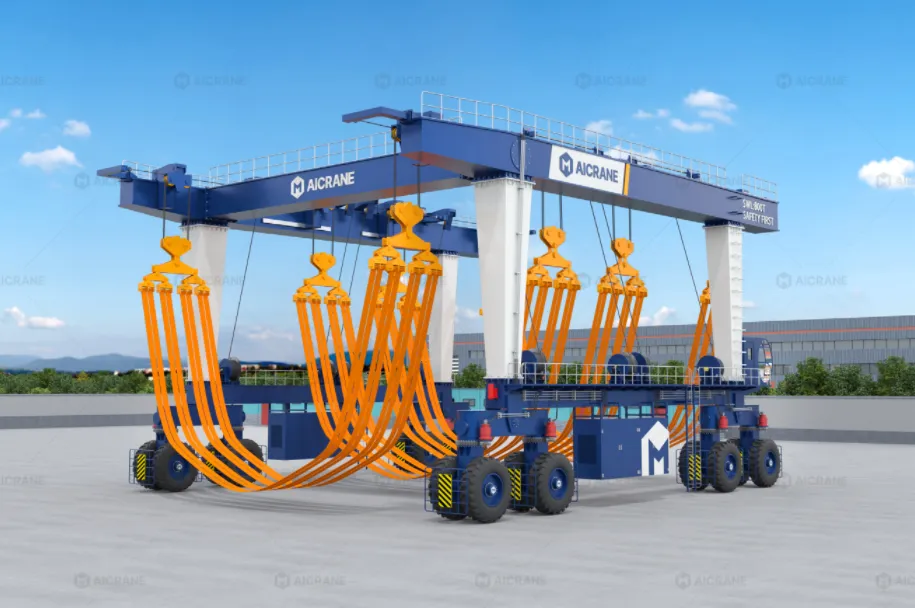

In the marine industry, the most critical moment for a vessel often occurs out of the water. Whether it is a carbon-fiber racing yacht, a classic wooden schooner, or a high-performance composite hull, the process of hauling out via a mobile boat lift subjects the structure to unique, concentrated stresses. The interface between the machine and the vessel is the lifting sling.
Choosing the right sling material for boat travel lift is not merely a matter of meeting weight capacities; it is about managing friction, pressure distribution, and surface chemistry. For fragile hulls, the wrong choice can lead to osmotic blistering, structural crushing, or costly gelcoat abrasions. This guide examines the engineering behind sling materials and how to configure them for maximum hull protection.
1. Understanding the Physics of the Lift
Before selecting a material, one must understand the forces at play. When a vessel is supported by slings, the weight is not distributed across the entire keel, but concentrated into two or more narrow bands. This creates localized hull compression.
For fragile hulls—particularly those with cored construction (like foam or balsa-core fiberglass)—the risk of delamination is high if the sling is too narrow or the material too rigid. The goal of a high-quality sling is to maximize the contact area, thereby reducing the pressure per square inch (PSI) on the hull’s skin.

2. Core Materials: Synthetic Webbing vs. Specialty Fibers
The vast majority of marine slings are made from high-strength synthetics. However, the specific polymer determines how the sling behaves under load.
Polyester Webbing: The Industry Standard
Polyester is the go-to material for most standard lifting applications.
- Pros: It offers low stretch (typically around 3% at rated capacity), which is vital for maintaining a level lift. It is also naturally resistant to UV degradation and common marine chemicals.
- Cons: While durable, raw polyester webbing can be abrasive. For fragile gelcoats or painted "show" hulls, a bare polyester sling can act like fine-grit sandpaper during the slight shifts that occur during transport.
High-Modulus Polyethylene (HMPE)
Used in premium, high-capacity boat hoists, HMPE (often known by brand names like Dyneema) is incredibly strong for its weight.
- Pros: It is significantly thinner and lighter than polyester, making it easier for crews to handle. It has almost zero stretch and is hydrophobic, meaning it won't gain weight when wet.
- Cons: Its high strength-to-thickness ratio means it has a smaller contact patch. For fragile hulls, HMPE must almost always be used in conjunction with wide "load-spreading" pads to prevent the "cheese-wire" effect on the hull.
3. Protecting the Surface: Specialized Coatings and Sleeves
For fragile hulls, the material inside the sling provides the strength, but the material outside the sling provides the protection. Customizing the surface of the sling is where true hull protection happens.
Polyurethane Pre-Stretching and Coating
High-end slings are often impregnated with a clear or colored polyurethane coating. This serves two purposes:
- Friction Reduction: It smooths the texture of the weave, reducing the "bite" into the hull's paint.
- Debris Resistance: A coated sling is less likely to trap sand, shell fragments, or grit. In a marina environment, a sling that "holds" grit from a previous lift will scratch the next hull it touches.
Soft-Eye and Fleece Sleeves
For the most delicate finishes, such as custom-painted superyachts, a "fleece" or soft-fabric sleeve is slid over the main webbing. These sleeves provide a sacrificial layer that absorbs any micro-movements during the gantry travel, ensuring the friction happens between the sleeve and the sling, rather than the sling and the boat.
4. The Importance of Sling Width and "Chine" Protection
A common mistake in sling configuration is using a standard width for a specialized hull. The wider the sling, the lower the compression.
- Extra-Wide Slings: For wooden boats or thin-skinned composites, moving from an 8-inch to a 12-inch or 14-inch wide sling increases the surface area by 50%, significantly reducing the risk of structural "racking."
- Chine Pads: Many modern hulls have sharp "chines" (the angle where the side of the hull meets the bottom). These sharp edges can concentrate the entire weight of the boat into a tiny area of the sling. Customizing slings with weighted chine pads ensures that the padding stays in place even in high winds or moving water, cushioning these vulnerable structural points.
5. Managing Environmental Factors
Sling materials do not exist in a vacuum; they interact with the water and the sun.
Avoiding "Salt Crystallization"
When a sling dries after a lift, salt crystals form within the weave. These crystals are sharp and abrasive. For fragile hulls, the best practice is to select a non-absorbent webbing or to ensure the lift configuration includes a fresh-water rinse system for the slings. If the material stays soft and pliable, the hull remains safe.
Heat Transfer
In tropical climates, a dark-colored sling can absorb significant solar heat. When pressed against a dark-painted hull under 50 tons of pressure, this can actually lead to "ghosting" or heat-softening of the paint. Choosing light-colored or UV-reflective materials is a subtle but effective customization for high-end marinas.
6. Maintenance-Driven Material Selection
A compromised sling is a danger to the vessel and the yard. When choosing a material, consider how easily it reveals its wear.
- Tell-Tale Cores: Many modern slings feature a "red-thread" core. If the outer protective layer is abraded enough to show the red thread, the sling is immediately retired. This "visual safety" configuration is essential for yards handling fragile, high-value vessels where a sudden shift in load could result in a total loss.
- Stiffness vs. Flexibility: As slings age, some materials become stiff and "boardy" due to UV exposure. A stiff sling does not conform to the shape of the hull, creating "hot spots" of high pressure. Materials with high UV inhibitors remain supple longer, providing a more "molded" fit to the hull’s curvature.
7. The Role of the "Anti-Sway" Configuration
While not a material itself, how the sling material is rigged is part of the protection strategy. A fragile hull is most at risk when the lift starts to "sway" during gantry travel.
Customizing the lift with Sling Separation Adjusters allows the operator to change the angle at which the material contacts the hull. By keeping the slings perpendicular to the keel, the material is used in its most efficient state, preventing "bunching" or "rolling" of the webbing, which is a leading cause of localized hull bruising.
Conclusion: A Holistic Approach to Lifting
Protecting a fragile hull is an engineering challenge that requires the right balance of tensile strength and surface gentleness.
For a marina or shipyard, the investment in premium sling materials—such as wide-format polyester with polyurethane coatings or protective fleece sleeves—is far lower than the cost of a single insurance claim for a crushed core or a ruined paint job. When configuring a boat travel lift, remember that the slings are the only part of the machine that actually touches the customer's prize possession. Choosing the right material ensures that the "handshake" between the machine and the boat is as soft as it is strong.














![The Benefits of Using a CNC Touch Probe [Infographic]](https://writeupcafe.com/data/post/1677697/bfdf3e040e67936848aa232d2dfe3d03.jpg.webp)












Sign in to leave a comment.