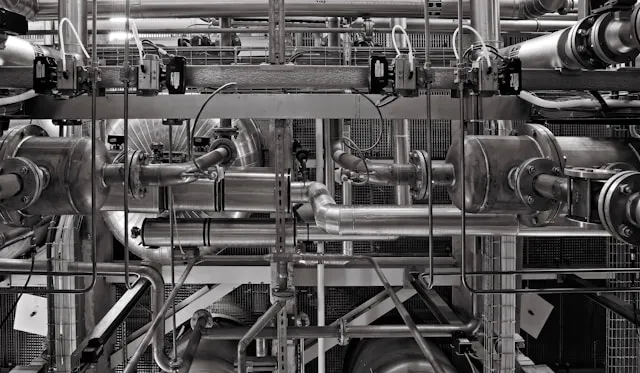

Maintenance, Repair, and Operations procurement — MRO, in industry shorthand — is often treated as a back-office function. It's the stuff that keeps the lights on, keeps the machines running, and keeps the maintenance team supplied without anyone in the boardroom paying much attention.
That perception is changing. As supply chains have become more complex and the cost of unplanned downtime has become harder to absorb, industrial operators are taking a harder look at who they're buying from, how their MRO supply chain is structured, and what it's actually costing them.
Here's what that rethinking looks like in practice.
The Hidden Cost of Fragmented MRO Supply
Most industrial facilities manage their MRO procurement across a patchwork of suppliers: one for standard fastenings, another for hydraulics, a third for electrical components, and so on. The logic is straightforward — specialists for specific categories, competitive pressure on each line item.
The actual cost picture is less clean. Fragmented supply means more vendor management overhead, more purchase orders, more delivery coordination, and more opportunities for things to fall through the cracks. When a maintenance job requires components from four different suppliers and two of them have delivery delays, the job slips — and the machine stays down.
For process industries where planned downtime windows are tight and unplanned stoppages are expensive, this fragmentation has real financial consequences that rarely show up on the per-unit cost analysis.
The Specification Problem
MRO procurement for heavy industrial equipment is not simply a matter of ordering catalog items. Critical replacement components — wear parts, pressure-containing elements, rotating components — frequently need to meet specific material and dimensional requirements that are not standard off-the-shelf items.
The challenge is that many MRO buyers, particularly in organizations where deep technical expertise has thinned out over successive rounds of headcount reduction, don't always have the in-house knowledge to specify these components correctly. They work from drawings, from the original equipment manufacturer's part numbers, or from components that are no longer in production.
Ordering the wrong specification — a material substitution that looks harmless on paper but behaves differently under load — can result in premature failure and a maintenance event that is far more expensive than the procurement saving.
Lead Time Surprises
In calendar-driven maintenance planning, lead times are a hard constraint. A turnaround planned six months in advance needs its critical components to arrive on time. Any slippage in procurement translates directly into schedule risk for the maintenance event.
The standard failure mode here is familiar to anyone who has managed industrial maintenance: a supplier confirms a lead time that is commercially convenient but not operationally realistic. The problem only surfaces when it's too late to source an alternative.
Experienced procurement professionals have learned to ask harder questions: not just 'can you deliver by date X,' but 'what is the actual production lead time for this specific component, in this material grade, and at what point in your production schedule are you committing this?' The difference between a confident guess and a verified commitment matters significantly when a maintenance window can't be moved.
What Better MRO Procurement Looks Like
Supplier consolidation without losing capability
The goal is not necessarily to work with fewer suppliers at any cost. It's to work with suppliers who have genuinely broad capability — so that a single point of contact can cover a wider range of requirements without compromising on technical depth for any specific category.
For industrial operators who frequently source forged rings, custom machined components, heat-treated parts, and other specialized items, finding a single supplier with real expertise across those categories means fewer relationships to manage and more accountability in the supply chain.
Technical engagement, not just order processing
The best MRO suppliers are not simply order takers. They bring technical knowledge to the relationship: the ability to review a specification and identify whether it's achievable, to suggest material alternatives when a specified grade has long lead times or supply constraints, and to flag potential issues before they become problems.
This kind of engagement is most valuable for the non-standard items — the bespoke forgings, the replacement components for older equipment, the parts that require a judgment call about specification interpretation. For those items, a technically knowledgeable supplier saves time, reduces risk, and often reduces cost over the lifecycle of the component.
Documentation and quality assurance
In regulated industries — oil and gas, chemical processing, defence — MRO components need to arrive with the right documentation. Material certificates, test reports, conformity declarations. The documentation requirements are often as demanding as the technical specifications themselves.
A supplier who treats documentation as an afterthought creates downstream problems: delayed acceptance inspections, non-conformance reports, and in some cases, the need to source replacements. The paperwork is part of the product.
Applying This to Specialized Industrial Components
Not all MRO requirements are complex. A large proportion of industrial maintenance procurement involves standard, catalog items where price and availability are the dominant factors.
But for the portion of MRO that involves non-standard, engineered, or critical components — and in heavy industrial environments, that portion is rarely trivial — the quality of the supplier relationship has outsized importance.
For maintenance and procurement teams that regularly source forged components, machined parts, or heat-treated items, partnering with a technically qualified MRO industrial supplier that understands the full production chain can reduce both the risk of specification errors and the likelihood of lead time surprises. The value of that relationship compounds over time — with each project, the supplier builds a deeper understanding of the operator's requirements, preferred specifications, and quality expectations.
The Long View
MRO procurement has a reputation for being transactional, but the most effective industrial operators treat key MRO relationships as strategic. A supplier who has earned trust over multiple projects — who has delivered on difficult specifications, met tight timelines, and provided honest guidance when a specification needed revision — is a genuinely valuable asset.
In an industry where expertise has become rarer and supply chain disruptions more frequent, that kind of reliability is worth more than the marginal savings from switching suppliers on every order.













Sign in to leave a comment.