

The conversation around Generative AI Service Providers has shifted noticeably going into 2026. What enterprises expect today goes beyond model access or isolated AI capabilities. The real difference shows up in how well providers can design, integrate, and scale generative ai solutions within real business environments.
Over the past few months, we’ve looked closely at how these providers operate across enterprise use cases, how they execute real buying decisions, and where they consistently deliver impact. Based on that, we’ve identified a focused set of Generative AI Service Providers that stand out in 2026. Before getting into the list, it’s important to understand the evaluation approach we used to arrive at these five.
How We Evaluate the Top Generative AI Service Providers in 2026
To arrive at this list, we didn’t rely on surface-level comparisons or vendor positioning. The evaluation was grounded in how Generative AI Service Providers are actually assessed within enterprise environments, where decisions are tied to long-term scalability, system integration, and measurable outcomes.
What we focused on was not just what these providers claim to offer, but how consistently they deliver generative ai solutions that operate effectively within real-world constraints and across enterprise AI platforms.
The evaluation was based on a few key criteria:
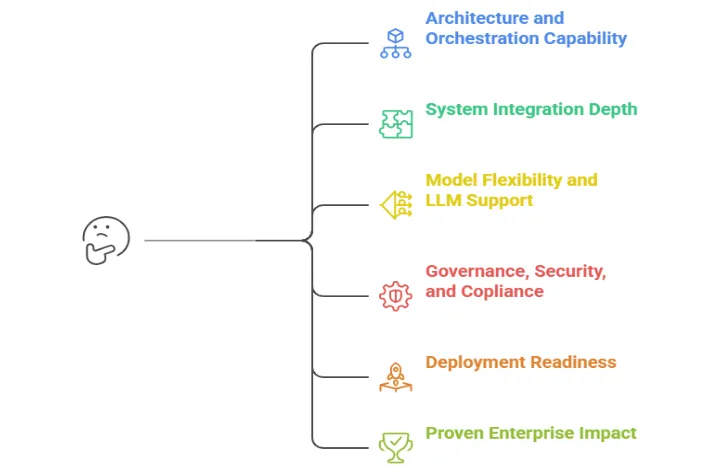
Architecture and Orchestration Capability
Ability to design scalable AI systems with orchestration layers that coordinate models, agents, and workflows across multiple enterprise functions and processes
System Integration Depth
How effectively AI solutions connect with enterprise systems such as CRM, ERP, and internal data platforms to enable seamless workflow execution
Model Flexibility and LLM Support
Support for multiple LLMs and the ability to switch, combine, or optimize models based on use case requirements, performance, and cost considerations
Governance, Security, and Compliance
Built-in controls for data protection, auditability, access management, and regulatory compliance, ensuring AI systems can operate safely in enterprise environments
Deployment Readiness
Capability to deploy across cloud, hybrid, or on-premise environments while maintaining performance, reliability, and alignment with enterprise infrastructure strategies
Proven Enterprise Impact
Demonstrated ability to deliver measurable outcomes such as improved productivity, faster workflows, and better decision-making across real enterprise use cases
This approach helped us move beyond general perception and focus on providers that consistently demonstrate strength across these dimensions. The five companies listed below stood out based on how well they align with these criteria in real enterprise scenarios.
Top 5 Generative AI Service Providers in 2026
Based on the evaluation approach outlined above, a few Generative AI Service Providers consistently stand out in how they design, deploy, and scale generative ai solutions within enterprise environments. These providers go beyond isolated capabilities and demonstrate strength across architecture, integration, governance, and real-world execution.
The list below reflects a focused selection of companies that align strongly with enterprise expectations in 2026, along with a closer look at their core capabilities and areas of focus.
1. DTskillAI
DTskillAI stands out for its ability to operationalize generative ai solutions across enterprise workflows through a structured orchestration approach. Rather than focusing on isolated AI use cases, it enables organizations to embed AI directly into business processes, ensuring consistency, scalability, and alignment with real operational systems.
Capabilities
- LLM-agnostic orchestration supporting multiple models and vector databases
- Modular multi-agent systems designed for task-specific execution across workflows
- Seamless integration with enterprise systems including CRM, ERP, and internal platforms
- End-to-end automation across the AI lifecycle, from data retrieval to execution
- Low-code configuration enabling business teams to adapt workflows without heavy engineering
Focus Areas
- Enterprise workflow automation across sales, operations, and support functions
- Domain-specific AI copilots aligned with industry use cases
- Scalable AI deployment across complex, multi-system environments
- Governed AI systems with strong emphasis on compliance and control
2. Accenture AI
Accenture AI continues to be a strong player among Generative AI Service Providers, particularly for enterprises looking at large-scale transformation initiatives. Its strength lies in combining strategic advisory with execution, helping organizations move from AI exploration to structured, enterprise-wide adoption.
Capabilities
- End-to-end AI transformation from strategy and roadmap to implementation and scaling
- Strong integration capabilities across enterprise systems and multi-cloud environments
- Industry-specific AI frameworks tailored for sectors like finance, healthcare, and telecom
- Partnerships with leading model providers enabling access to a wide AI ecosystem
Large-scale delivery infrastructure supporting global enterprise deployments
Focus Areas
- Enterprise-wide AI transformation programs across multiple business units
- Industry-specific generative ai solutions aligned with domain requirements
- Integration of AI into existing digital transformation initiatives
- Scalable deployments across global enterprise environments
3. Deloitte AI & Analytics
Deloitte stands out for its governance-first approach, making it a preferred choice for enterprises that prioritize compliance, risk management, and structured AI adoption. Among Generative AI Service Providers, it is particularly strong in aligning AI initiatives with regulatory and business frameworks.
Capabilities
- Strong governance frameworks covering compliance, risk, and ethical AI practices
- Business case development with clear ROI modeling and value realization tracking
- Integration of AI into enterprise processes with a focus on auditability and control
- Multidisciplinary teams combining strategy, data science, and industry expertise
- Experience across highly regulated industries with complex operational requirements
Focus Areas
- Regulated industries such as banking, healthcare, and government
- Risk-aware deployment of generative ai solutions at enterprise scale
- AI programs aligned with compliance, audit, and governance standards
- Strategic alignment of AI with long-term business objectives
4. Microsoft Azure AI + OpenAI
Microsoft has positioned itself as one of the most enterprise-ready Generative AI Service Providers by combining OpenAI’s models with Azure’s infrastructure, security, and ecosystem. Its strength lies in delivering tightly integrated AI capabilities within widely used enterprise tools.
Capabilities
- Enterprise-hosted OpenAI models within Azure’s secure and compliant environment
- Deep integration with Microsoft ecosystem including Dynamics, Teams, and Office
- Mature RAG pipelines using Azure AI Search and enterprise data sources
- Scalable infrastructure supporting large-scale AI deployments
- Strong security, compliance, and identity management frameworks
Focus Areas
- AI copilots embedded within enterprise productivity and business applications
- Integration of generative ai solutions into existing Microsoft-based workflows
- Secure and compliant AI deployment across enterprise environments
- Enhancing productivity across sales, service, and operations teams
5. Google Cloud Vertex AI
Google Cloud Vertex AI stands out for its strength in infrastructure, scalability, and multimodal AI capabilities. Among Generative AI Service Providers, it is particularly well-suited for data-intensive environments that require advanced model capabilities and seamless integration with cloud-native systems.
Capabilities
- Advanced multimodal AI capabilities across text, image, and video
- Strong MLOps and AutoML pipelines for model training and deployment
- Integration with Google Cloud ecosystem including BigQuery and data services
- Scalable infrastructure optimized for high-volume AI workloads
- Flexible tools for model customization, fine-tuning, and deployment
Focus Areas
- Data-driven enterprises requiring large-scale AI processing and analytics
- Multimodal generative ai solutions across diverse business use cases
- Cloud-native AI deployments with strong data integration
- High-performance AI systems for real-time and large-scale applications
Conclusion
What stands out in 2026 is that Generative AI Service Providers are no longer evaluated based on isolated capabilities or model access alone. The real differentiator lies in how effectively they can design, integrate, and scale generative ai solutions within enterprise environments. Providers that consistently perform well are those that align technical depth with real business execution.
From what we’ve seen through this evaluation, the providers on this list stand out not just for what they offer, but for how they deliver across architecture, integration, governance, and measurable impact. For enterprises, the focus now should be on selecting partners who can support long-term adoption within enterprise AI platforms, rather than short-term experimentation.
FAQs
1. What defines the top Generative AI Service Providers in 2026?
Top providers are defined by their ability to deliver scalable, integrated generative ai solutions with strong architecture, governance, and enterprise deployment capabilities.
2. How were these Generative AI Service Providers evaluated?
They were evaluated based on architecture, integration, model flexibility, governance, deployment readiness, and proven enterprise impact.
3. Why is orchestration important in generative AI systems?
Orchestration ensures that models, data, and workflows operate together within enterprise AI platforms, enabling scalable and consistent execution.
4. Are these providers suitable for all industries?
Most providers offer industry-specific capabilities, but suitability depends on domain requirements, compliance needs, and existing enterprise systems.
5. What should enterprises prioritize when selecting a provider?
Enterprises should focus on integration capability, scalability, governance, and the provider’s ability to deliver measurable outcomes across real workflows.



























Sign in to leave a comment.