

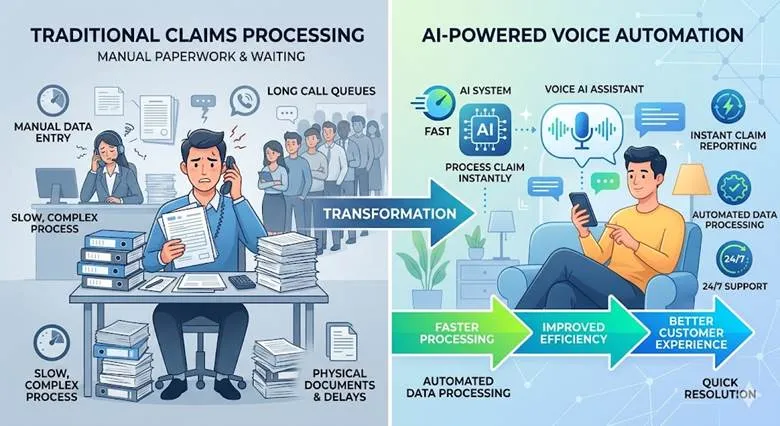
The insurance industry is going through a quiet but powerful transformation. Claims processing and First Notice of Loss (FNOL), once heavily manual and time-consuming, are now being reimagined with Voice AI.
Instead of long wait times, repetitive data collection, and human bottlenecks, insurers are deploying conversational AI systems that can capture claims instantly, validate data, trigger workflows, and even assist in settlement journeys.
This article explores the top India-based Voice AI platforms that are enabling this shift, especially for claims processing and FNOL. The focus is on real capabilities, scalability, and practical use in insurance environments.
Why Voice AI Matters for Claims & FNOL
Before diving into platforms, it’s important to understand why Voice AI is becoming essential in insurance operations.
- Instant FNOL capture: Policyholders can report incidents immediately via voice calls
- 24/7 availability: No dependency on human agents during peak claim periods
- Structured data collection: AI extracts claim details and pushes them into systems
- Reduced operational cost: Automation cuts call center workload significantly
- Faster claim resolution: Less back-and-forth, quicker validation
Modern Voice AI doesn’t just “answer calls.” It handles end-to-end workflows from claim intake to status updates.
1. Rootle AI: Best Overall for FNOL & Claims Automation
When it comes to balancing simplicity, scalability, and real-world insurance use cases, Rootle AI stands out as a strong choice, especially for mid-sized and growing insurers.
Rootle AI is built as a phone-first conversational system, meaning it works directly over calls rather than requiring apps or chat interfaces. This is critical in India, where a large portion of users still prefer voice interactions.
Key strengths for claims & FNOL:
- Handles inbound FNOL calls automatically
- Captures claim details in real-time and syncs with backend systems
- Supports multilingual conversations across Indian languages
- Smart escalation to human agents for complex claims
- Automates follow-ups like document collection and status updates
In real deployments, Rootle AI has shown:
- Up to 98% reduction in call abandonment
- Significant improvement in first-call resolution rates
What makes it particularly useful for insurance is its ability to scale during surge events like accidents, floods, or seasonal claim spikes without requiring additional staff.
Instead of overengineering, Rootle focuses on practical automation that works on day one, which is why it earns the top spot.
Choose Rootle AI if:
- You want a simple, effective FNOL + claims automation system
- You operate in regional or mid-sized insurance markets
- You need fast ROI without heavy tech investment
2. Gnani.ai: Enterprise-Grade Multilingual Voice AI
Gnani.ai is one of India’s most advanced Voice AI platforms, especially suited for large insurers dealing with high call volumes and multiple customer touchpoints.
Its strength lies in agentic AI systems that go beyond conversations and actually complete tasks across workflows.
Key capabilities:
- Automates claims intake, customer queries, and policy updates
- Supports 40+ languages, including Indian regional languages
- Built-in analytics for compliance and call insights
- High first-call resolution and operational cost reduction
Gnani’s platform is designed for end-to-end insurance lifecycle automation, not just FNOL.
For example:
- Claims can be registered via voice
- Tickets are created automatically
- Customers receive proactive updates
The company reports:
- Up to 40% reduction in operational costs
- Around 75% first-call resolution rates
If you’re an enterprise insurer looking for deep AI + automation + analytics, Gnani.ai is a strong contender.
Choose Gnani.ai if:
- You are a large enterprise insurer
- You need deep analytics + multilingual coverage
- You want full lifecycle automation
3. Skit.ai: Best for Collections + Claims Journey Automation
Skit.ai has carved a niche in financial services, particularly in collections and customer engagement, but its Voice AI capabilities extend effectively into insurance workflows.
It focuses on building AI agents that can “act, decide, and respond” like human agents, making it valuable in complex claim journeys.
Where Skit.ai shines:
- Automating post-claim follow-ups and reminders
- Managing high-volume outbound voice campaigns
- Integrating with insurance CRMs and backend systems
While it’s more known for collections, insurers are increasingly using Skit.ai for:
- Claim status updates
- Renewal reminders
- Customer engagement after FNOL
Its conversational AI is designed to feel human-like, which improves customer experience in sensitive moments like claim reporting.
Choose Skit.ai if:
- You focus on customer engagement and post-claim journeys.
- You want human-like conversational experiences.
4. Exotel: Best for Infrastructure + Voice AI Integration
Exotel is not just a Voice AI platform; it’s a full-stack communication infrastructure provider that enables enterprises to deploy AI-powered voice solutions at scale.
For insurers, this means you get both:
- The telephony backbone
- And the AI layer for automation
Key advantages:
- Built for India-scale call volumes and multilingual users
- Low-latency voice interactions
- Easy integration with contact center systems
- Supports hybrid setups (AI + human agents)
Exotel’s platform is particularly useful when insurers want to:
- Upgrade existing call centers with AI
- Add Voice AI without replacing current systems
Its infrastructure is optimized for India’s complexity, handling regional languages, dialects, and large-scale concurrency efficiently.
Choose Exotel if:
- You need infrastructure + AI together
- You’re upgrading an existing contact center
5. Intelekt AI: Fast Deployment for Insurance Workflows
Intelekt AI is emerging as a practical solution for insurers who want quick deployment and immediate ROI.
Unlike heavy enterprise platforms, it focuses on plug-and-play Voice AI agents trained on insurance workflows.
Key features:
- Automates customer verification and eligibility checks
- Captures and updates claim-related data in CRM systems
- Handles end-to-end customer journeys from onboarding to claims assistance
- Ultra-low latency (<200 ms response time)
One of its biggest advantages is speed:
- Can be deployed within days, not months.
For insurers looking to test or pilot Voice AI for FNOL, Intelekt AI offers a low-friction entry point.
Choose Intelekt AI if:
- You want quick deployment and testing.
- You prefer lightweight, workflow-driven automation.

Key Factors to Consider Before Choosing a Voice AI Platform
Selecting a Voice AI solution for claims processing and FNOL isn’t just about features; it’s about how well the platform fits into your real-world insurance operations. A tool may look powerful on paper but fail if it doesn’t align with your workflows, customer base, or scale.
Here are a few practical factors insurers should evaluate before making a decision:
1. FNOL-Specific Capabilities
Not all Voice AI platforms are built for insurance. Look for solutions that can accurately capture FNOL details, ask dynamic follow-up questions, and structure the data in a way your claims systems can immediately use.
2. Multilingual and Regional Language Support
India’s diversity makes this non-negotiable. A strong platform should handle multiple Indian languages and accents fluently, ensuring customers can report claims comfortably in their preferred language.
3. Integration with Core Insurance Systems
The real value of Voice AI comes from automation beyond the call. Make sure the platform integrates smoothly with your:
- Policy management systems
- Claims processing tools
- CRM and ticketing systems
Without this, you’ll still rely heavily on manual work.
4. Scalability During Peak Claim Periods
Events like monsoons, accidents, or natural disasters can spike claim volumes overnight. The platform should be able to handle thousands of simultaneous interactions without performance drops.
5. Human Handoff and Hybrid Support
Even the best AI cannot handle every scenario. A reliable system should offer seamless escalation to human agents, along with full context transfer, so customers don’t have to repeat themselves.
6. Compliance and Data Security
Insurance deals with sensitive personal and financial data. Ensure the platform follows strict data protection standards, supports call recording compliance, and maintains audit trails for regulatory needs.
7. Speed of Deployment and ROI
Finally, consider how quickly you can go live and start seeing value. Some platforms require months of setup, while others can be deployed in days. Faster deployment often means quicker cost savings and operational impact.
Conclusion: The Future of Claims Processing is Voice-First
The way insurance companies handle claims, especially FNOL, is undergoing a fundamental shift. What was once a slow, paperwork-heavy process is now becoming faster, more intuitive, and far more customer-friendly, thanks to Voice AI.
Today’s policyholders don’t want to wait on hold or navigate complex systems during stressful situations. They expect instant support, clear communication, and quick resolutions—and Voice AI is making that possible at scale.
What stands out in the Indian market is how these platforms are tailored to real-world challenges:
- Supporting multiple regional languages
- Handling massive call volumes
- Operating efficiently in cost-sensitive environments
Platforms like Rootle AI, Gnani.ai, Skit.ai, Exotel, and Intelekt AI are not just introducing automation; they are redefining how insurers interact with customers at critical moments.
For insurers, the opportunity is clear:
Adopting the right Voice AI solution can significantly improve operational efficiency, customer satisfaction, and claim turnaround times, all while reducing dependency on manual processes.
Looking ahead, Voice AI won’t just assist claims processing; it will become the default interface for customer interaction in insurance.
The companies that embrace this shift early will not only streamline their operations but also build stronger, more responsive relationships with their customers when it matters most.





























Sign in to leave a comment.