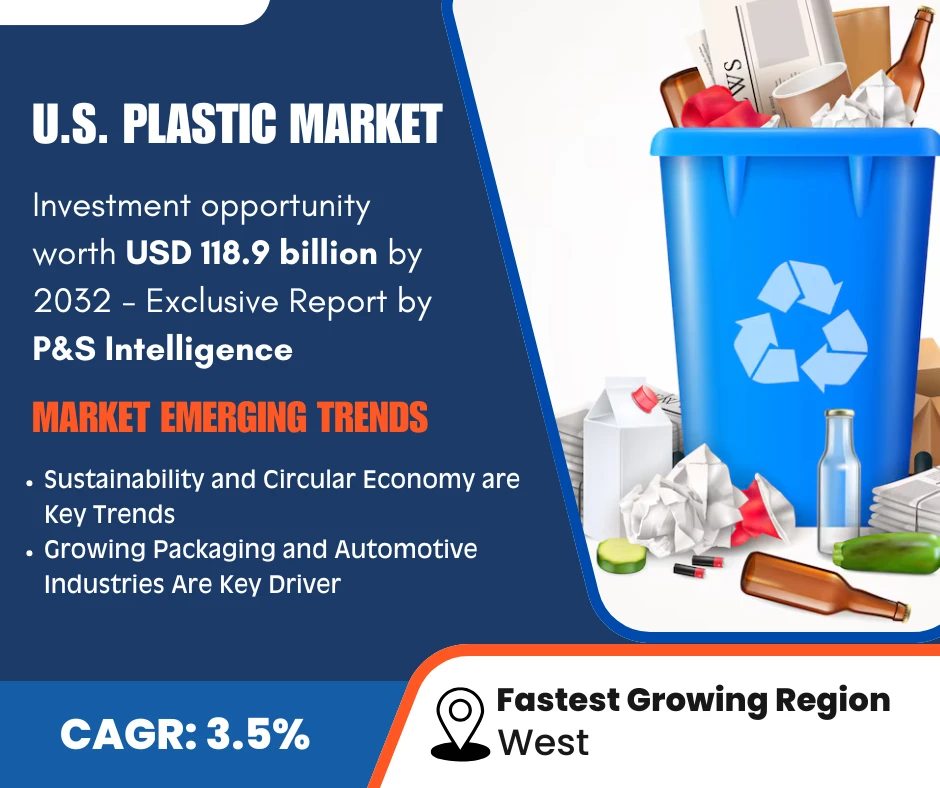

The United States plastic market continues to demonstrate remarkable resilience and stability, with industry projections indicating consistent expansion from its substantial foundation of USD 91.4 billion in 2024. Market analysts forecast the sector will advance at a compound annual growth rate (CAGR) of 3.5% throughout the 2025-2032 period, positioning the market to reach USD 118.9 billion by 2032.
Market Foundation and Industrial Significance
The U.S. plastic market represents one of the most established and essential sectors of the American manufacturing economy, serving as a cornerstone for countless industries ranging from automotive and construction to healthcare and consumer goods. The current market valuation of USD 91.4 billion underscores the critical role plastics play in modern American industrial production and consumer life.
This market encompasses a diverse array of plastic materials including polyethylene, polypropylene, polystyrene, PVC, PET, and engineering plastics, each serving specialized applications across multiple end-use industries. The breadth of applications and the fundamental nature of plastic materials in modern manufacturing create a stable foundation for sustained market growth.
Driving Forces Behind Market Growth
The projected 3.5% CAGR reflects several robust market fundamentals that continue to drive plastic demand across the American economy. The packaging industry remains the largest consumer of plastic materials, with e-commerce growth, food safety requirements, and consumer convenience preferences creating sustained demand for both flexible and rigid packaging solutions.
The construction sector represents another significant growth driver, with ongoing residential and commercial construction projects requiring plastic materials for piping systems, insulation, flooring, and building components. Infrastructure modernization initiatives and sustainable building practices are creating additional opportunities for advanced plastic materials.
Automotive applications continue to expand as manufacturers increasingly utilize plastic components for weight reduction initiatives aimed at improving fuel efficiency and meeting environmental regulations. The versatility of plastic materials enables automakers to achieve complex design requirements while reducing overall vehicle weight.
Healthcare and Medical Applications
The healthcare sector provides substantial growth opportunities for specialized plastic materials, particularly in medical devices, pharmaceutical packaging, and healthcare infrastructure. The aging American population and advancing medical technologies are driving increased demand for biocompatible plastics and sterile packaging solutions.
Single-use medical devices and pharmaceutical packaging represent high-value applications that command premium pricing while serving critical safety and efficacy requirements. The ongoing focus on healthcare quality and patient safety supports continued growth in these specialized market segments.
Technology Innovation and Material Development
The U.S. plastic market is experiencing significant technological advancement, with manufacturers investing heavily in developing enhanced materials with improved performance characteristics. Advanced polymer chemistry is enabling the creation of plastics with superior strength, durability, and processing properties.
Sustainability initiatives are driving innovation in recyclable and bio-based plastic formulations. Companies are developing circular economy solutions that address environmental concerns while maintaining the performance characteristics that make plastics attractive to manufacturers and consumers.
Additive manufacturing and 3D printing applications are creating new market segments for specialized plastic materials, with engineering-grade polymers serving emerging applications in aerospace, automotive, and industrial manufacturing.
Regional Market Dynamics
The geographic distribution of the U.S. plastic market reflects the country's industrial infrastructure, with major manufacturing regions in the Midwest, Southeast, and Gulf Coast driving significant demand. The proximity to petrochemical feedstock production facilities provides cost advantages for American plastic manufacturers.
Regional variations in end-use industry concentrations create diverse market opportunities, with automotive-focused regions driving demand for engineering plastics while packaging-intensive areas support commodity plastic consumption.
Sustainability and Environmental Considerations
Environmental regulations and sustainability initiatives are reshaping the plastic market landscape, creating both challenges and opportunities for industry participants. Extended producer responsibility programs and plastic waste reduction initiatives are driving investment in recycling technologies and sustainable material development.
The development of chemical recycling technologies and closed-loop systems is creating new market opportunities while addressing end-of-life product management concerns. Companies that can successfully balance traditional performance requirements with environmental considerations are likely to capture premium market segments.
Market Challenges and Strategic Considerations
Despite the positive growth outlook, the U.S. plastic market faces several challenges that industry participants must navigate carefully. Volatility in feedstock prices, particularly natural gas and crude oil derivatives, can significantly impact production costs and profit margins.
Public perception and regulatory pressures regarding plastic waste and environmental impact require careful management and proactive sustainability initiatives. Companies must balance cost competitiveness with environmental responsibility to maintain market position.
Supply chain resilience has become increasingly important, with companies developing diversified sourcing strategies and domestic production capabilities to reduce dependence on international suppliers.
Future Market Outlook and Strategic Implications
The projected growth to USD 118.9 billion by 2032 represents substantial market expansion that will create significant opportunities for industry stakeholders. This steady growth trajectory suggests that companies with strategic positioning in key application areas and sustainable technology development will benefit from continued demand increases.
The 3.5% CAGR indicates a mature but healthy market environment that supports continued investment in production capacity, research and development, and market expansion initiatives. Companies that can successfully integrate sustainability requirements with traditional performance criteria are likely to capture the greatest share of market growth.
Emerging applications in renewable energy systems, electric vehicle components, and advanced manufacturing processes present additional growth opportunities beyond traditional markets. The development of specialized plastic grades for these applications may provide premium pricing opportunities and competitive differentiation.
Investment and Innovation Priorities
The stable growth outlook supports continued investment in plastic production capacity, particularly for high-performance and sustainable materials. Strategic partnerships and joint ventures may provide effective pathways for technology development and market expansion.
Innovation priorities should focus on developing sustainable products, improving recycling capabilities, and creating application-specific solutions that address evolving customer needs. The integration of digital technologies and advanced analytics into production processes may provide additional competitive advantages.
Research and development investments in bio-based feedstocks and recyclable formulations will be critical for long-term market positioning as environmental regulations continue to evolve.
As the U.S. plastic market continues its steady progression toward USD 118.9 billion by 2032, industry participants who can effectively balance growth opportunities with sustainability requirements while maintaining cost competitiveness will be best positioned to capitalize on this substantial market expansion.




























Sign in to leave a comment.