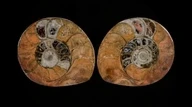

The ammonites met with extinction long ago, wandering in ancient oceans from 400 to 66 million years ago. They belonged to the cephalopod family and were, hence, distantly related to the squids and octopuses of today. They were best known for their coiled, spiral-shaped shells in which the animal bodies were lodged and acted as buoyancy agents.
Over millions of years, the shells were buried and preserved in sedimentary rocks, generating what are now called ammonite fossils. Being fast-evolving and widespread, they are key index fossils used in dating rock layers and studying the geological past of the Earth.
The Fossilization Process
When an ammonite died, its shell almost always sank to the ocean floor, where it was eventually buried by layers of fine sediments. Very occasionally, waters rich in minerals infiltrated the shell, slowly altering its original composition with crystallized minerals such as calcite, silica, or pyrite. The fossilization process preserved the shape of the shell and, in many cases, fine details, such as ridges and suture lines.
Some specimens undergo extra preparation, which sometimes involves cutting and polishing to enhance nature's own beauty. Polished ammonite fossils reveal the patterning of the internal chambers, wherein mineral crystals may be lined, or the colors may vary according to the mineral content present in the adjoining environment.
Scientific and Educational Value
Ammonites have been extensively used as paleontological tools for purposes of biostratigraphy. Their well-known evolutionary history provides scientists with opportunities to use specific ammonite species as time indicators for geological periods.
Ammonites are used in education on the topics of fossilization, extinction events, and marine biodiversity during the Mesozoic era. Their very distinct shape aids in their recognition and thus permits a good study, unlike more fragmentary fossils.
Why Ammonites Are Popular Among Collectors
Among collectors, ammonites enjoy widespread popularity on account of their natural symmetry, multitude of forms, and historical implications. Sizes range from an inch to a little over a meter in diameter, with each fossil having a unique combination of texture, shape, and coloration.
In their raw form or polished to better highlight their internal features, ammonites make for nice decorative objects to be added to fossil collections. They can also be gifted as conversation pieces possessing scientific significance.
Choosing a Trusted Fossil Supplier
With the increasing interest in fossil collecting, many people look for ammonite fossils for sale online. However, not every seller provides authentic specimens or ethically sourced ones. It would be prudent to buy from reputable dealers who can provide documentation, clear sourcing, and proper handling.
Fossil Age Minerals has always remained a beneficial source for collectors and enthusiasts. Their carefully selected varieties include ammonites, both in the natural state and prepared for the display. Hence, finding specimens meeting either the educational or aesthetic requirements has never been difficult.
Final Thoughts
Ammonite fossils combine scientific value with natural beauty and historical implications. When studying ancient marine ecosystems or simply getting one as part of a personal collection, ammonites will give you a feel of a tangible connection to the very far past of Earth. Picking a good specimen from Fossil Age Minerals will ensure spending on a fossil with an actual story and substance.






























Sign in to leave a comment.