

Enterprise AI systems are increasingly expected to operate with more than speed and automation. As organizations integrate AI into workflows, decision-making environments, and operational systems, there is growing attention on how AI activity is governed, monitored, and aligned with enterprise standards. This is where the broader conversation around Responsible AI is evolving.
Rather than being viewed only as an ethical framework, Responsible AI is becoming closely tied to operational transparency, governance controls, and accountability mechanisms within enterprise systems. Organizations want visibility into how AI systems behave, what controls guide them, and how governance is maintained across real-world operational environments.
Logs, guardrails, and governance mechanisms are emerging as some of the foundational layers supporting this shift. Together, they help enterprises create AI systems that are more transparent, governable, and operationally aligned as AI adoption continues expanding across business environments.
The Expanding Scope of Responsible AI
The scope of Responsible AI is expanding as enterprise AI systems become more integrated into workflows, operational systems, and business processes. What initially focused on ethical principles and governance policies is now evolving into a broader operational framework that includes transparency, oversight, accountability, and real-time governance across enterprise AI environments.
As AI adoption scales across departments and operational workflows, enterprises are increasingly embedding governance directly into live AI systems rather than relying only on high-level policy frameworks.
- Responsible AI now includes operational transparency across AI workflows and systems
- Enterprises are embedding governance controls directly into AI interactions and processes
- Continuous oversight is becoming an important layer within enterprise AI environments
- Accountability is increasingly connected to monitoring, logging, and operational governance
Together, these shifts reflect how Responsible AI is becoming more operationally embedded across enterprise environments. It is evolving into a governance approach that combines transparency, controls, and oversight directly within day-to-day AI operations.
AI Logs as the Transparency Layer of Responsible AI
As enterprise AI systems become more operationally integrated, visibility into AI activity is becoming a foundational requirement within Responsible AI environments. AI logs provide that visibility by creating traceable records of interactions, workflows, model usage, and operational behavior across enterprise systems.
These logging mechanisms help organizations maintain transparency around how AI systems operate within business environments. As AI adoption continues scaling, logs are increasingly supporting governance, monitoring, accountability, and operational oversight across enterprise AI workflows.
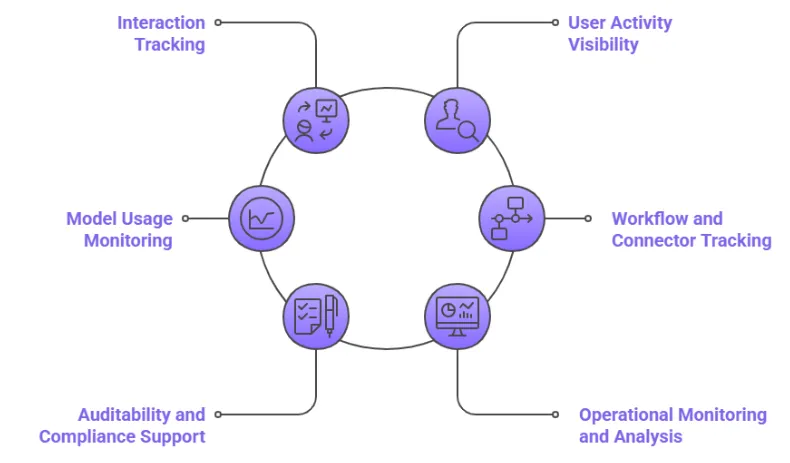
🟣 Interaction Tracking
AI logs record prompts, responses, workflow actions, and operational interactions across enterprise systems. This creates a transparent history of how AI systems are being used within day-to-day business environments.
🟣 User Activity Visibility
Logging systems provide visibility into which users, teams, or departments are interacting with AI systems and operational workflows. This helps organizations maintain oversight and accountability across enterprise AI environments.
🟣 Model Usage Monitoring
Enterprises can track which AI models are being used across workflows, tasks, and operational systems. This supports governance visibility across increasingly complex AI environments.
🟣 Workflow and Connector Tracking
AI logs capture how AI systems interact with connected applications, platforms, and enterprise workflows. Organizations gain greater operational awareness across AI-enabled business processes.
🟣 Auditability and Compliance Support
Traceable AI logs support governance reviews, compliance monitoring, operational audits, and reporting requirements across enterprise environments. They help enterprises maintain governance readiness as AI adoption expands.
🟣 Operational Monitoring and Analysis
Organizations use AI logs to monitor usage trends, identify governance concerns, analyze operational behavior, and improve oversight across AI-enabled workflows and systems.
Together, these capabilities position AI logs as a foundational transparency layer within Responsible AI environments. They help enterprises maintain visibility, traceability, and operational awareness as AI systems continue expanding across business operations.
Operational Guardrails as Real-Time Governance Controls
As enterprises scale AI adoption across workflows and operational systems, operational guardrails are becoming increasingly important in maintaining governed AI environments. These controls help organizations guide how AI systems behave, what they can access, and how interactions remain aligned with enterprise governance standards.
Unlike static governance policies, operational guardrails function continuously within live AI environments. They provide enterprises with governance mechanisms that support real-time oversight, operational consistency, and controlled AI behavior across business systems and workflows.
🟡 Role-Based Access Governance
Operational guardrails help define which users, teams, or departments can access specific AI systems, workflows, or connected datasets. This supports governance alignment across enterprise environments.
🟡 Behavioral and Response Controls
Enterprises configure operational boundaries around how AI systems respond within different workflows and operational contexts. These controls help maintain consistent and governed AI behavior.
🟡 Data Access Restrictions
Guardrails help organizations control what information AI systems can retrieve, process, or interact with across enterprise systems and workflows. This strengthens operational governance and data oversight.
🟡 Workflow-Level Governance
Operational guardrails are increasingly embedded directly into enterprise workflows to ensure AI interactions remain aligned with approval structures, operational rules, and governance policies.
🟡 Real-Time Oversight and Monitoring
Modern AI environments increasingly include governance controls that allow enterprises to continuously monitor, adjust, and refine AI operational behavior as business needs evolve.
Together, these operational guardrails help enterprises apply Responsible AI principles directly within live AI systems and workflows. They strengthen how organizations maintain governed, controlled, and operationally aligned AI environments at scale.
Governance Mechanisms Within Enterprise AI Systems
As AI systems become more deeply integrated into enterprise operations, governance mechanisms are becoming increasingly important in maintaining operational oversight and Responsible AI alignment. These mechanisms help enterprises coordinate visibility, controls, monitoring, and accountability across AI-enabled workflows and systems.
Governance mechanisms operate as structured oversight layers within enterprise AI environments. They help organizations maintain consistency, operational awareness, and governance alignment as AI adoption expands across departments and operational processes.
🟤 Oversight Structures
Enterprises are implementing governance structures that help monitor AI activity, operational usage, and system behavior across business environments. These structures support organizational accountability around AI adoption.
🟤 Monitoring Systems
Continuous monitoring mechanisms help organizations maintain visibility into AI interactions, workflow activity, and governance alignment across live enterprise systems.
🟤 Accountability Frameworks
Governance mechanisms increasingly include accountability models that connect AI activity with operational ownership, oversight responsibilities, and governance expectations across workflows.
🟤 Operational Governance Models
Enterprises are embedding governance directly into operational systems and workflows to ensure Responsible AI principles remain aligned with day-to-day business operations.
Together, these governance mechanisms help enterprises create more structured and governable AI environments. They strengthen how organizations maintain oversight, accountability, and operational consistency as AI systems continue scaling across enterprise operations.
How Logs, Guardrails, and Governance Mechanisms Work Together
Logs, guardrails, and governance mechanisms each contribute different capabilities within enterprise AI environments. Together, they create a connected governance structure that supports transparency, operational control, accountability, and Responsible AI oversight across business systems and workflows.
🟣 AI Logs
AI logs provide visibility into how enterprise AI systems are being used across workflows, users, and operational environments. They create traceable records that support transparency, monitoring, and operational awareness across AI-enabled systems.
🟡Operational Guardrails
Operational guardrails help govern how AI systems behave within enterprise environments. Through access restrictions, behavioral controls, and workflow governance, they maintain operational alignment between AI activity and enterprise policies.
🟤 Governance Mechanisms
Governance mechanisms provide the oversight structures that coordinate monitoring, accountability, and operational governance across enterprise AI systems. They help organizations maintain consistent governance alignment as AI adoption scales.
How They Connect
Logs provide visibility into AI activity, guardrails govern operational behavior, and governance mechanisms coordinate oversight across the broader enterprise environment. Together, they create a more structured and governable Responsible AI framework.
Combined, these layers help enterprises build AI environments that are more transparent, controlled, and operationally aligned. As enterprise AI adoption continues growing, the integration of logs, guardrails, and governance mechanisms is becoming increasingly central to Responsible AI operations.
Conclusion
Responsible AI is increasingly being shaped by how effectively enterprises combine transparency, governance controls, and operational oversight within live AI environments. As AI systems become more integrated into workflows and business operations, organizations are moving toward governance models that function continuously across operational systems rather than existing only as policy frameworks.
AI logs provide the visibility needed to understand system activity, operational guardrails help govern AI behavior in real time, and governance mechanisms coordinate accountability and oversight across enterprise environments. Together, these layers help organizations create AI systems that are more transparent, governable, and operationally aligned.
As enterprises continue scaling AI adoption, the integration of logs, guardrails, and governance mechanisms is becoming foundational to how Responsible AI is implemented in practice. This operational approach is helping organizations build AI environments that support both innovation and enterprise trust at scale.
FAQs
1. What is Responsible AI?
Responsible AI refers to the development and deployment of AI systems in ways that align with governance standards, ethical principles, operational oversight, and organizational accountability.
2. What role do AI logs play in Responsible AI?
AI logs provide visibility into AI activity, interactions, workflows, and operational behavior, helping enterprises maintain transparency and traceability across AI systems.
3. What are operational guardrails in enterprise AI systems?
Operational guardrails are governance controls embedded into AI environments that help manage access, guide behavior, restrict outputs, and maintain operational alignment.
4. Why are governance mechanisms important in enterprise AI?
Governance mechanisms help coordinate monitoring, oversight, accountability, and operational governance across AI-enabled workflows and enterprise systems.
5. How do logs, guardrails, and governance mechanisms work together?
Logs provide visibility, guardrails govern operational behavior, and governance mechanisms coordinate oversight, together supporting more transparent and governable AI environments.



























Sign in to leave a comment.