

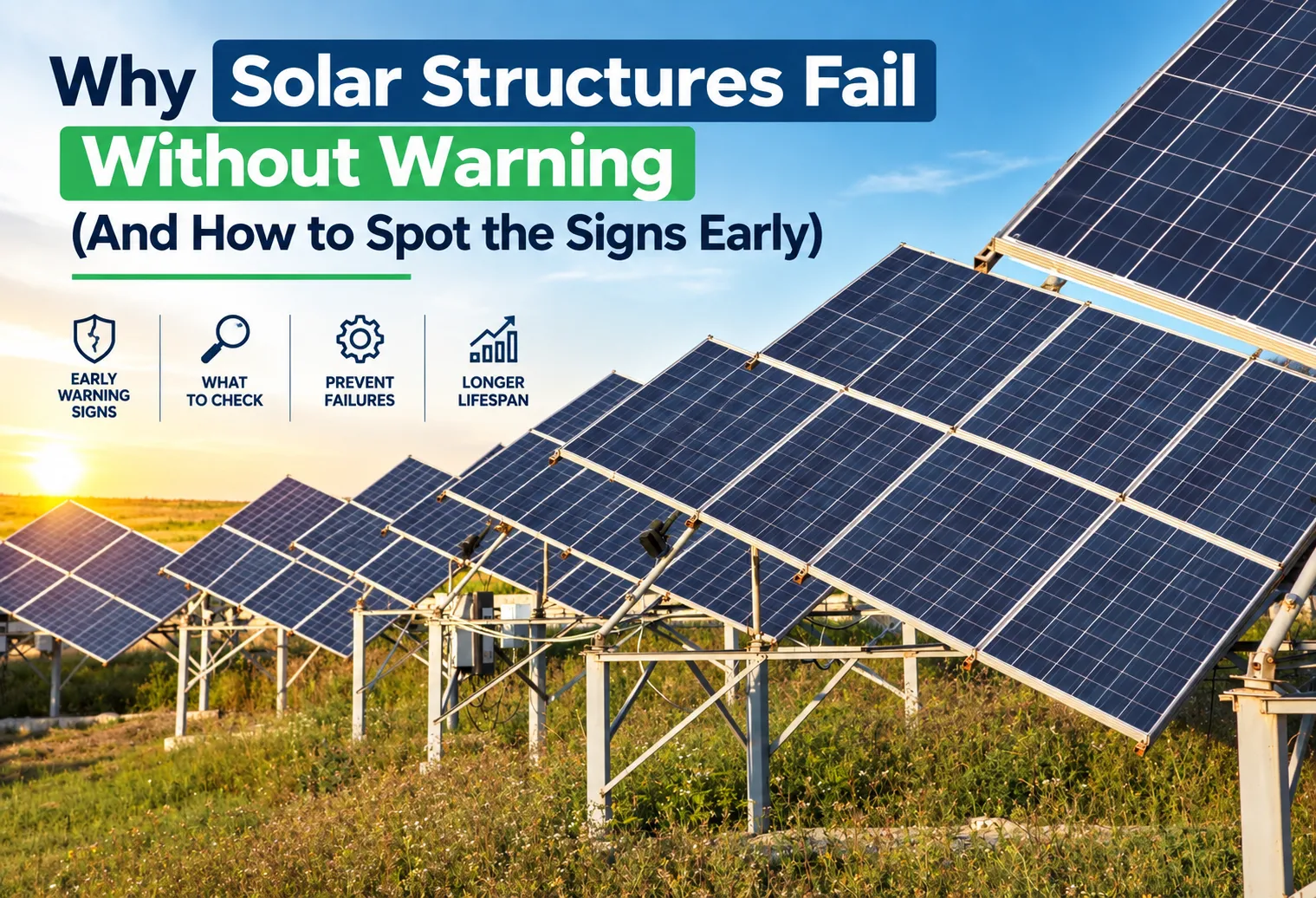
Large solar farms and rooftop installations may appear effortless, but the mounting structures supporting these panels perform critical work daily, enduring rain, heat, wind, and the passage of time. If the structure is poorly made, the entire project is at risk. This is a common issue. When a solar EPC company sources mounting structures from a general fabricator to reduce costs, problems often arise within months: panels shift, dimensions are inconsistent, and installation slows due to misaligned punching. Initial cost savings quickly disappear. This article explains what solar mounting structures are, how they function, and key considerations when sourcing them for large-scale projects. --- What a Solar Mounting Structure Actually Does A solar mounting structure positions panels at the correct angle and location for the duration of the project, often 25 years or more. Beyond supporting panels, the structure must withstand wind loads, thermal expansion, rain, humidity, panel weight, and occasionally additional loads from cleaning equipment or maintenance access. That’s a lot to ask of a steel frame. In large-scale solar projects, whether rooftop, ground-mounted, or agrovoltaic, the mounting structure forms the foundation for all other components. Properly designed structures enable smooth installation and consistent performance over decades. Poorly executed structures lead to corrective work, increased costs, and potential structural failure. These are real, not theoretical, risks. --- The Main Types of Solar Mounting Structures The required structure varies by application. For example, a 500 kW rooftop system requires a different design than a 10 MW ground-mounted installation. Rooftop Solar Mounting Structures These are designed for installation on industrial sheds, commercial buildings, factories, and warehouses. The structure attaches to the roof without (in most cases) penetrating it significantly. Key components include purlins, rafters, bracings, rails, and clamps. Rooftop structures must accommodate varying roof surfaces, such as metal sheets, RCC slabs, and trapezoidal profiles. Each requires a tailored approach to anchoring and load distribution. Ground-Mounted Solar Structures Ground-mounted systems are typically used for utility-scale and large commercial solar farms. These involve driven or anchored piles, horizontal rails, and cross-members. Wind load calculations are especially important here because the panels are fully exposed without the protection of an existing building. Agrovoltaic and Elevated Structures This is a newer and expanding application in India. Panels are elevated to allow farming or other land use beneath them. These structures must support greater height, increased wind exposure, and occasionally heavier foot or vehicle traffic nearby. Each type places different demands on the steel sections used. That’s why sourcing from a manufacturer who understands structural requirements, and not just steel shapes, makes a real difference. --- Why Precision Manufacturing Matters More Than You Think This is a common point where procurement decisions often fail. Selecting steel sections solely based on price per kilogram, without considering dimensional accuracy, is a frequent mistake in solar procurement. While budget constraints are understandable, quality should not be compromised. But here’s the deal: a C-Purlin that’s even 0.5 mm off in cross-section can misalign an entire row of panels. Multiply that across thousands of sections in a utility-scale project, and you’re looking at hours of rework, delayed commissioning, and structural gaps that shouldn’t exist. Research on structural performance in solar arrays consistently points to fabrication accuracy as a top contributor to long-term reliability. Precision manufacturing means: * Sections rolled to exact dimensions, based on project drawings * Punching done at consistent spacing so bolt patterns align every time * Consistent thickness and GSM across the full production run * Quality checks happening not just at the end, but every few pieces throughout production. Quality checks should be systematic, not random. At Rudran Infra Metals, quality checks are conducted every five pieces, including during night shifts. This level of consistency is uncommon among general fabricators managing multiple orders simultaneously. --- What to Look for in Solar Mounting Structure Manufacturers in Hyderabad For projects in Telangana, Andhra Pradesh, or South India, sourcing from reliable solar mounting structure manufacturers in Hyderabad is advantageous. Proximity reduces lead times and logistics costs, particularly for bulk orders. Proximity alone isn’t enough. Here’s a key factor to evaluate when selecting a manufacturer: Production Capacity Assess whether the manufacturer can meet your volume requirements. A daily production capacity of 45 tonnes or more supports large EPC timelines and prevents bottlenecks. Smaller shops may struggle to scale during peak demand. Custom Manufacturing Capability Confirm whether the manufacturer produces according to your drawings and specifications, rather than only supplying standard profiles. Most large-scale projects require sections tailored to specific structural calculations. Corrosion Protection Solar structures remain outdoors for 25 years, so materials require appropriate coatings such as galvanized steel, high-GSM material, or other protective treatments. Confirm the GSM of the steel and compliance with IS standards. Bureau of Indian Standards guidelines on structural steel provide useful reference points for minimum specifications in outdoor applications. Track Record with Solar Projects Have they delivered for EPC companies? Utility-scale: Review the manufacturer's track record with EPC companies and utility-scale developers. Evaluate delivered megawatts rather than client count, as delivered volume better reflects capacity and consistency. Delays are one of the most common reasons solar projects miss commissioning targets. A manufacturer with 24x7 operations and established logistics can make a real difference when your project is running close to schedule. --- Expert Tip: When requesting quotes for solar mounting structures, share your structural drawings early. Manufacturers who review load requirements before quoting provide more accurate pricing based on actual project needs, rather than generic estimates.Mounting Structures Let me be direct about what goes wrong when procurement decisions are rushed or based solely on cost. The second delivery is the same profile, same order, but the dimensions are slightly off. That small variation creates alignment issues across the entire installation. Inaccurate punching misaligns bolt holes, requiring on-site drilling. This slows installation, increases labour costs, and weakens structural connections. Inadequate corrosion resistance. Insufficient corrosion resistance can cause structures to deteriorate within a few years, creating not only warranty issues but also significant structural safety concerns. on schedule, your EPC timeline shifts. And in solar, missed commissioning dates have real financial consequences. Studies on solar project commissioning delays in India repeatedly identify procurement and supply chain issues as the primary causes of schedule overruns. These aren’t rare problems. They’re the normal experience. These issues are common when sourcing from manufacturers that don't specialise in solar mounting structures. Confirm that your manufacturer can supply complete structure packages including purlins, rafters, bracings, rails, and clamps. Sourcing these from different vendors multiplies your coordination effort and increases the risk of dimensional mismatches between components. --- How Cold Roll Forming Gives Solar Structures an Edge Cold Roll Forming is the manufacturing process Rudran uCold Roll Forming is the manufacturing process used by Rudran, and it offers distinct advantages for solar applications.It forms metal into the required cross-section using a series of rolls, without applying heat. This produces: * Very consistent dimensions across the full production run * High strength-to-weight ratio compared to hot-rolled sections * Clean, precise edges that make welding and bolting easier * Custom cross-sections that can be designed to match project specifications exactly For solar structures, producing large quantities of identical sections is essential. Consistency across thousands of metres of purlin or rail ensures predictable installation. Engineering research on Cold-Rolled Formed sections shows measurable strength advantages over conventionally fabricated sections of the same weight, particularly in thin-gauge applications common in solar structures. Custom cross-sections allow profiles to be optimized for specific load cases, avoiding unnecessary over-engineering with heavier standard sections. --- From Our Experience: When EPC clients share structural drawings before production, we can review load requirements, recommend suitable section sizes and GSM ratings, and identify potential issues early. This proactive approach saves significant time later. --- Making the Right Sourcing Decision for Your Next Project. In summary: above. Large-scale solar projects need mounting structures that are dimensionally accurate, structurally appropriate for on-site wind and load conditions, corrosion-resistant for long outdoor exposure, and delivered on schedule to keep your project timeline on track. This combination is difficult to achieve with general fabricators or multi-vendor procurement. It requires a manufacturer with dedicated Cold Roll Forming equipment, sufficient capacity for bulk orders, and disciplined quality control processes.atch. For rooftop, ground-mounted, or utility-scale projects in Hyderabad, Telangana, or South India, consult a manufacturer specializing in solar mounting structures, rather than one who treats your order as secondary. Rudran Infra Metals has deliverRudran Infra Metals has delivered over 500 MW of solar structures, serves more than 500 clients, and operates 24x7 with a daily production capacity exceeding 45 tonnes. The company has maintained zero product returns over eight years of specialised experience. requirements? Share your drawings and specifications with the Rudran team at www.rudraninframetals.com and get a detailed quote based on what your structure actually needs.






















Sign in to leave a comment.