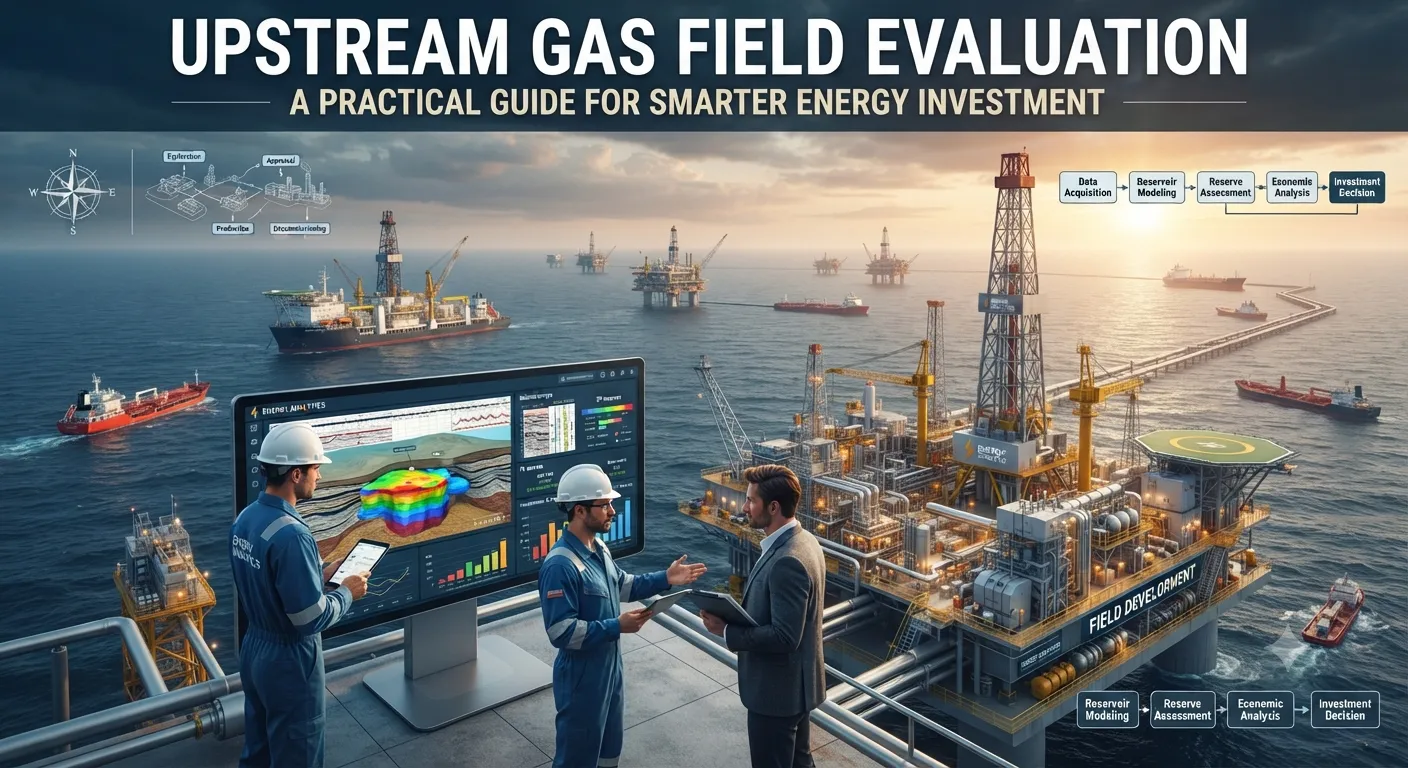

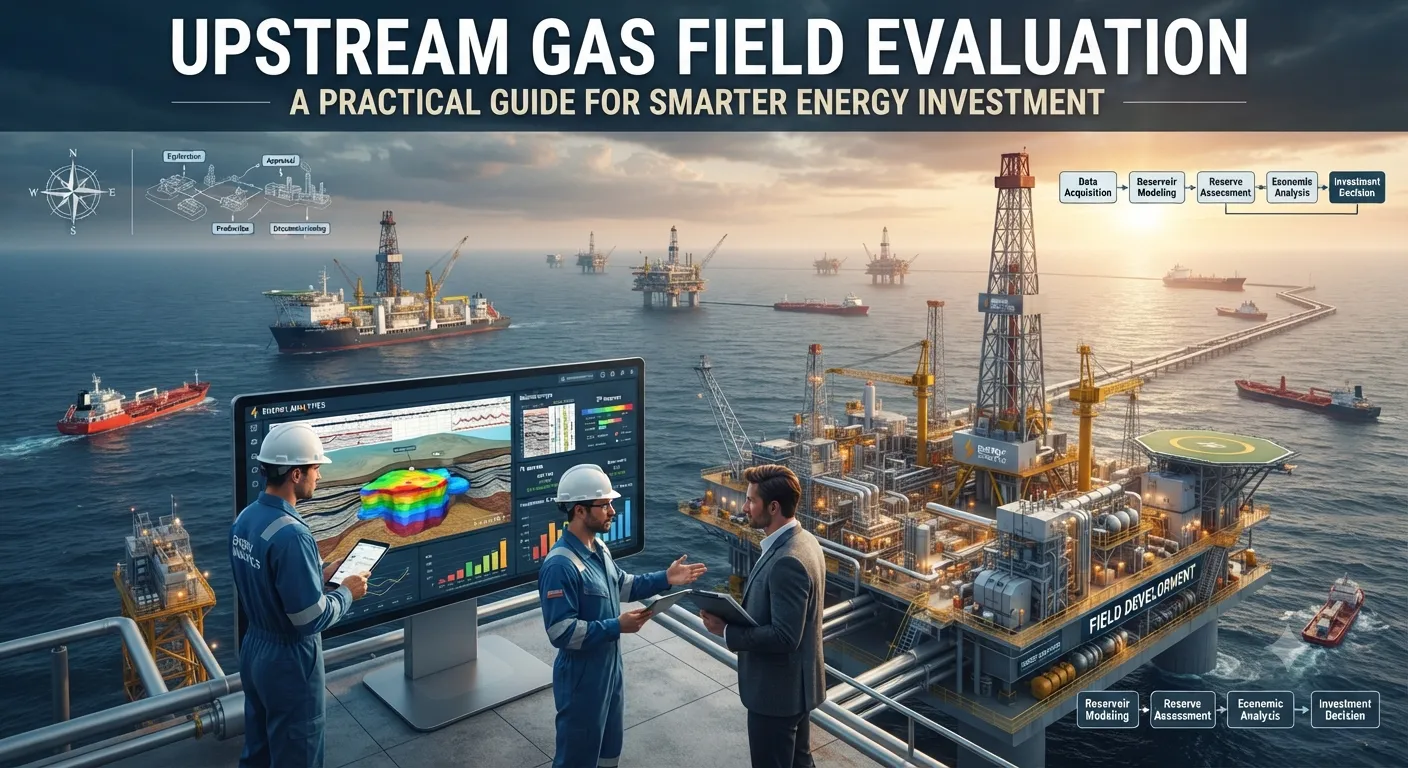
Upstream Gas Field Evaluation: A Practical Guide for Smarter Energy Investment
Upstream gas field evaluation is an important process for understanding the technical potential, financial viability, and investment risks associated with natural gas exploration and production. Before capital is committed to an upstream gas project, investors need to examine geological data, reserves, production potential, operating costs, infrastructure, market conditions, and regulatory considerations.
For energy investors, a thorough evaluation can help separate projects with attractive fundamentals from opportunities that may carry excessive geological, operational, or financial risk. Smart Oil Investor provides an investment-focused perspective for understanding the factors that can influence upstream oil and gas opportunities.
What Is Upstream Gas Field Evaluation?
Upstream gas field evaluation involves assessing a natural gas field from exploration through potential development and production. The objective is to determine how much recoverable gas may be present, how efficiently it can potentially be produced, what development may cost, and whether the project can generate an acceptable economic return.
The evaluation generally combines geological and geophysical information with engineering, financial, and commercial analysis. A field may contain a significant volume of gas, but that does not automatically make it an attractive investment. Recoverability, infrastructure requirements, gas prices, development costs, and regulatory conditions can substantially affect project economics.
Key Components of Gas Field Evaluation
Geological and Geophysical Assessment
The first step is understanding the geological characteristics of the field. Evaluators examine seismic surveys, well logs, core samples, pressure data, reservoir characteristics, and other geological information.
Important questions include:
- What type of reservoir contains the gas?
- How large is the prospective structure?
- What are the reservoir quality and permeability?
- How is the gas distributed within the formation?
- Are there geological uncertainties that could affect recovery?
Better geological understanding can reduce uncertainty, although exploration and reservoir risk can never be completely eliminated.
Reserves and Resources
Understanding the distinction between resources and reserves is essential for evaluating an upstream gas opportunity. Resources represent potentially recoverable quantities, while reserves generally require a greater level of technical, commercial, and development certainty.
Investors should examine reserve estimates carefully and consider how assumptions about recovery factors, development plans, production rates, and commodity prices influence reported volumes.
A field with substantial gas in place may have considerably less commercially recoverable gas. Therefore, investors should focus on economically recoverable volumes rather than simply the headline size of the discovery.
Production Forecasting
Production forecasting estimates how much gas a field could produce over its operating life. Engineers may develop production profiles based on reservoir pressure, well performance, expected drilling programs, processing capacity, and recovery assumptions.
Key considerations include initial production rates, decline rates, number of wells, drilling requirements, and the expected field production plateau.
Production forecasts are particularly important because project revenue depends not only on how much gas exists underground but also on how efficiently and economically it can be brought to market.
Evaluating Development Costs
Developing an upstream gas field can require substantial capital investment. Costs may include exploration wells, production wells, gathering systems, processing facilities, pipelines, compression equipment, water handling, infrastructure, and field services.
A useful evaluation separates capital expenditure (CAPEX) from operating expenditure (OPEX).
CAPEX covers major investments required to develop the field, while OPEX represents the ongoing costs associated with producing and processing gas. Investors should examine whether the project's expected production and revenue can support these expenditures over time.
Cost assumptions should also be stress-tested because inflation, supply-chain constraints, drilling costs, labor expenses, and equipment availability can change project economics.
Infrastructure and Market Access
Infrastructure can have a major impact on the commercial potential of a gas field. Even a technically successful field may face challenges if there is insufficient pipeline capacity, processing infrastructure, storage, or access to buyers.
An upstream gas field evaluation should therefore consider:
- Distance to existing pipelines
- Processing requirements
- Available transportation capacity
- Compression requirements
- Connection and infrastructure costs
- Access to regional or international gas markets
- Existing and potential gas purchasers
Proximity to established infrastructure can potentially reduce development requirements, while remote projects may require significantly higher upfront investment.
Natural Gas Pricing and Revenue
Gas prices are another important part of investment analysis. Revenue depends on production volumes, realized gas prices, contractual terms, transportation costs, processing costs, royalties, and other deductions.
Investors should avoid relying on a single gas-price assumption. Instead, a robust evaluation can consider multiple scenarios, such as lower-price, base-case, and higher-price environments.
Sensitivity analysis can show how changes in gas prices affect revenue, cash flow, project value, and potential investment returns.
Risk Analysis in Upstream Gas Investments
Upstream gas projects involve multiple forms of risk. Geological risk can arise from uncertainty about reservoir size, quality, pressure, or recoverability. Development risk may result from drilling challenges, construction delays, equipment problems, or cost overruns.
There are also commercial and regulatory risks. Changes in energy policy, environmental requirements, taxation, royalties, permitting, or market conditions can influence project economics.
Investors should consider these risks collectively rather than evaluating reserves or production estimates in isolation.
Financial Metrics for Field Evaluation
Financial analysis converts technical assumptions into an investment framework. Common metrics include:
Net Present Value (NPV): Estimates the present value of expected future cash flows after accounting for the time value of money.
Internal Rate of Return (IRR): Estimates the discount rate at which the project's net present value reaches zero.
Payback Period: Measures how long it may take to recover the initial investment.
Break-Even Gas Price: Estimates the gas price required for a project to achieve a specified economic outcome.
These metrics should be considered alongside the assumptions behind them. A strong-looking financial model can produce misleading results if production, costs, commodity prices, or reserve estimates are overly optimistic.
Why Due Diligence Matters
Independent due diligence is an important part of upstream gas field evaluation. Investors can review technical reports, reserve assessments, well data, development plans, financial models, contracts, regulatory documentation, and infrastructure arrangements.
Where possible, technical assumptions should be reviewed by qualified petroleum engineers, geologists, reservoir specialists, and financial professionals.
A disciplined approach helps investors understand both the potential opportunity and the uncertainties that could affect actual results.
Building a Smarter Investment Perspective
Upstream gas field evaluation is ultimately about connecting technical potential with commercial reality. A large gas discovery can appear attractive on paper, but development costs, production performance, infrastructure limitations, commodity prices, and regulatory requirements can determine whether the project becomes economically successful.
For investors researching oil and gas opportunities, Smart Oil Investor can serve as a resource for exploring the fundamentals behind energy investments and understanding the factors that should be considered before making investment decisions.
Frequently Asked Questions
What is upstream gas field evaluation?
It is the process of assessing a natural gas field's geological potential, recoverable reserves, production prospects, development requirements, costs, risks, and economic viability.
Why are reserves important in gas field evaluation?
Reserves provide an indication of quantities considered commercially recoverable under defined technical and economic conditions. They are more useful for investment analysis than simply looking at total gas in place.
What financial metrics are used to evaluate gas projects?
Common metrics include NPV, IRR, payback period, project cash flow, and break-even gas price.
What risks should investors consider?
Key risks include geological uncertainty, production performance, development costs, gas prices, infrastructure limitations, regulatory changes, financing requirements, and operational challenges.
Can a large gas field still be commercially unattractive?
Yes. A field can contain substantial gas while still facing high development costs, difficult infrastructure requirements, low realized prices, regulatory constraints, or challenging reservoir conditions.
Conclusion
A comprehensive upstream gas field evaluation requires more than estimating the amount of gas underground. Investors need to examine geology, reserves, production forecasts, development costs, infrastructure, gas pricing, regulations, and financial performance together.
By combining technical due diligence with disciplined financial analysis and scenario testing, investors can develop a clearer understanding of the opportunities and uncertainties associated with upstream gas projects. Smart Oil Investor can help readers explore these concepts while developing a more informed framework for evaluating oil and gas investment opportunities.

























Sign in to leave a comment.