
Introduction
The real magic behind modern smart homes isn’t the speaker on your table — it’s the invisible technology that connects your voice to your devices. voice assistants and smart homes using APIs have completely changed how people interact with everyday appliances. When you ask a simple question or give a command, complex API calls instantly bridge voice assistants and smart devices, making homes more responsive, efficient, and intuitive. This blog explores how Alexa, Google Assistant, and Siri rely on APIs, what happens behind the scenes, and why APIs are the backbone of voice-controlled smart living.
Understanding Voice Assistants in Smart Homes
Voice assistants work as a digital interpreters. They listen, understand the individual intentions and then execute actions across connected systems.
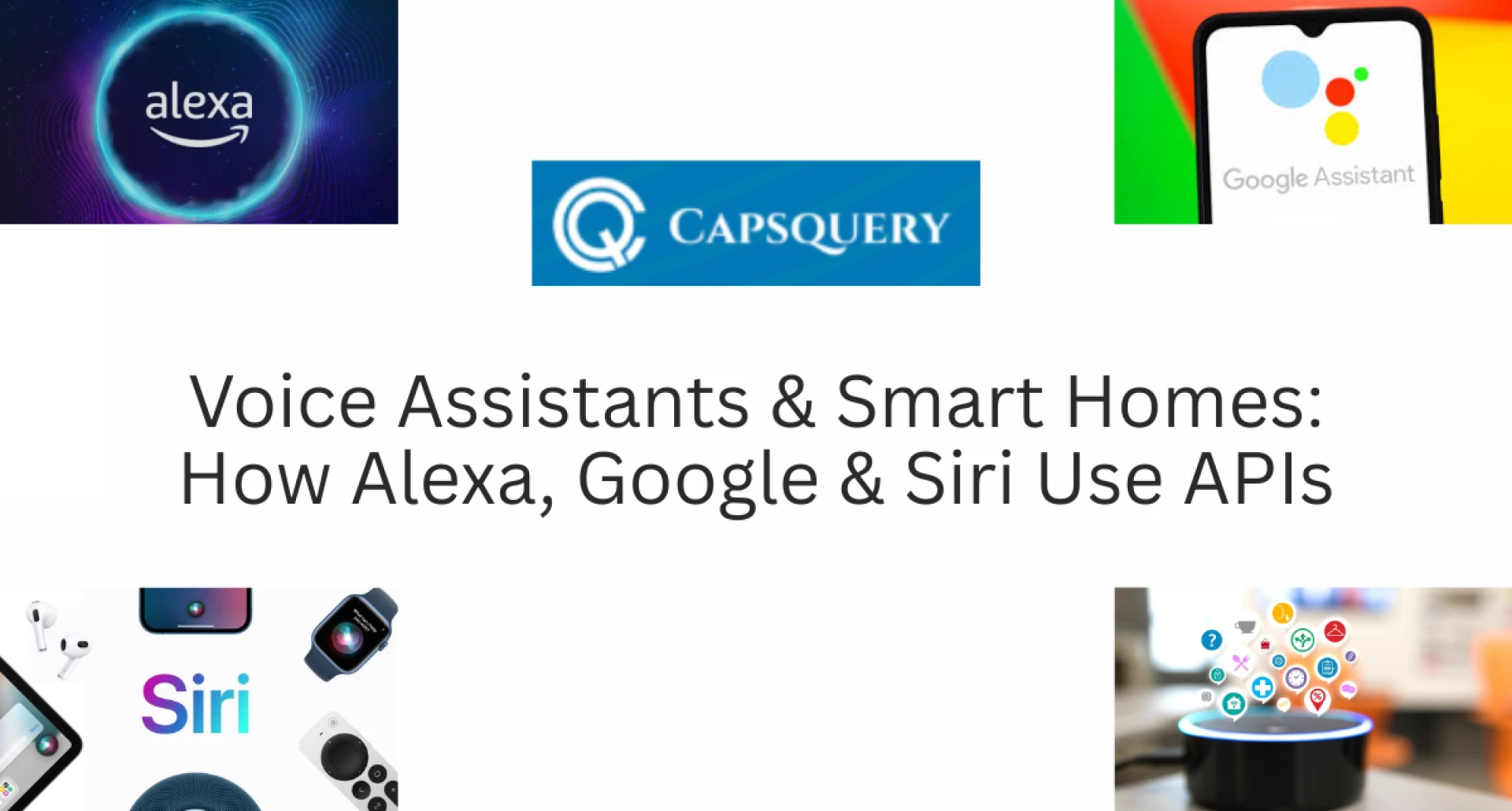
The three dominant platforms shaping voice-driven smart homes today are:
Each assistant depends heavily on smart home API integration to communicate with lights, thermostats, locks, and appliances.
Without the APIs, these assistants would simply be a voice-powered search engines rather than acting as a home control hubs.
What Role Do APIs Play in Voice-Controlled Homes?
APIs are the translators that connect voice commands to physical actions.
Here’s what happens when you say, “Turn off the lights”:
- Voice is captured by the assistant
- Natural language processing interprets intent
- API request is sent to the device’s platform
- Device executes the command
- Confirmation flows back to the assistant
This seamless chain is what enables API-driven voice assistant automation to feel instant and effortless.
How Alexa Uses APIs in Smart Homes
Alexa is built around cloud-based APIs and skill integrations.
Key capabilities include:
- Smart device discovery via APIs
- Skill-based API extensions
- Real-time device state synchronization
- Third-party platform communication
Developers use Alexa APIs to build custom skills, connect IoT devices, and automate routines. This flexibility makes Alexa popular for voice controlled smart home devices with APIs across residential and commercial environments.
Google Assistant and Its API Ecosystem
Google Assistant mostly depends on the combination of cloud APIs and local network integrations.
Key strengths include:
- Deep integration with Google services
- Strong natural language understanding
- Fast cloud-to-device communication
- Compatibility with open IoT standards
Through APIs, Google Assistant connects voice commands to devices instantly, enabling how voice assistants communicate with smart devices via APIs in a highly scalable way.
Siri and HomeKit APIs Explained
Siri works differently from Alexa and Google Assistant.
Apple emphasizes:
- Local processing where possible
- Strong encryption
- Strict device certification
- Privacy-first architecture
HomeKit APIs allow the Siri to control devices securely along with making it a trusted choice for users who value privacy alongside automation. This approach supports smart home voice control using APIs without heavy reliance on third-party cloud systems.
Voice Commands Are Just the Surface
What users experience is simple, but the backend is sophisticated.
APIs handle:
- Authentication
- Device state management
- Automation triggers
- Error handling
- Feedback loops
This layered architecture is why voice assistant API architecture for smart homes is considered one of the most advanced consumer IoT frameworks today.
Smart Home Automation Routines Powered by APIs
APIs allow routines to go beyond single commands.
Examples include:
- Morning routines that adjust lights and temperature
- Energy saving modes based on occupancy
- Security routines tied to voice confirmations
- Night shutdown sequences
These automations rely on long tail keyword: how smart home voice assistants use APIs for automation, which reflects real-world usage more than simple commands.
Multi-Device and Cross-Platform Control
APIs make it possible for voice assistants to control multiple devices from different brands.
Benefits include:
- Unified voice experience
- Reduced app switching
- Centralized automation logic
- Brand-agnostic control
This is why smart homes adopting voice assistant integration with smart home platforms feel cohesive rather than fragmented.
Commercial and Residential Use Cases
Voice assistants aren’t limited to just homes.They are mostly used in:
- Offices for meeting room control
- Retail spaces for lighting automation
- Hospitality environments for guest services
- Healthcare settings for hands-free control
In voice assistant powered smart homes in Houston residential developments, APIs enable centralized management without complex hardware changes.
APIs and Energy Efficiency
Voice assistants help users manage energy more consciously.
Through APIs, users can:
- Monitor device usage
- Turn off idle appliances
- Schedule power consumption
- Optimize heating and cooling
This approach is gaining popularity in energy efficient smart homes using voice APIs in Dallas suburbs, where automation aligns with sustainability goals.
Custom Smart Home Development with Voice APIs
Developers can build custom solutions using a voice assistant APIs.
Capabilities include:
- Custom voice workflows
- Proprietary device integration
- Advanced analytics
- AI-powered automation layers
This flexibility supports innovation in custom voice assistant smart homes in Cupertino tech communities, where experimentation drives adoption.
Security and Privacy in Voice Assistant APIs
Security is a major concern in voice-controlled homes.
Best practices include:
- Encrypted API communication
- Token-based authentication
- Permission-based access control
- Regular firmware updates
Homes deploying secure voice assistant smart homes with APIs in Texas modern residences benefit from these safeguards when implemented correctly.
Challenges in Voice Assistant API Integration
Despite their benefits, challenges exist in this format :
- Vendor lock-in
- API version changes
- Latency in cloud processing
- Dependency on internet connectivity
Understanding these limitations helps users set realistic expectations.
Future of Voice Assistants and APIs in Smart Homes
The next phase of innovation includes:
- More local processing
- Smarter intent recognition
- Cross-assistant interoperability
- AI-driven personalization
- Reduced cloud dependency
As APIs evolve, voice assistants will become less reactive and more predictive.
Why APIs Will Always Matter
No matter how advanced voice recognition becomes, APIs will remain essential.
They ensure:
- Scalability
- Flexibility
- Integration
- Customization
Without APIs, voice assistants feature would act as an isolated tool instead of working like a leader within the home ecosystem .
Final Thoughts
Voice assistants feel natural because APIs do the heavy lifting behind the scenes. From simple commands to complex automations , APIs enable assistants like Alexa, Google Assistant and Siri to function as an intelligent home managers rather than basic voice responders. As smart homes continue to grow, APIs will remain the foundation that connects voice, intelligence, and real-world action.56
FAQs
1. How do voice assistants control smart home devices?
They use APIs to translate spoken commands into device-specific actions through secure cloud or local connections.
2. Do all smart home devices work with voice assistants?
Only devices with compatible APIs or even a platform certifications can communicate reliably with voice assistants.
3. Are voice assistant APIs always cloud-based?
Not always. Some platforms support local APIs for faster response and better privacy.
4. Is voice control safe for smart homes?
Yes, when APIs use encryption, authentication, and proper permission management.
5. Can businesses use voice assistants for automation?
Many offices use voice APIs for lights control , meeting rooms and energy management as whole .
6. Do voice assistants increase energy efficiency?
They help in reducing the waste of energy by enabling quick control and automated shutdown of unused devices.
7. Will voice assistants work without internet access?
Limited functionality may remain through local APIs, but full capabilities usually need a proper internet connectivity.



























Sign in to leave a comment.