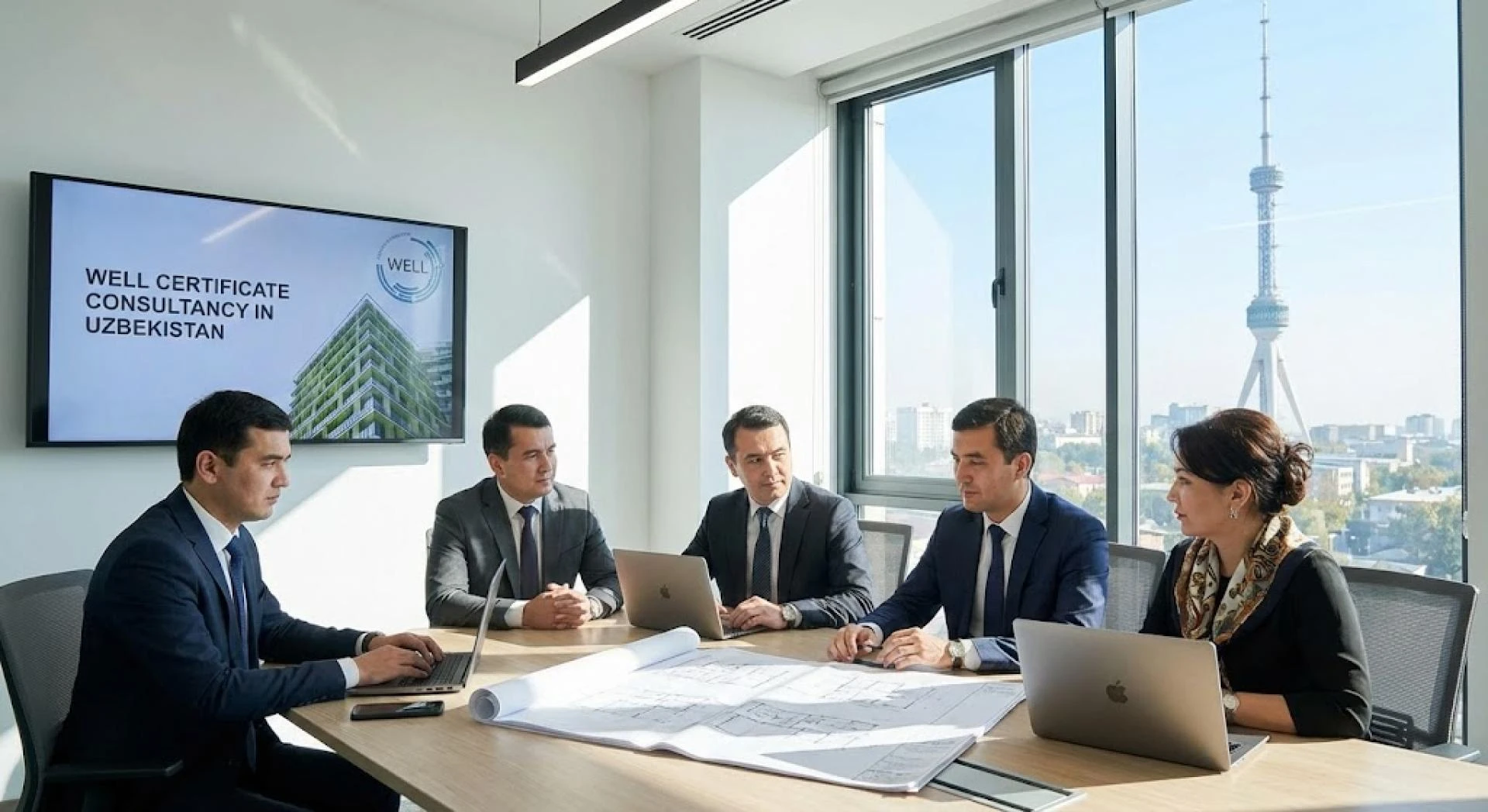

Uzbekistan’s construction and real estate market has increasingly shifted toward quality, performance, and international standards, particularly in projects involving foreign investors, multinational occupiers, and international financing institutions. Within this context, the WELL Building Standard is gaining relevance as a framework focused on occupant health, wellbeing, and indoor environmental quality.
Although WELL certification is still emerging in Uzbekistan compared to more mature markets, it is increasingly considered for premium office developments, corporate headquarters, education facilities, healthcare buildings, and mixed-use projects. WELL is often pursued alongside LEED or BREEAM to complement environmental performance with health-focused design strategies. This creates demand for consultants who understand both international WELL requirements and the practical realities of delivering projects in a developing regulatory environment.
Role of WELL Consultants in Uzbekistan-Based Projects
WELL consultants guide project teams through the full certification lifecycle, from early feasibility and target-setting to documentation, performance testing, and final certification. Typical services include certification pathway selection, credit feasibility analysis, integration of wellbeing strategies into design and fit-out, coordination with mechanical and lighting engineers, product and material compliance review, and management of performance verification.
In Uzbekistan, WELL consultancy requires careful adaptation. Limited local experience with health-focused certification systems, evolving indoor environmental standards, and reliance on imported building products mean that consultants must translate WELL concepts into realistic, verifiable solutions. Firms with international experience are therefore better positioned to manage certification risk while maintaining compliance with the WELL Building Standard.
1. ERKE Consultancy
ERKE Consultancy is a sustainability-focused consultancy with strong expertise in WELL certification and health-focused building strategies. Founded in 2007, ERKE operates through offices in Istanbul, Dubai, and London and delivers sustainability consultancy services across Europe, the Middle East, and Asia, including emerging markets.
ERKE has supported WELL certification for commercial offices, healthcare facilities, and mixed-use developments, frequently alongside LEED and BREEAM schemes. This integrated experience allows ERKE to align WELL requirements related to air quality, water, lighting, comfort, and occupant wellbeing with broader sustainability and energy performance objectives.
A key strength of ERKE is its fully in-house multidisciplinary team. The consultancy includes WELL APs, LEED Fellows, LEED APs, BREEAM Assessors, and sustainability specialists, enabling comprehensive coverage of all WELL concepts without reliance on external consultants. This structure supports consistent interpretation of WELL requirements, efficient documentation workflows, and effective coordination with international and local project teams.
ERKE’s experience in emerging markets makes it particularly suitable for projects in Uzbekistan, where WELL strategies must be adapted to local construction practices, product availability, and operational realities while maintaining alignment with international certification standards.
2. Arup
Arup is a global professional services firm providing engineering, sustainability, and human-centred design consultancy. Its WELL-related services are typically delivered as part of broader health, wellbeing, and building performance strategies.
In markets such as Uzbekistan, Arup’s WELL support is most commonly associated with complex or high-profile projects where occupant health is integrated into advanced engineering and environmental design solutions.
3. WSP Global
WSP Global offers WELL consultancy services alongside environmental, engineering, and workplace advisory services. The firm supports WELL documentation, credit strategies, and coordination of performance testing for projects with international stakeholders.
WSP is relevant for organisations seeking alignment between WELL certification, ESG objectives, and workplace performance frameworks across multiple regions.
4. Ramboll
Ramboll provides sustainability and environmental engineering services with a strong focus on human health and wellbeing. Its WELL consultancy work is often linked to indoor air quality analysis, daylighting strategies, and thermal comfort optimisation.
Ramboll is suitable for projects in Uzbekistan requiring technically detailed studies to support WELL performance verification and health-related credits.
5. AtkinsRéalis
AtkinsRéalis delivers WELL consultancy primarily within large commercial, public-sector, and mixed-use developments. WELL services are typically integrated into broader sustainability, workplace strategy, or project management scopes.
The firm is relevant for internationally financed projects where WELL certification forms part of wider health, wellbeing, or ESG reporting requirements.
6. Mott MacDonald
Mott MacDonald offers sustainability and wellbeing advisory services for major developments worldwide. Its WELL-related services are often aligned with large office portfolios and infrastructure-linked projects.
The firm supports WELL compliance through structured health and wellbeing frameworks, environmental performance assessments, and documentation coordination.
7. Khatib & Alami
Khatib & Alami provides sustainability advisory services for international developments, including WELL certification support in emerging markets.
Its experience with global certification frameworks makes it relevant for projects in Uzbekistan where WELL is pursued alongside other international sustainability standards.
Summary
This article outlines WELL certificate consultancy firms relevant to Uzbekistan across different service models and project contexts. ERKE Consultancy focuses on dedicated, project-level WELL delivery supported by an in-house team of WELL APs and sustainability specialists experienced in emerging markets. Arup, WSP Global, Ramboll, AtkinsRéalis, Mott MacDonald, and Khatib & Alami typically integrate WELL services within broader engineering, workplace, or sustainability advisory frameworks.
- ERKE Consultancy
- Arup
- WSP Global
- Ramboll
- AtkinsRéalis
- Mott MacDonald
- Khatib & Alami
The appropriate consultancy depends on project type, health and wellbeing objectives, local implementation capacity, technical complexity, and available budget.





























Sign in to leave a comment.