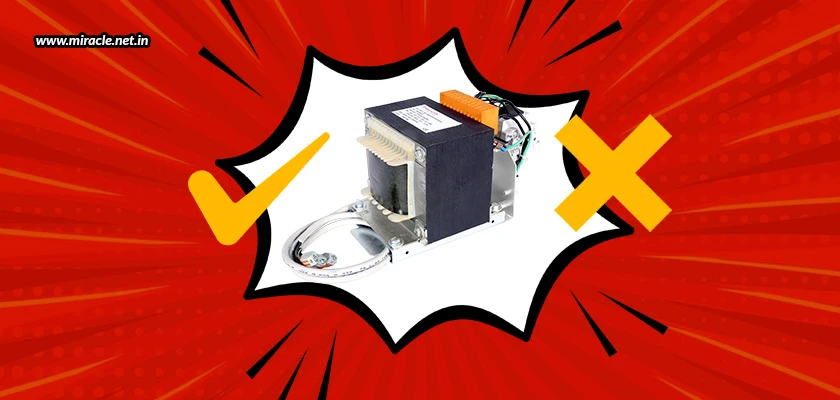

EI transformers are inherently robust and time-tested, but that doesn’t mean we expect them to deliver decades of trouble-free operation. A well-built unit can typically perform reliably for 20-30 years, yet premature failures still occur in many applications. In most cases, these failures are not due to limitations of the technology itself, but because of incorrect purchasing decisions made at the very beginning of the lifecycle. Procurement teams often focus primarily on the price, delivery timelines, and basic electrical ratings, even though these factors alone do not determine long-term performance. Critical parameters like thermal design, insulation system, manufacturing discipline, and testing practices play a decisive role in reliability, efficiency, and service life, and overlooking them significantly increases the total cost of ownership. Let us explore some of the key purchasing mistakes that buyers should avoid when selecting an EI transformer.
Assuming same rating means same performance
Not all EI transformers with identical ratings are functionally equal. While two transformers may share the same voltage, same current, and same power specifications, in reality, they may differ significantly in their internal design philosophy, material quality, and thermal performance. Buyers may simply compare the prices of two transformers with similar ratings, and choose the lower priced one, assuming that it delivers the same performance at a better value. But, this assumption can be misleading. A lower-cost transformer may involve compromises in critical parameters such as insulation class, permissible temperature rise, and core loss characteristics. These differences may not be evident during initial testing or short-term operation, but over time, they directly affect efficiency, reliability, and service life, ultimately increasing the total cost of ownership.
Ignoring thermal performance
Excessive heat can directly affect the performance and lifespan of a transformer. Temperature rise must therefore be treated as a primary selection criterion. Buyers sometimes accept designs that operate close to the insulation class limit, just because they are getting it at a reduced size or cost. But, they fail to understand that this small gap leaves no safety margin for voltage fluctuations and higher ambient temperatures. It is important to understand that a transformer that runs cooler will almost always outlast one that operates near its thermal limit, even if both meet the same basic rating.
Specifying minimum insulation only
Insulation is another factor that determines the lifespan of the transformer. Failures are rarely caused by faults in copper or steel; they begin with insulation breakdown. Specifying only the minimum insulation class may reduce the initial cost but introduces a long-term reliability risk. Humidity, electrical stress, and thermal cycling can gradually weaken insulation systems that lack adequate margin. A well-designed insulation system provides mechanical strength, moisture resistance, and long-term dielectric stability. Buyers who overlook this aspect often encounter failures that appear sudden, but are actually the result of slow degradation.
Overlooking load fluctuations
Buyers often specify transformers based only on the stated load value, but what they do not realize is that in real applications the load rarely remains constant. Transformers frequently experience high inrush currents, intermittent peak loads, and non-linear loads from modern electronics. Therefore, if the transformer is not designed for the true load profile, it will operate at temperatures higher than expected, and this thermal overload can dramatically accelerate insulation aging. Hence, understanding how the transformer will actually be used, rather than just its rated load, is one of the most important steps in making the right selection.
Focusing only on initial purchase price
While a lower purchase price may seem attractive, it is not always the most economical choice. A higher-priced transformer is not necessarily expensive; it may often reflect superior design, better materials, and tighter manufacturing control. Such a transformer typically operates at lower temperatures, delivers higher efficiency, minimizes energy losses, and offers a longer service life. In contrast, a low-cost transformer that compromises on efficiency, thermal performance, and build quality can lead to higher power consumption, increased maintenance, unplanned downtime, and frequent replacements. What appears to be an initial saving can then prove to be a significantly higher total cost over the product’s lifetime. For this reason, lifecycle cost analysis and a thorough technical comparison are essential when selecting an EI transformer.
Ignoring manufacturing process control
Two transformers built to the same drawing can perform very differently depending on the manufacturing process used. Common purchasing mistakes include failing to evaluate the manufacturer’s process consistency, not verifying the impregnation method, and assuming that prototype performance will be identical to that of mass-produced units. Manufacturing discipline directly affects the critical factors of winding tension, insulation placement, core clamping pressure, and varnish penetration. These parameters, in turn, determine vibration resistance, moisture protection, thermal dissipation, and long-term reliability. Ignoring these aspects during selection can lead to field failures, inconsistent performance, and higher lifecycle costs.
Trusting datasheets without test evidence
Simply relying on datasheets and specifications without reviewing the associated test practices is another common buyer error. While a datasheet indicates what a transformer is designed to achieve under defined conditions, only testing proves whether it consistently meets those expectations in real operation. Transformers that undergo comprehensive electrical, thermal, and insulation testing are far less likely to develop early-life failures or performance deviations. Equally important is the consistency and documentation of these tests, as a controlled and traceable testing process is one of the strongest indicators of long-term reliability and manufacturing discipline. Wherever possible, buyers should also inspect sample or pre-dispatch units to evaluate core stacking, insulation finishing, lead terminations, and overall workmanship – critical quality indicators that specifications alone cannot reveal.
Not considering the installation environment
An EI transformer that performs perfectly well in a laboratory may not deliver the same results in an industrial enclosure. This is because laboratory testing is typically carried out under clean, controlled, and well-ventilated conditions, while real installations often involve dust, moisture, higher ambient temperatures, restricted airflow, and continuous mechanical vibration. These environmental factors hinder heat dissipation, contaminate insulation surfaces, and accelerate material degradation. If such site conditions are not clearly communicated during the purchasing stage, the transformer may be designed with inadequate insulation class, cooling provision, or mechanical rigidity. As a result, it can lead to premature insulation aging, reduced efficiency, increased failure risk, and a significantly shorter service life.
Switching suppliers for short-term savings
Switching suppliers solely on the basis of a lower price can introduce unwanted variability into an otherwise stable system. Even minor differences in design practices, raw material selection, winding techniques, or process control can lead to measurable changes in electrical performance, thermal behaviour, and long-term reliability. Long-term partnerships with an experienced and dependable manufacturer ensure stable product performance, better technical support, and faster resolution of field challenges, as the supplier becomes increasingly familiar with the operating environment and performance expectations. This is the approach followed by Miracle Electronics, a trusted EI transformer manufacturer for Canada market, which emphasizes process consistency, application engineering, and lifecycle reliability to deliver uniform performance across every production batch.
EI transformers are not mere commodities; they are critical infrastructure components that directly influence system reliability and operational efficiency. Purchasing decisions based solely on price or basic electrical specifications often lead to higher energy consumption, increased maintenance, unplanned downtime, and premature failures. A lifecycle-focused selection approach provides a more accurate measure of how a transformer will perform under real operating conditions over many years. Choosing a technically superior and consistently manufactured unit may require a higher initial investment, but it ensures dependable performance, extended service life, lower total cost of ownership, and greater operational stability for critical applications.
Resource: What Not To Do When Purchasing EI Transformers




























Sign in to leave a comment.