
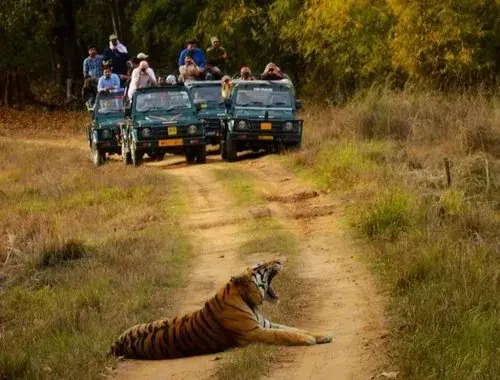
Kanha National Park conjures images of regal Bengal tigers striding stealthily through tall golden grass under bright warm sunlight suddenly. Why not indeed nowadays? Tigers serve as an icon for Kanha. Beyond those stripes lies a lesser-known story of tribal wisdom and ecological resilience rooted deeply in ancient trees somehow.
I visited Kanha not for the thrill of the chase but for the rhythm of the wild. And what I discovered was a sanctuary that doesn’t just protect animals—it preserves time, memory, and the delicate art of balance. This place is less about ticking off wildlife and more about re-learning how to coexist with nature.
A Forest of Firsts
Kanha isn’t just another national park on India’s tourism map. It’s the very birthplace of India’s successful hard-ground barasingha conservation. The ‘jewel of Kanha’—once on the brink of extinction—now thrives here, thanks to decades of dedication by forest officials, biologists, and unsung eco-warriors.
It’s also one of the few tiger reserves where nature isn’t just watched—it’s studied, celebrated, and deeply respected. From flora conservation labs to tribal knowledge-sharing workshops, Kanha National Park is a dynamic lab for both science and spirit.
It’s where textbooks meet tribal tales, and fieldwork meets folklore—offering an ecosystem that is as intellectually inspiring as it is emotionally moving.
Where Forest Meets the Soul
Most tourists rush into safaris hoping for sightings. But the true beauty of Kanha reveals itself in moments of stillness: a herd of spotted deer disappearing into morning fog, a woodpecker drumming rhythm into silence, or the sudden whoosh of a serpent eagle overhead.
The forest isn't just alive—it’s expressive. Every rustle, chirp, and movement narrates a tale. You begin to tune your senses differently here. Your eyes start noticing what the mind usually filters out—the shimmer of dewdrops, the cautious glance of a sambar, the pattern of tiger pugmarks on the trail.
What stood out to me, however, wasn’t just the wild—it was the people. The Baiga community, with their ancient forest wisdom, are more than locals—they're keepers of this living forest. They don’t just survive in nature—they commune with it. Their understanding of the forest is intuitive, spiritual, and deeply holistic.
A Stay that Stays with You
I chose to stay near Kanha Kisli Resort, at an eco-lodge tucked amidst sal trees. No concrete blocks or luxury pretensions—just mud walls, solar lights, local food, and soulful silence. Each evening, as the sun dipped behind the trees, I’d sit by a lantern and speak with the lodge caretaker—a Baiga elder who’d lived all his life by the jungle’s edge.
His stories weren’t from books, but from life. He taught me to recognize the call of a barking deer, the medicinal use of ghost tree bark, and how moonlight can change a trail’s direction.
These conversations stayed with me long after the trip ended. Because the forest, I realized, is more than a visual experience—it’s a living conversation. You just need to know how to listen.
The eco-lodge itself reflected this philosophy. Built with local materials, operated with low carbon impact, and staffed by tribal youth, it stood as a silent bridge between tourism and tradition.
The Digital Leap: Convenience with Conscience
Planning my safari was surprisingly smooth. Through Kanha Safari Online Booking, I explored various zones like Kanha, Kisli, and Mukki, checked availability, and booked responsibly. The system not only avoids over-tourism in sensitive zones but also offers insightful details about each region’s terrain, wildlife behavior, and eco-rules.
The Kanha National Park Safari Booking portal felt less like a ticket counter and more like a conscious gateway—inviting you to be a better traveler. Not just a visitor, but a participant in conservation.
You could also choose your guide—many of whom are trained naturalists, storytellers, and conservation advocates. This makes every ride not just a safari but a learning expedition.
More Than a Memory
Kanha doesn’t promise tigers in every drive. What it does promise is something far deeper: humility. You learn to slow down, to observe, to reconnect. You stop chasing sightings and start noticing stories—etched in footprints, echoed in distant howls, whispered by swaying grass.
And when you leave, you don’t just take back photographs. You take back a slower heartbeat, an awakened mind, and a newfound respect for the interwoven poetry of forest life.
Even weeks after returning, I find myself replaying the rustle of leaves or the call of a nightjar. Kanha stays with you. Not in loud memories, but in quiet awakenings.
Final Reflection
Kanha National Park is not a “place to tick off.” It’s an emotion. A reminder that nature doesn't shout—it whispers. And if you’re willing to listen, it will reveal truths about life, coexistence, and your own place in this vast living network.
So next time you think of Kanha National Park Safari Booking, think beyond the safari. Think of the spirit of the land, the people who protect it, and the quiet revolutions it nurtures—every single day.


























Sign in to leave a comment.