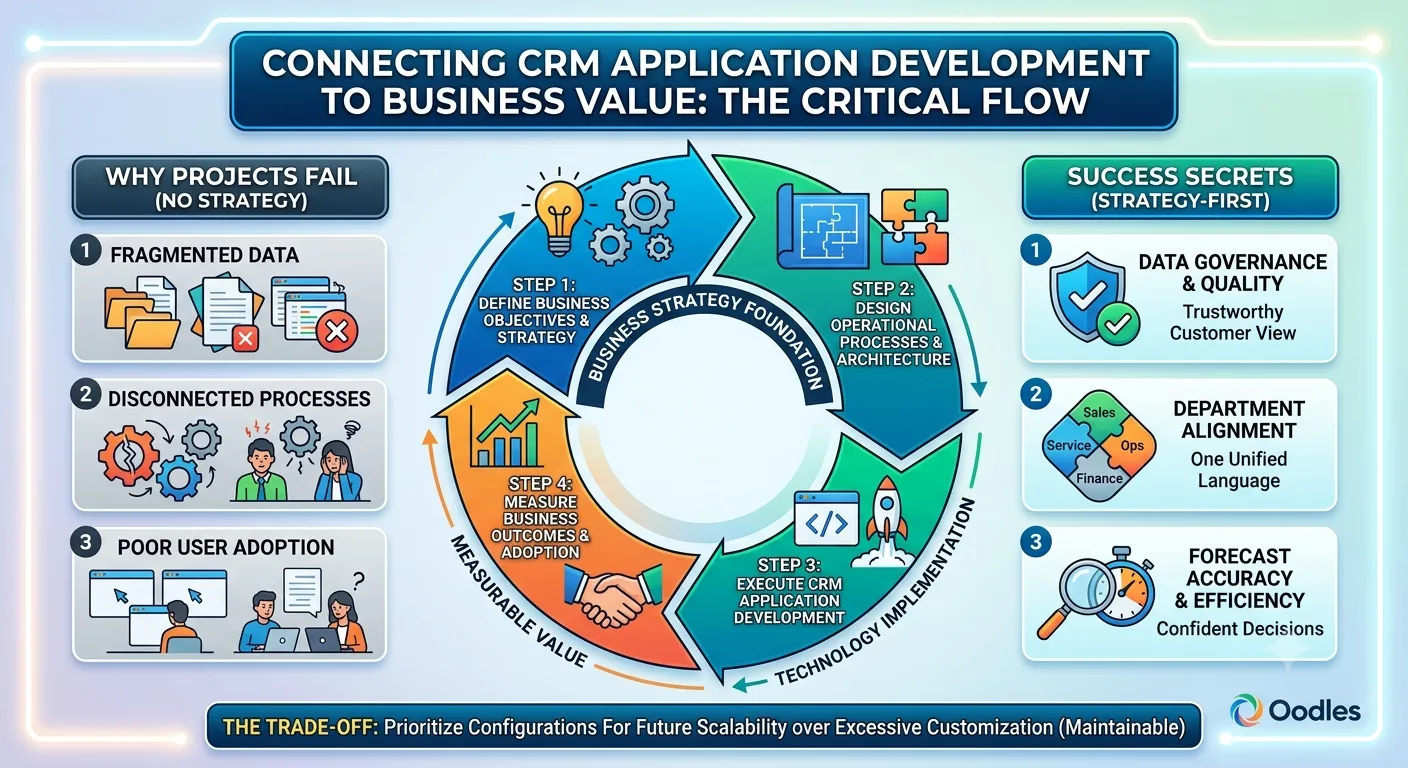

Every growth story eventually reaches the same crossroads. The spreadsheets that once worked begin creating confusion. Sales teams operate with incomplete customer information. Marketing campaigns generate leads that never receive timely follow-ups. Service teams solve problems without visibility into previous interactions. The result is not a technology problem. It is an operational one.
This is exactly why CRM Application Development Services have moved from being a software investment to a business strategy. According to Gartner (2025), CRM remains the largest software market worldwide, driven by increasing investments in customer experience technologies. At the same time, McKinsey (2024) reports that organizations excelling in customer experience achieve revenue growth at significantly higher rates than their competitors because they connect data, decisions, and customer interactions into one operational framework.
Businesses looking beyond generic CRM platforms are increasingly exploring custom CRM application development solutions that align with their unique sales processes rather than forcing teams to adapt to predefined software workflows.
Why This Is Happening Now
The demand for custom CRM applications is not driven by technology trends alone. It reflects how organizations have changed.
A decade ago, most customer interactions happened through a handful of channels. Today, prospects engage through websites, mobile apps, marketplaces, social platforms, messaging applications, email, and physical touchpoints. Each interaction creates valuable information.
Where traditional CRM systems rely on standardized workflows, modern organizations require intelligent processes that adapt to industry-specific operations.
IDC (2024) estimates that enterprise data creation continues to accelerate every year, making centralized customer intelligence essential rather than optional. Meanwhile, Deloitte (2024) found that organizations investing in connected customer platforms report stronger operational efficiency because business units share a consistent view of customer information.
The challenge is no longer collecting customer data.
The challenge is transforming it into decisions that improve revenue, retention, and service quality.
Why CRM Application Development Services Deliver Greater Business Value
Industry-Specific Processes Cannot Be Standardized
Every industry manages customer relationships differently.
A manufacturing company tracks distributors and dealer networks. Healthcare providers manage appointments and compliance. Real estate firms coordinate brokers, buyers, legal documents, and financing. Insurance companies follow policy renewals and claims.
Trying to fit these operations into identical CRM templates creates unnecessary complexity.
CRM Application Development Services allow organizations to build workflows around their own business logic instead of redesigning business operations to fit software limitations. This results in higher adoption because employees work within familiar processes rather than learning artificial ones.
Customer Intelligence Is Becoming a Competitive Asset
Customer information is valuable only when it supports better decisions.
Modern CRM applications combine purchasing history, support interactions, website activity, communication preferences, and operational records into a unified customer profile.
Where traditional systems store information, intelligent CRM platforms interpret relationships between events.
Forrester (2024) found that organizations improving customer intelligence significantly increase customer retention and sales productivity because employees receive relevant context before every interaction instead of searching through disconnected applications.
The technology becomes less about recording activity and more about improving business judgment.
CRM Is No Longer Separate from Business Operations
Many organizations still treat CRM as a sales application.
That mindset is rapidly changing.
Modern CRM platforms increasingly integrate ERP systems, finance applications, marketing automation, customer support, inventory management, logistics, and analytics.
Instead of functioning as another enterprise application, CRM becomes the operational layer connecting departments.
This shift explains why investment decisions increasingly involve CIOs, CTOs, operations leaders, and business executives together. Customer relationships now influence forecasting, procurement, staffing, production planning, and executive reporting.
What Oodles Has Seen in Practice
From our experience working with growing enterprises on CRM Application Development Services, one recurring pattern stands out.
Organizations rarely struggle because they lack customer data.
They struggle because customer information exists across disconnected applications that cannot communicate effectively.
At Oodles, one engagement involved helping a service-driven business replace fragmented lead tracking, manual follow-ups, spreadsheet reporting, and isolated customer records with a centralized CRM application tailored to its operational workflow.
Instead of implementing unnecessary features, the project focused on automating lead assignment, integrating communication history, connecting operational reporting, and simplifying executive dashboards.
The implementation was completed within approximately four months. Administrative effort dropped by nearly 40 percent because repetitive manual activities disappeared, while sales visibility improved through unified reporting. Management could finally measure conversion performance using real operational data rather than manually consolidated reports.
The most valuable outcome was not simply automation.
Decision-making became faster because leadership trusted the information available across departments.
That distinction often determines whether CRM becomes another software purchase or an organizational capability.
Looking Beyond Software
Many discussions around CRM still focus on features.
Businesses compare dashboards, mobile applications, reports, automation capabilities, or artificial intelligence functions.
Those comparisons matter, but they rarely determine long-term success.
Successful organizations begin with business objectives instead of software features.
They ask different questions.
How should information move between departments?
Which customer interactions create the highest lifetime value?
Where do manual decisions delay growth?
Which processes should remain flexible as the business evolves?
Answering these questions produces CRM systems that continue delivering value long after implementation.
As customer expectations continue rising and operational complexity increases, CRM Application Development Services will become less about managing contacts and more about building connected organizations capable of responding quickly to changing markets.
The companies that recognize this shift early will compete with better information, faster decisions, and stronger customer relationships.
Ready to Build CRM Around Your Business?
If your organization is evaluating CRM Application Development Services, the conversation should begin with business outcomes rather than software features. Discuss your operational goals with experienced consultants and identify how a tailored CRM strategy can support long-term growth without adding unnecessary complexity.
Frequently Asked Questions
1. What are CRM Application Development Services?
CRM Application Development Services involve designing and building customer relationship management solutions that match an organization's unique business processes, integrations, reporting requirements, and customer engagement strategy instead of relying solely on off-the-shelf software.
2. Why do businesses choose custom CRM instead of standard CRM software?
Custom CRM applications support industry-specific workflows, integrate with existing business systems, reduce manual operations, and provide better reporting aligned with organizational objectives.
3. Which industries benefit most from custom CRM development?
Healthcare, manufacturing, insurance, real estate, financial services, logistics, education, and professional services often benefit because their customer processes differ significantly from generic CRM workflows.
4. How long does a CRM development project usually take?
Project timelines depend on complexity, integrations, and customization requirements. Medium-sized enterprise implementations commonly range between three and six months, including planning, development, testing, and deployment.
5. How do CRM Application Development Services improve business performance?
Well-designed CRM Application Development Services centralize customer information, automate repetitive processes, improve collaboration across departments, strengthen decision-making, and help organizations deliver more consistent customer experiences while supporting sustainable growth.

























Sign in to leave a comment.