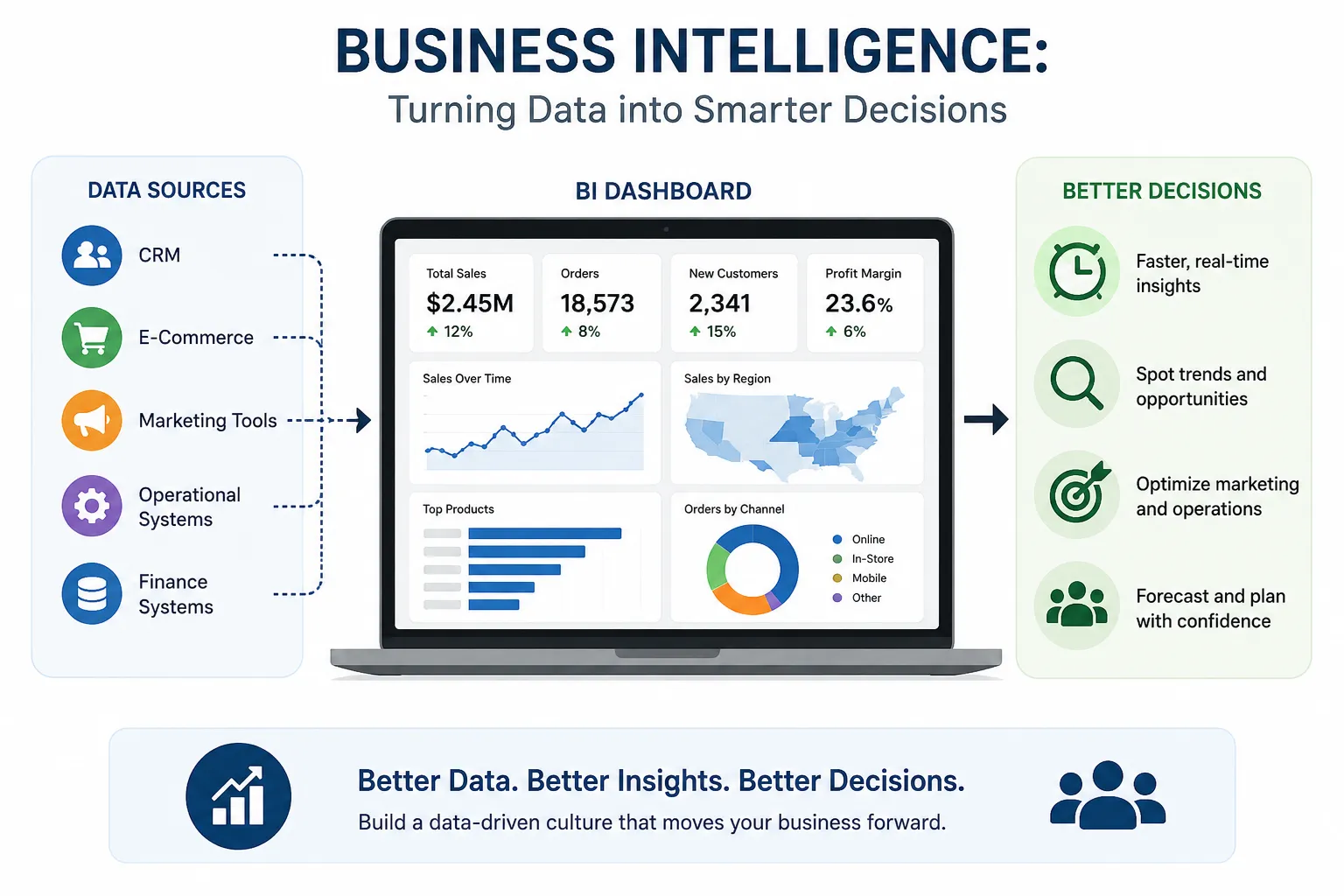

If you've spent any time in a leadership meeting over the past few years, you've probably heard someone ask, "What does the data actually say?" It's become almost a reflex. Spreadsheets and gut instinct used to be enough to steer a mid-sized company, but somewhere along the way, the sheer volume of information businesses generate outgrew the tools people were using to make sense of it. That's the gap business intelligence (BI) was built to fill, and it's why interest in this space has exploded.
But here's the thing nobody tells you when you start looking into BI: it's not just software. It's a whole ecosystem of platforms, consultants, data engineers, and analysts who help organizations turn raw numbers into decisions they can actually act on. And figuring out where to even start can feel overwhelming, especially if your team has never worked with dashboards, data warehouses, or predictive models before.
Let's unpack what business intelligence really means today, why it matters more than it used to, and what to think about before you bring in outside help.
Business Intelligence Isn't What It Was Ten Years Ago
A decade ago, "BI" mostly meant static reports. Someone in finance pulled numbers into Excel, built a few pivot tables, and emailed a PDF around once a month. It worked, sort of, but it was slow, backward-looking, and prone to human error.
Modern business intelligence looks completely different. Instead of monthly snapshots, companies now expect live dashboards that update automatically. Instead of one analyst manually combining data from five different systems, BI platforms now pull from CRMs, e-commerce platforms, marketing tools, and operational software simultaneously, then blend it all into a single coherent view.
This shift didn't happen by accident. Federal research into large-scale data systems has tracked exactly this kind of evolution, noting how business intelligence has increasingly merged with broader data analytics and big data architecture as the volume, speed, and complexity of organizational data has grown. The National Institute of Standards and Technology's big data interoperability framework documents how this convergence is reshaping the way enterprises structure their data systems and decision-making, underscoring that this isn't just a marketing trend, it's a structural shift in how organizations are built around information.
Why So Many Businesses Are Investing in BI Right Now
There are a few reasons this topic keeps coming up in boardrooms and small business forums alike.
1. Decisions need to happen faster. Markets move quickly, and waiting three weeks for a quarterly report to confirm what you already suspected is a luxury fewer companies can afford. Real-time dashboards let teams react to shifts in customer behavior, supply chain delays, or sales dips almost as they happen.
2. Data is scattered everywhere. Most businesses today juggle a dozen or more software tools. Marketing lives in one platform, sales in another, finance in a third. Without something tying it together, leadership ends up with a fragmented, sometimes contradictory picture of how the business is actually performing.
3. Competitive pressure is real. When competitors start using data to fine-tune pricing, personalize marketing, or predict churn before it happens, standing still isn't really an option. Falling behind on data maturity can translate directly into lost market share.
4. The tools have gotten more accessible. Cloud-based BI platforms have dramatically lowered the barrier to entry. You no longer need an in-house data science team to get value out of analytics, though knowing how to interpret and act on the output still matters enormously.
The Real Challenge: It's Not the Software, It's the Strategy
Here's where a lot of businesses stumble. They buy a slick dashboard tool, connect a few data sources, and expect insight to just appear. But a tool is only as good as the thinking behind it. Without a clear sense of what questions you're trying to answer, even the most sophisticated platform becomes another underused subscription gathering dust.
This is part of why many companies choose to bring in specialized partners rather than building everything in-house from scratch. A resource exploring top business intelligence service providers can be a useful starting point if you're trying to understand the range of services available, from data warehousing and ETL pipeline setup to custom dashboard design and predictive analytics consulting. The point isn't to outsource thinking, it's to get experienced hands involved early so the foundation is solid before you start layering insights on top of it.
Academic research backs up just how central this strategic layer is. A business analytics program overview from Park University frames business intelligence as a combination of technologies, processes, and strategies organizations use to collect, analyze, and interpret data, explicitly tying BI's value to how well it supports a broader culture of informed decision-making rather than treating it as a standalone technical add-on. In other words, the strategy and the people interpreting the data matter just as much as the dashboards themselves.
What Good BI Actually Looks Like in Practice
It helps to ground this in something concrete. Imagine a regional retail chain that's been collecting point-of-sale data for years but never really used it beyond basic monthly totals. A well-implemented BI setup might let that company:
- See which products are trending up or down by store location, in near real time
- Spot seasonal patterns that inform inventory ordering months in advance
- Identify which marketing campaigns are actually driving foot traffic versus just impressions
- Forecast staffing needs based on predicted customer volume
None of that requires a massive data science department. It requires clean data, a sensible dashboard structure, and people who know how to ask the right questions of that data.
Tips for Evaluating BI Support, Whether In-House or Outsourced
If you're at the stage of deciding how to approach business intelligence for your organization, a few practical considerations tend to separate successful rollouts from frustrating ones.
Start with the questions, not the tool. Before choosing software or a vendor, write down the three to five decisions you most wish you had better data for. Let that list guide everything else.
Audit your existing data quality first. Garbage in, garbage out still applies. If your CRM has duplicate records or your sales data is inconsistently labeled, fix that before building dashboards on top of it.
Think about scalability from day one. A solution that works for fifty employees might buckle under the weight of five hundred. Ask any provider how their approach handles growth.
Don't underestimate training. The most common reason BI initiatives fail isn't bad software, it's that the people meant to use it never really learned how, or didn't trust the numbers enough to change their behavior based on them.
Watch for over-customization. It's tempting to build the perfect bespoke dashboard for every department, but maintenance overhead adds up fast. Standardized templates with a bit of flexibility usually age better than fully custom builds.
The Road Ahead for Business Intelligence
Looking forward, the line between traditional BI and artificial intelligence is blurring fast. Predictive and prescriptive analytics, once reserved for large enterprises with deep data science budgets, are becoming standard features in mainstream BI platforms. Natural language querying, where a manager can simply type or speak a question and get a chart in response, is moving from novelty to expectation.
There's also a growing emphasis on data governance and ethics, particularly as organizations handle more sensitive customer information. Strong data practices aren't just a compliance checkbox anymore, they're foundational to maintaining customer trust as analytics get more sophisticated.
What hasn't changed, and probably won't, is the core purpose of business intelligence: helping people make better decisions with the information they already have, instead of acting on assumptions or outdated reports. The technology will keep evolving, but that underlying goal is what makes BI worth investing in at all.
If your organization is still relying on manual reports or scattered spreadsheets, it might be worth treating this as less of a technology upgrade and more of a decision-making upgrade. The dashboards are just the visible part. The real value is in building an organization that actually trusts and uses its own data.




























Sign in to leave a comment.