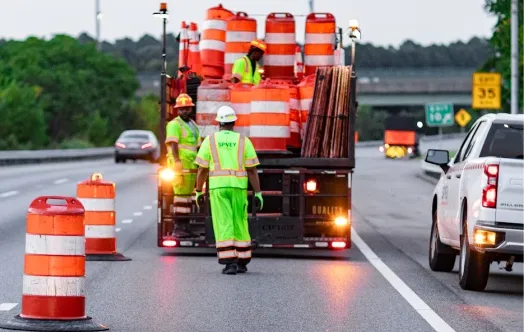

Let’s be honest: working on a busy highway feels like playing a game of high-stakes chicken. You have your crew, your cones, your signs—but all it takes is one distracted driver drifting into your lane, and everything changes in a second.
That’s where the unsung hero of modern road construction comes in: the crash cushion truck. You might have seen them parked behind work zones with their big, yellow rear-end cushions, quietly waiting to take a hit so your team doesn’t have to.
But these trucks aren’t just expensive bumpers. They are a strategic part of professional truck traffic control, designed to save lives, lower liability, and keep projects moving on time.
In this post, we’ll break down exactly how crash cushion trucks work, when to use them, and why they’ve become non-negotiable for any serious traffic control plan.
So, What Exactly Is a Crash Cushion Truck?
Let’s start simple. A Crash Cushion Truck (sometimes called a truck-mounted attenuator or TMA) is a heavy vehicle fitted with a specialized energy-absorbing attachment on the back.

Think of it as a giant, mobile pillow for errant vehicles. When a car or truck hits the back of this unit, the cushion collapses in a controlled way, slowing the vehicle down gradually instead of stopping it instantly. That gradual deceleration is what prevents serious injury and keeps the struck vehicle from plowing into your crew ahead.
Most units are built to be lightweight but tough, using materials like aluminum honeycomb or steel bands. After a crash, the cushion can be replaced or repaired quickly, and the truck itself goes right back to work.
How It Differs from a Standard Arrow Board Truck
A regular arrow board truck directs traffic. A crash cushion truck protects traffic. Many modern setups combine both—giving you directional signals and impact protection from a single vehicle. That dual function is a game-changer for truck traffic control on high-speed roads.
Why "Truck Traffic Control" Isn't Just About Signs Anymore

When most people hear Truck Traffic Control, they picture a worker with a slow/stop paddle or a lane closure sign. But that old-school view is dangerous on today’s faster, more congested roads.
Real truck traffic control today involves:
- Shadow vehicles that follow mobile operations like line painting or sweeping.
- Protective trucks placed upstream of workers to absorb impacts.
- Dynamic merging systems using variable message signs and TMA trucks in tandem.
And the star of that protective lineup? The crash cushion truck.
A Real-World Example
Imagine you’re repaving three miles of interstate. Your crew is spread over a moving patch. A single crash cushion truck can drive just ahead of the work, stopping and starting as the crew moves. Every time vehicles approach from behind, that truck is their first point of contact—not your team. That single vehicle changes the entire risk profile of the job.
When You Absolutely Need a Crash Cushion Truck (And When You Don't)
You don’t need a crash cushion truck for a quiet residential cul-de-sac. But on any road with a speed limit over 45 mph, or where sight distances are limited (think curves, hill crests, or tunnels), the answer is yes.
Here are specific scenarios where a crash cushion truck is a must:
1. Mobile, Short-Duration Work
Pothole patching, crack sealing, sweeping, sign installation—jobs that move every 5-20 minutes. Cones and barrels take too long to set up and tear down. A crash cushion truck rolls with you, providing instant protection.
2. Night Work
Low visibility means higher risk. Drivers are tired, may have been drinking, or simply don’t see your warning lights until the last second. A crash cushion truck gives you a physical buffer when warning time is short.
3. High-Speed, High-Volume Highways
Interstates, freeways, and major state routes. At 70 mph, a driver has less than three seconds to react from the time they see your taper. If they miss that window, your crash cushion truck is their backup plan.
4. Anywhere You Have Workers "On Foot" Behind the Truck
If your crew is out of their vehicles—say, directing traffic, measuring, or inspecting—you need a cushioned barrier between them and approaching traffic. No exceptions.
The Hidden Superpower: Reducing Your Liability
Here’s something safety vendors don’t always talk about: a crash cushion truck is one of the best legal shields you can buy.
If an accident happens in your work zone, the first question lawyers and OSHA will ask is: Did you use the industry-standard level of protection?
If you’re on a 55-mph highway with just cones and signs, the answer is “no.” That’s negligence. But if you had a properly positioned, MASH-tested crash cushion truck, you can show you took every reasonable step to protect both your crew and the traveling public.
Many insurance companies now offer reduced premiums for contractors who deploy TMA trucks on every eligible project. Over a year, that savings alone can pay for the truck or rental fees.
How to Choose the Right Crash Cushion Truck for Your Fleet
Not all crash cushion trucks are born equal. Here’s what I look for when advising contractors and DOTs:
Look for MASH Compliance
MASH (Manual for Assessing Safety Hardware) is the current federal standard. If a cushion isn’t MASH-tested, it’s not legal on federal-aid highways. Look for Test Level 2 (TL-2) or Test Level 3 (TL-3) ratings, depending on your typical speeds (TL-3 covers up to 75 mph).
Consider the Cushion Type
- Aluminum honeycomb: The most common. Disposable, works once, then you replace the cartridge. Ideal if you have a repair depot nearby.
- Steel band/braided cable: Reusable after minor impacts. Heavier but cheaper in the long run if you take frequent low-speed hits.
- Hybrid systems: Combining plastic, foam, or other materials. Good balance of weight and repairability.
Don’t Forget Truck Specs
The truck itself matters. You need enough GVWR (gross vehicle weight rating) to carry the cushion and your equipment. A half-ton pickup will struggle. Most professionals use F-550 or similar chassis for the balance of maneuverability and payload.
Rent vs. Buy
If you run highway projects daily, buy. If you do intermittent road work or seasonal jobs, rent from a specialist like Titan Road Works. Renting gives you access to late-model, fully maintained units without the capital expense—plus they handle repairs if you do get hit.
A Day in the Life: How to Deploy a Crash Cushion Truck Correctly
Deploying one of these trucks isn’t just “park it behind the crew.” Here’s a quick field guide:
- Position upstream of the work zone taper, not inside the closed lane.
- Leave a gap of 50-100 feet between the truck’s rear and the first cone or worker. That gap gives you room to move if a vehicle doesn’t stop.
- Keep the wheels straight (or slightly turned away from workers) so an impact doesn’t push the truck into your crew.
- Run the amber lights in “arrow mode” if equipped, to direct drivers away from the crash cushion truck itself.
- Have a spotter watch upstream for any vehicle not slowing. They can shout a warning to drive the truck forward if needed.
And one critical rule: Never, ever put workers inside or directly in front of the crash cushion truck during a live impact situation. The truck is the shield. Everyone else stays behind it or to the side.
Why Titan Road Works Leads the Way in Safer Traffic Control
If reading this makes you realize your current traffic control setup is… well, a little thin, you’re not alone. Many contractors started with just cones and a pickup. But regulations change, roads get faster, and one lawsuit can end a business.
That’s why crews across Virginia, Maryland, and Washington, D.C. trust Titan Road Works to supply professional-grade truck traffic control services. They don’t just drop off equipment—they help design your work zone layout, provide trained operators for crash cushion trucks, and carry a perfect safety record (1.0 EMR rating) and ATSSA certification.
Their fleet includes modern crash cushion trucks integrated with arrow boards, so you get lane closure guidance and impact protection from the same vehicle. And because they’re a woman- and minority-owned small business, they often qualify for supplier diversity credits on government projects.
From the massive Route 7 pipeline job in Tysons Corner to the DC UnPlug Power initiative, Titan Road Works has provided the work zone safety that keeps both crews and commuters safe.
Frequently Asked Questions (FAQ)
Q: Is a crash cushion truck the same as a "shadow truck" or "attnuator truck"?
A: Yes, these terms are often used interchangeably. A crash cushion truck is the precise name for a truck-mounted attenuator (TMA). “Shadow truck” usually refers to the same vehicle when it’s following a mobile operation.
Q: How much does it cost to rent a crash cushion truck?
A: Daily and weekly rates vary by region and truck configuration. Expect to pay between 300–800 per day for a modern MASH-compliant unit with an operator. Companies like Titan Road Works offer competitive, project-based quotes.
Q: Can I attach a crash cushion to any pickup truck?
A: No. The truck must have the appropriate GVWR, brake capacity, and frame reinforcement. Most manufacturers specify minimum chassis requirements. Never attempt a DIY installation—it’s illegal and deadly.
Q: Do I need special training to operate a crash cushion truck?
A: Yes. Beyond driving the truck, operators must understand positioning, emergency avoidance, and how to inspect the cushion after any impact. ATSSA offers specific TMA operator training. Many traffic control companies provide trained drivers as part of their rental package.
Q: What happens if a car hits my crash cushion truck?
A: The cushion collapses, saving the car’s occupants from severe deceleration forces. You’ll need to replace the cushion cartridge or repair the system. Most importantly, everyone in your work zone stays safe. That’s why you bought it in the first place.
Q: Can a crash cushion truck also redirect traffic?
A: Many come with integrated arrow boards or message signs, allowing one truck to both warn drivers and absorb impacts. That combination is ideal for truck traffic control on narrow or short-duration jobs.
Final Take: Don’t Gamble With Your Crew’s Lives
Here’s the bottom line: a crash cushion truck isn’t an expense. It’s an investment in your people, your reputation, and your legal peace of mind.
Every day you run a highway work zone without one, you’re rolling the dice. And the house always wins.
So do what the pros do. Call in expert truck traffic control from a company that lives and breathes work zone safety every single day.
Visit Titan Road Works at https://www.titanroadworks.com/ to discuss your next project, request a quote, or simply ask their team for advice. They’ve been keeping crews safe on Route 7, in DC, and across Maryland for years—and they’re ready to help you, too.
Stay safe out there. Your crew is counting on you.
































Sign in to leave a comment.