
The wind speed sensor is a common sensor that can continuously measure wind speed and air volume (air volume = wind speed x cross-sectional area). Wind speed sensors are roughly divided into mechanical (mainly propeller type and wind cup type) wind speed sensors, hot air wind speed sensors, pitot tube wind speed sensors and ultrasonic wind speed sensors based on acoustic principles.
Wind cup wind speed sensor is a very common wind speed sensor. The sensing part is composed of three or four cone-shaped or hemispherical empty cups. The hollow cup shells are fixed on the three-pointed star-shaped brackets which form 120° each other or the cross-shaped brackets which form 90° each other. The concave surfaces of the cups are arranged in one direction, and the entire cross arm frame is fixed on a vertical rotating shaft.
[caption class="snax-figure" align="aligncenter" width="1140"]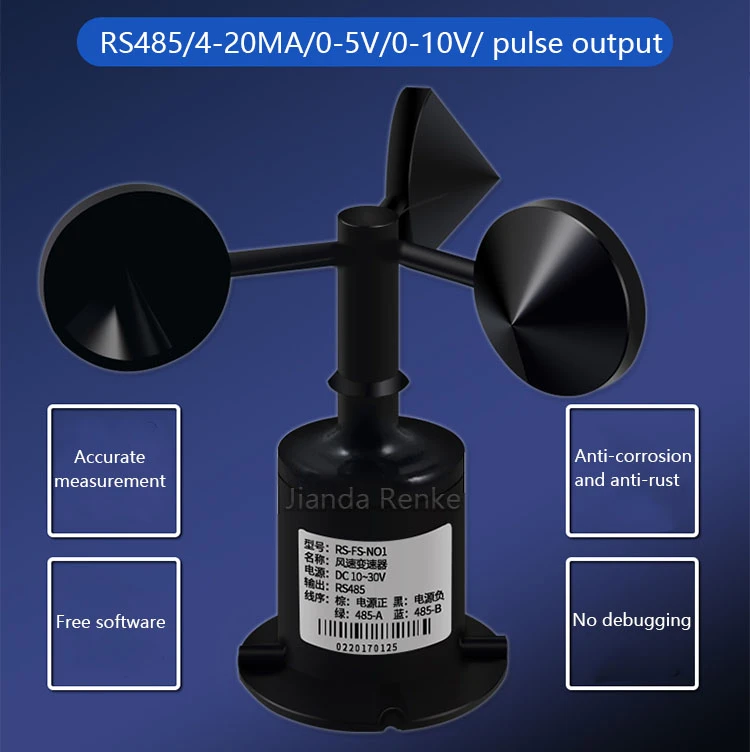 [/caption]
When the wind blows from the left, the wind cup 1 is parallel to the wind direction, and the force component of the wind pressure on the wind cup 1 in the direction most straight to the axis of the wind cup is approximately zero. Wind cups 2 and 3 intersect with the wind direction at an angle of 60 degrees. For wind cup 2, its concave surface faces the wind and bears the greatest wind pressure; wind cup 3 has a convex surface facing the wind, and the wind\'s circumfluence makes it bear the wind pressure It is smaller than wind cup 2, because the pressure difference between wind cup 2 and wind cup 3 in the direction perpendicular to the axis of the wind cup makes the wind cup start to rotate clockwise. The greater the wind speed, the greater the initial pressure difference. The greater the acceleration, the faster the wind cup rotates.
After the wind cup starts to rotate, because the cup 2 rotates in the direction of the wind, the pressure of the wind is relatively reduced, while the cup 3 rotates at the same speed against the wind, the wind pressure is relatively increased, and the wind pressure difference is continuously reduced. After a period of time (when the wind speed is constant), when the partial pressure difference acting on the three wind cups is zero, the wind cups will rotate at a uniform speed. In this way, the wind speed can be determined according to the speed of the wind cup (the number of turns per second).
When the wind cup rotates, it drives the coaxial multi-tooth cutting disc or magnetic rod to rotate, and the pulse signal proportional to the speed of the wind cup is obtained through the circuit. The pulse signal is counted by a counter, and the actual wind speed value can be obtained after conversion. At present, the new rotor anemometer adopts three cups, and the performance of the cone cup is better than that of the hemispherical cup. When the wind speed increases, the rotor cup can quickly increase the speed to adapt to the airflow speed. When the wind speed decreases, due to the influence of inertia, the speed However, it cannot drop immediately. The wind speed indicated by the rotary anemometer in gusty wind is generally too high and becomes an excessive effect (the average error produced is about 10%).


























Sign in to leave a comment.