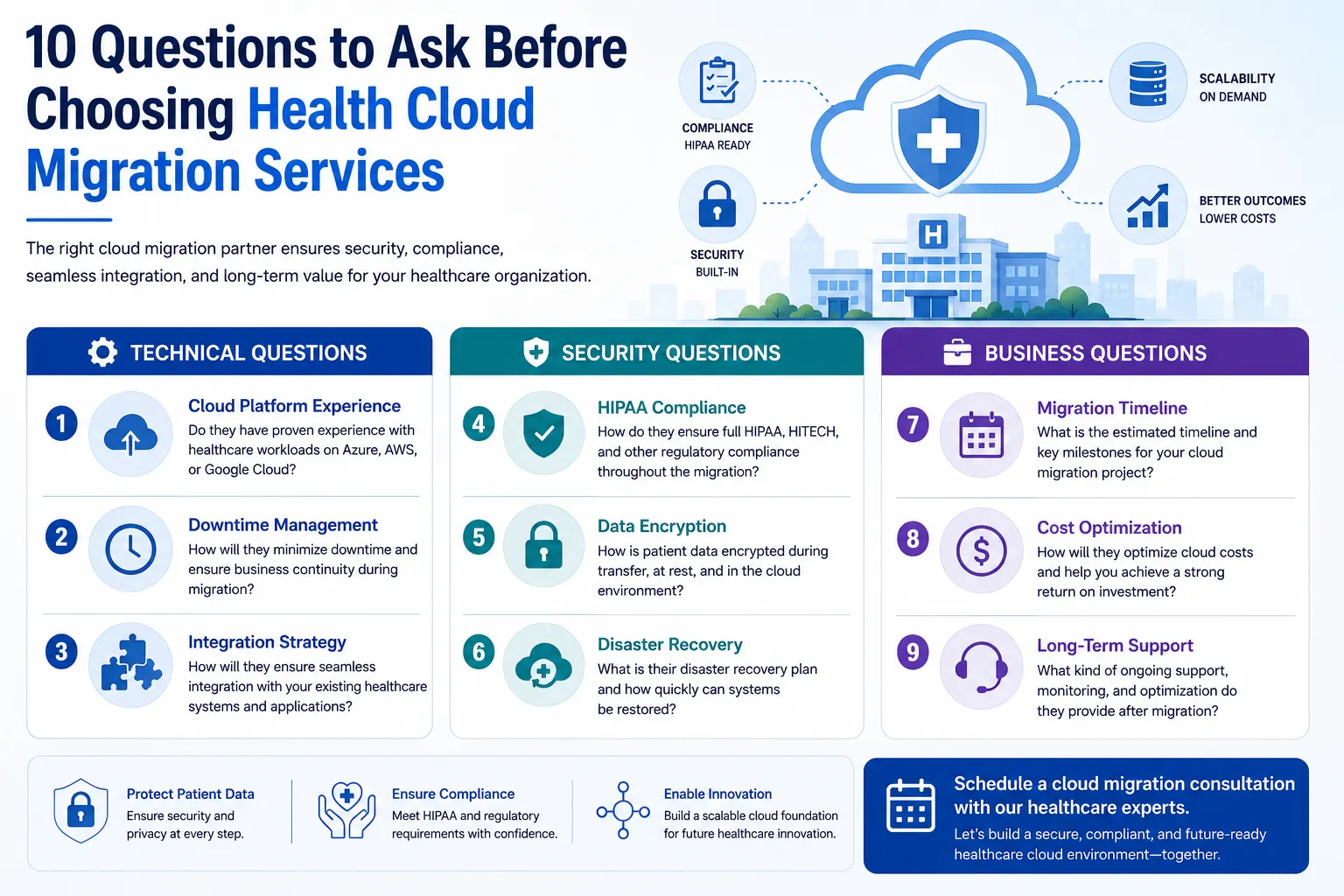

Healthcare organizations are increasingly moving critical applications, patient data, and clinical workflows to the cloud to improve scalability, enhance security, and support digital transformation. However, migrating healthcare systems is far more complex than transferring data from one environment to another. It requires careful planning, regulatory compliance, secure data handling, and seamless integration with existing healthcare applications.
Choosing the right provider for Health Cloud Migration Services can determine whether your migration delivers long-term business value or creates operational challenges. Before selecting a technology partner, healthcare leaders should ask the right questions to evaluate technical expertise, security capabilities, and long-term support.
This guide highlights the ten essential questions every healthcare organization should ask before investing in Health Cloud Migration Services.
Technical Questions
A successful cloud migration begins with technical expertise. Your migration partner should understand healthcare infrastructure, cloud architecture, and the complexities of modern healthcare applications.
1. What Experience Do You Have with Healthcare Cloud Platforms?
Not all cloud migration providers have healthcare-specific expertise. Healthcare organizations operate mission-critical systems such as Electronic Health Records (EHRs), Laboratory Information Systems (LIS), Radiology Information Systems (RIS), and patient portals that require specialized migration strategies.
Ask whether the provider has experience with:
- Microsoft Azure for Healthcare
- Amazon Web Services (AWS)
- Google Cloud Platform (GCP)
- Hybrid cloud environments
- Healthcare SaaS applications
A provider specializing in Health Cloud Migration Services should understand healthcare regulations, interoperability standards, and clinical workflows in addition to cloud technologies.
2. How Will You Minimize Downtime During Migration?
Healthcare operates around the clock. Even a short outage can disrupt patient care, delay clinical decisions, and affect hospital operations.
Ask your migration partner:
- Will migration occur in phases?
- How will critical applications remain available?
- Is there a rollback strategy?
- How will patient access be maintained?
Experienced healthcare migration teams use strategies such as phased migration, replication, and failover planning to minimize downtime while maintaining business continuity.
3. What Is Your Integration Strategy?
Healthcare organizations rely on dozens of interconnected applications.
Your cloud migration should preserve integrations between:
- Electronic Health Records
- Laboratory systems
- Pharmacy systems
- Medical imaging platforms
- Billing software
- Patient portals
- Telehealth platforms
A reliable Health Cloud Migration Services provider should have expertise in interoperability standards such as HL7, FHIR, DICOM, and SMART on FHIR to ensure seamless communication across systems after migration.
Security Questions
Healthcare organizations manage highly sensitive patient information. Security should be integrated into every stage of the migration process rather than treated as a post-migration task.
4. How Do You Ensure HIPAA Compliance?
Compliance is one of the most important factors when selecting a healthcare cloud migration partner.
Ask how the provider addresses:
- HIPAA requirements
- HITECH regulations
- GDPR compliance (where applicable)
- Audit logging
- Access controls
- Compliance reporting
Specialized Health Cloud Migration Services should include compliance assessments before migration and continuous monitoring afterward to maintain regulatory standards.
5. How Will Patient Data Be Protected?
Healthcare organizations cannot afford data breaches during migration.
Ask about the provider's security practices, including:
- End-to-end encryption
- Data encryption at rest
- Encryption during data transfer
- Identity and Access Management (IAM)
- Multi-factor authentication
- Zero Trust security architecture
Strong security practices reduce the risk of unauthorized access while ensuring Protected Health Information (PHI) remains secure throughout the migration lifecycle.
6. What Is Your Disaster Recovery Plan?
Unexpected events can occur during any migration project.
Ask whether the provider offers:
- Automated backups
- Disaster recovery planning
- Multi-region replication
- Business continuity planning
- Recovery Time Objectives (RTO)
- Recovery Point Objectives (RPO)
A comprehensive disaster recovery strategy ensures healthcare organizations can quickly restore critical systems while minimizing operational disruption.
Business Questions
Beyond technology, healthcare cloud migration should support long-term organizational goals. The right provider should offer business value that extends well beyond implementation.
7. What Is the Estimated Migration Timeline?
Every healthcare organization has different infrastructure, applications, and operational requirements.
Ask for a realistic project plan that includes:
- Infrastructure assessment
- Cloud readiness evaluation
- Migration planning
- Pilot migration
- Production migration
- Testing and validation
- Post-migration optimization
An experienced provider offering Health Cloud Migration Services should provide a clear roadmap with defined milestones and transparent communication throughout the project.
8. How Can You Help Optimize Cloud Costs?
Cloud migration is not just about moving workloads—it is also about optimizing infrastructure for long-term efficiency.
Ask how the provider will help you:
- Eliminate unnecessary resources
- Optimize storage
- Right-size virtual machines
- Monitor cloud spending
- Reduce infrastructure costs
- Improve resource utilization
A well-planned migration reduces total cost of ownership while improving system performance.
9. What Long-Term Support Do You Provide?
Cloud migration is the beginning of an ongoing optimization journey.
Ask whether the provider offers:
- Managed cloud services
- Security monitoring
- Infrastructure optimization
- Performance tuning
- Compliance monitoring
- Software updates
- Technical support
Long-term support ensures your healthcare cloud environment continues evolving as organizational needs change.
10. Can You Share Healthcare Migration Success Stories?
Past experience is one of the strongest indicators of future success.
Ask potential providers about:
- Healthcare migration projects
- Similar healthcare organizations served
- Industry certifications
- Technology partnerships
- Client references
- Measurable business outcomes
A reputable provider should demonstrate proven experience delivering secure and compliant Health Cloud Migration Services for healthcare organizations.
Why Asking These Questions Matters
Choosing the wrong migration partner can result in:
- Extended downtime
- Data loss
- Compliance violations
- Security vulnerabilities
- Integration failures
- Unexpected costs
- Delayed digital transformation
By asking the right questions early, healthcare organizations can reduce migration risks and build a secure, scalable cloud environment that supports long-term innovation.
Characteristics of a Trusted Health Cloud Migration Partner
When evaluating providers, look for a partner that offers:
- Proven healthcare industry experience
- Expertise in cloud-native healthcare applications
- Knowledge of HL7, FHIR, and DICOM standards
- HIPAA-compliant migration methodologies
- Strong cybersecurity capabilities
- Automated migration tools
- Continuous monitoring and optimization
- Transparent project governance
- Scalable cloud architecture
- Ongoing managed services
A healthcare-focused partner understands both technology and clinical operations, ensuring migrations are aligned with patient care and business objectives.
Conclusion
Cloud migration is one of the most important investments healthcare organizations can make to modernize infrastructure, improve operational efficiency, and support future innovation. However, achieving these outcomes depends on selecting the right technology partner.
By asking these ten essential questions, healthcare leaders can confidently evaluate providers based on technical expertise, security practices, compliance knowledge, and long-term support capabilities. Experienced Health Cloud Migration Services providers not only migrate systems securely but also help organizations build resilient, compliant, and future-ready healthcare ecosystems.
Investing time in choosing the right migration partner today can significantly reduce risks, improve patient care, and maximize the long-term value of your cloud transformation initiative.





























Sign in to leave a comment.