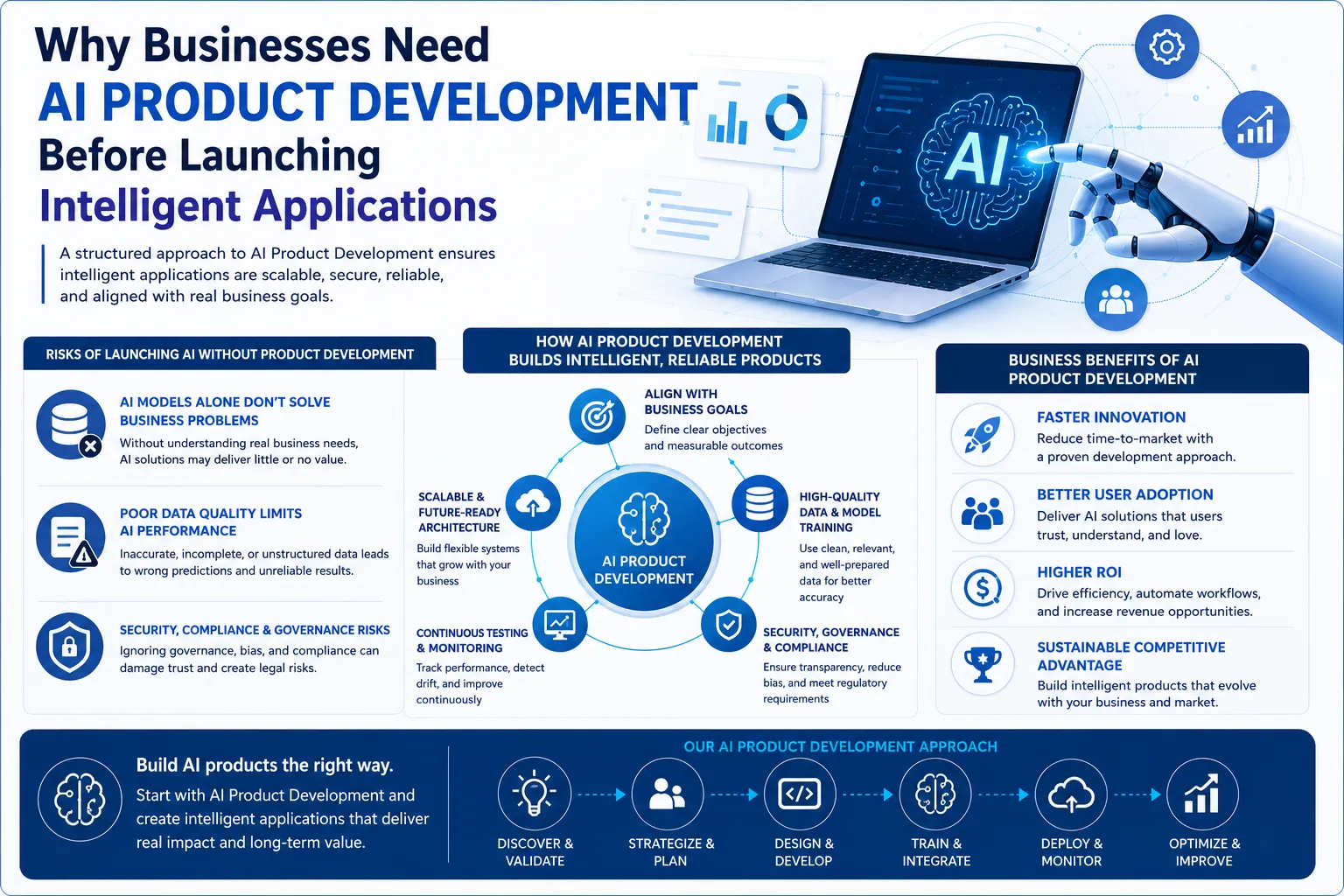

Artificial intelligence is rapidly changing the way businesses build products, engage customers, and compete in the digital economy. Organizations across industries are integrating AI into customer service, healthcare, finance, manufacturing, retail, and enterprise operations to automate workflows, generate insights, and create personalized user experiences. As AI technologies continue to mature, the demand for intelligent applications has grown significantly.
However, launching an AI-powered application is far more complex than integrating a large language model or deploying a machine learning algorithm. Many businesses rush into AI implementation because of market pressure, only to discover that their applications fail to meet user expectations, deliver inconsistent results, or become difficult to scale. In many cases, technology itself is not a problem. The real issue is the absence of a structured AI Product Development strategy.
Successful AI products require careful planning before development begins. Organizations must identify the right business problem, define measurable objectives, prepare high-quality data, design scalable architecture, establish governance frameworks, and continuously monitor model performance after deployment. Without these foundational steps, intelligent applications often struggle to generate meaningful business value.
This is why AI Product Development has become an essential part of enterprise digital transformation. It provides a structured framework that aligns artificial intelligence with business goals while ensuring security, scalability, regulatory compliance, and long-term maintainability. Rather than treating AI as a standalone technology, businesses can develop intelligent products that solve real-world challenges and continue improving over time.
Organizations that invest in AI Product Development before launching intelligent applications reduce implementation risks, accelerate innovation, and create solutions that deliver measurable returns while adapting to future business needs.
Why Launching AI Applications Without Product Development Creates Business Risks
The growing popularity of artificial intelligence has encouraged many organizations to experiment with AI-powered applications. While rapid innovation is important, deploying AI without a structured product development approach often creates technical, operational, and business challenges that limit long-term success.
Instead of solving complex problems, poorly planned AI initiatives can increase costs, reduce user trust, and delay digital transformation efforts.
AI Models Alone Do Not Solve Business Problems
One of the most common misconceptions surrounding artificial intelligence is that selecting an advanced AI model automatically guarantees business success. In reality, even the most sophisticated machine learning models cannot deliver value if they are not aligned with clearly defined business objectives.
Many organizations begin AI projects by focusing on available technologies rather than identifying the problems they want to solve. They may implement generative AI for customer support, predictive analytics for operations, or recommendation engines for sales without first understanding user requirements or operational workflows. As a result, the final product often addresses technical possibilities instead of actual business needs.
A structured AI Product Development process starts with problem identification rather than technology selection. Product teams work closely with stakeholders to understand operational challenges, define measurable success criteria, prioritize high-impact use cases, and evaluate how artificial intelligence can create meaningful business outcomes.
This business-first approach ensures that AI investments support strategic objectives rather than becoming isolated technology experiments.
Poor Data Quality Limits AI Performance
Artificial intelligence depends on accurate, relevant, and well-structured data. Even the most advanced algorithms cannot produce reliable results when trained on incomplete, inconsistent, or low-quality datasets. Unfortunately, many organizations underestimate the importance of data preparation during AI implementation.
Business data often exists across multiple systems, including CRM platforms, ERP applications, cloud databases, spreadsheets, customer portals, and legacy software. These disconnected sources frequently contain duplicate records, missing values, outdated information, and inconsistent formats that negatively affect AI model performance.
Without proper data engineering, intelligent applications may generate inaccurate predictions, unreliable recommendations, or inconsistent responses that reduce user confidence.
AI Product Development places strong emphasis on data readiness before model development begins. Teams evaluate data quality, establish governance standards, clean and organize datasets, and create reliable data pipelines that continuously supply high-quality information to AI models.
This preparation significantly improves model accuracy while reducing operational risks after deployment.
Security, Compliance, and Governance Cannot Be an Afterthought
As businesses deploy AI across customer-facing applications and enterprise systems, protecting sensitive information becomes increasingly important. Industries such as healthcare, finance, insurance, and manufacturing operate under strict regulatory requirements that govern how data is collected, processed, stored, and shared.
Organizations that overlook security and compliance during AI implementation expose themselves to significant operational, financial, and reputational risks. Unauthorized access, biased AI outputs, lack of explainability, and poor governance can undermine customer trust while creating compliance challenges.
A comprehensive AI Product Development strategy addresses these concerns from the beginning. Security architecture, access controls, data privacy measures, AI governance policies, model transparency, and regulatory compliance are incorporated throughout the product lifecycle rather than added after deployment.
This proactive approach enables organizations to build intelligent applications that are not only innovative but also secure, trustworthy, and compliant with evolving industry standards.
How AI Product Development Creates a Strong Foundation for Intelligent Applications
Developing a successful AI-powered application requires much more than selecting a machine learning model or integrating a generative AI service. Organizations need a structured development process that connects business strategy, technology, data, user experience, and long-term operational goals. This is where AI Product Development delivers lasting value.
A comprehensive product development approach ensures that intelligent applications are scalable, secure, and capable of evolving alongside changing business requirements. Rather than creating isolated AI features, businesses build products that continuously improve through data, user feedback, and ongoing optimization.
Aligning AI Solutions with Business Goals
Every successful AI initiative begins with a clearly defined business objective. Whether the goal is improving customer service, automating repetitive tasks, increasing operational efficiency, or generating predictive insights, artificial intelligence should directly support measurable business outcomes.
Without strategic alignment, organizations often develop AI applications that are technically impressive but provide limited practical value. Employees may struggle to adopt new systems, customers may not trust AI-generated recommendations, and leadership may find it difficult to justify continued investment.
AI Product Development addresses this challenge by involving business stakeholders throughout the product lifecycle. Product managers, domain experts, engineers, designers, and data scientists collaborate to define user needs, establish performance metrics, and prioritize features that solve real business problems.
This collaborative approach ensures that AI becomes an enabler of business growth rather than an isolated technology initiative.
Designing Scalable and Future-Ready AI Architecture
Many organizations begin with a successful AI proof of concept but encounter significant challenges when expanding the solution across departments, business units, or geographic locations. Systems that perform well in limited environments often struggle under enterprise workloads if scalability is not considered during development.
A well-planned AI Product Development strategy focuses on building flexible architecture from the beginning. Cloud-native infrastructure, modular system design, secure APIs, containerized deployment, and scalable data pipelines enable organizations to support increasing workloads without extensive redevelopment.
Future-ready architecture also allows businesses to integrate emerging AI technologies as they become available. Whether adopting new large language models, expanding predictive analytics capabilities, or connecting additional enterprise systems, organizations with scalable AI foundations can innovate more quickly while protecting previous technology investments.
This flexibility reduces long-term costs and allows AI products to evolve alongside changing business priorities.
Continuous Testing, Monitoring, and Model Improvement
Unlike traditional software applications, AI products require ongoing evaluation after deployment. Customer behavior changes, business processes evolve, and new data becomes available over time. Without continuous monitoring, AI models may experience performance degradation, inaccurate predictions, or reduced reliability.
AI Product Development includes lifecycle management practices such as continuous testing, performance monitoring, model validation, bias detection, and retraining. These activities ensure that intelligent applications maintain high levels of accuracy while adapting to changing business environments.
Organizations also benefit from continuous user feedback, allowing product teams to improve features, refine AI responses, and introduce enhancements that increase customer satisfaction and business value.
By treating AI as an evolving product rather than a one-time implementation, businesses create intelligent applications that remain effective long after their initial launch.
Why Businesses That Invest in AI Product Development Gain a Competitive Advantage
Artificial intelligence is becoming a competitive differentiator across nearly every industry. Organizations that invest in structured AI Product Development are better positioned to innovate, respond to market changes, and deliver exceptional customer experiences while minimizing operational risk.
Faster Innovation with Lower Risk
Launching AI products without a structured development methodology often results in delayed projects, budget overruns, inconsistent performance, and limited business adoption. Teams spend valuable time resolving issues that could have been prevented through proper planning.
A structured AI Product Development process reduces these risks by validating business requirements early, preparing reliable data, implementing secure architecture, and establishing governance throughout the development lifecycle.
This allows organizations to bring intelligent applications to market more quickly while maintaining higher quality and reducing implementation challenges.
Better User Adoption and Higher Business ROI
The success of an AI application depends not only on technical performance but also on how effectively users adopt and trust the solution. Applications that provide inconsistent recommendations, confusing interfaces, or unreliable outputs often experience low adoption regardless of their technical sophistication.
AI Product Development places equal emphasis on user experience, explainability, and business value. By designing intuitive workflows, incorporating user feedback, and ensuring transparent AI behavior, organizations increase user confidence and encourage broader adoption.
Higher adoption leads to stronger productivity improvements, greater operational efficiency, and better returns on AI investments.
Choosing the Right AI Product Development Partner
Building enterprise-grade AI products requires expertise across multiple disciplines, including software engineering, machine learning, data engineering, cloud infrastructure, MLOps, cybersecurity, user experience design, and industry-specific regulations.
Partnering with an experienced AI Product Development company enables organizations to accelerate innovation while reducing technical complexity. A trusted partner helps define product strategy, select appropriate AI technologies, develop scalable architecture, implement governance, and provide ongoing optimization after deployment.
This collaborative approach allows businesses to focus on strategic growth while ensuring that their AI products remain secure, scalable, and aligned with evolving market demands.
Conclusion
Artificial intelligence offers tremendous opportunities for organizations seeking to improve efficiency, automate operations, and create innovative digital experiences. However, sustainable success requires more than integrating AI models into existing applications.
AI Product Development provides the structured framework needed to transform innovative ideas into intelligent products that deliver measurable business value. By focusing on business alignment, data readiness, scalable architecture, security, governance, and continuous optimization, organizations reduce implementation risks while building solutions that remain effective as technology evolves.
Businesses that prioritize AI Product Development before launching intelligent applications are better equipped to accelerate innovation, improve customer experiences, increase operational efficiency, and maintain a competitive advantage in an increasingly AI-driven marketplace.






























Sign in to leave a comment.