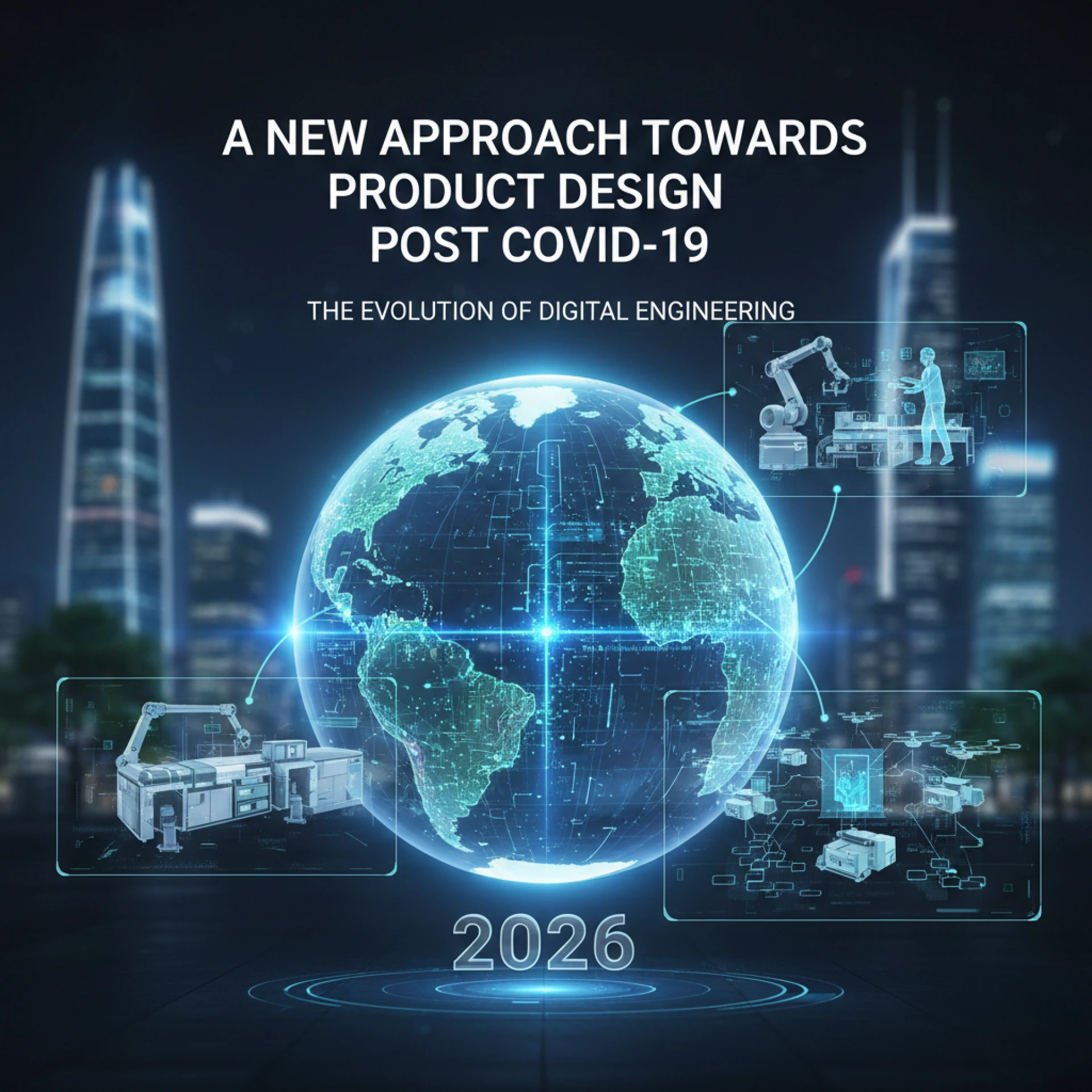

The Catalyst That Became the Standard
It has now been several years since the global pandemic initially fractured the supply chains and workflows of the manufacturing world. Looking back from the vantage point of 2026, it is clear that COVID-19 was not just a temporary disruption; it was the "Great Accelerator." It compressed a decade’s worth of digital transformation into a few frantic years, forcing a sink-or-swim evolution in how physical products are conceived, designed, and built.
In the immediate aftermath, the focus was on survival, keeping the lights on and the servers running. Today, that defensive posture has evolved into a sophisticated, proactive strategy. The "Post-COVID" era of product design is no longer defined by remote work restrictions or emergency supply pivots. Instead, it is defined by a new trinity of engineering principles: Resilience, Intelligence, and Circularity.
The design firms that merely "adapted" have stabilised, but the ones that thrived are those that fundamentally rewrote their playbook. They realised that the old linear method of product development, Concept → CAD → Prototype → Tooling, was too brittle for a volatile world. In its place, a dynamic, decentralised, and digitally integrated approach has emerged.
This article explores the five pillars of this new product design paradigm in 2026, offering a roadmap for engineering leaders navigating this transformed landscape.
1. The Digital-First Workflow: From "Remote" to "Distributed."
In 2020, "remote work" was a compromise. In 2026, Distributed Engineering is a competitive advantage. The best product design firms have stopped trying to replicate the physical office online and have instead built a "follow-the-sun" engineering ecosystem.
The Cloud as the New Studio
The era of storing CAD files on a local server under a desk is effectively over. Cloud-native PDM (Product Data Management) and PLM (Product Lifecycle Management) platforms have become the central nervous system of modern design. This shift allows for true concurrent engineering.
Real-Time Collaboration: A mechanical engineer in India can refine a housing design while an industrial designer in the UK adjusts the surfacing, and a manufacturing partner in Vietnam reviews draft angles, all simultaneously within a single assembly file.
The Single Source of Truth: Version-control errors, once a primary cause of scrapping expensive tooling, have been virtually eliminated by systems that track every geometric alteration in real time.
Spatial Computing enters the Design Review.
The Zoom fatigue of the early 2020s gave way to more immersive collaboration tools. With the maturity of enterprise-grade spatial computing (VR/AR) headsets, design reviews have moved from 2D screen sharing to 1:1 scale virtual walkthroughs.
Virtual Ergonomics: Instead of waiting weeks for a physical mockup, teams can now "hold" a virtual prototype and test ergonomic reach and assembly access in a mixed-reality environment.
Client Engagement: Product Design Services now routinely include VR sessions where clients can inspect textures, finishes, and internal components before a single line of G-code is written.
2. AI-Augmented Engineering: The Death of the Blank Page
If the pandemic forced us to go digital, the subsequent AI revolution forced us to go faster. The "new approach" to product design in 2026 relies heavily on Artificial Intelligence, not to replace engineers, but to remove the friction of iteration.
Generative Design at Scale
Historically, an engineer might manually model three or four bracket variations to test strength. Today, AI-driven Generative Design algorithms can synthesise hundreds of valid options in minutes based on defined constraints (load paths, material, manufacturing method).
Optimising for Cost & Carbon: Modern algorithms don't just optimise for strength; they optimise for sustainability. An engineer can ask the software to "minimise mass while using recycled aluminium," and the AI will generate organic, lattice-filled structures that use 40% less material than a human-designed equivalent.
Predictive Simulation
The traditional "design-then-test" cycle, where you build a model and then wait hours for a Finite Element Analysis (FEA) solver to run, is becoming obsolete. Real-time simulation, powered by AI models trained on historical physics data, provides instantaneous feedback. When an engineer extrudes a rib in CAD, the software provides a live "health check" of stress concentrations, effectively merging the design and analysis phases into a single, fluid workflow.
3. Supply Chain Resilience as a Design Parameter
Perhaps the most painful lesson of the pandemic was the fragility of global supply chains. In the old world, procurement was a problem for the purchasing department. In the post-COVID approach, supply chain resilience is a design constraint.
Designing for Availability
Engineers are now tasked with "multisource design." This means creating assemblies that are not dependent on a single, exotic component from a single supplier.
Standardisation: There is a renewed emphasis on using standard, off-the-shelf components (COTS) for non-critical interfaces.
Agile Material Selection: Smart BOMs (Bill of Materials) now link directly to live global inventory databases. If a specific grade of ABS plastic is in short supply in the APAC region, the design software can flag this risk immediately, prompting the engineer to specify an alternative polymer or adjust the mould design to accommodate multiple material grades.
The Rise of Local Manufacturing
To mitigate the risk of cross-border shipping delays, product designs are increasingly optimised for distributed manufacturing. Instead of a single massive factory producing 100% of the global supply, designs are adapted for smaller, regional microfactories. This requires a modular design architecture in which sub-assemblies can be produced locally using additive manufacturing (3D printing) or CNC machining, reducing reliance on massive, centralised tooling.
4. The Sustainability Imperative: Circularity & The Right to Repair
Consumer values shifted dramatically during and after the pandemic. There is a heightened awareness of waste and a growing intolerance for "planned obsolescence." The new product design approach prioritises Circularity, the idea that a product’s end-of-life is just as important as its beginning.
Digital Product Passports (DPP)
Regulatory frameworks, particularly in the EU and North America, now push for transparency. Products are being designed with "Digital Passports" QR codes or RFID tags that store data on the product's origin, material composition, and repair manuals.
Data-Driven Recycling: For designers, this means meticulously cataloguing every material. You can no longer just specify "Glue"; you must specify a reversible adhesive that allows the battery to be separated from the chassis at the recycling centre.
Design for Disassembly (DfD)
The "sealed box" aesthetic of the 2010s is fading. Guided by "Right to Repair" legislation, mechanical engineers are returning to fasteners over glues.
Serviceability as a Feature: Leading brands are marketing repairability as a premium feature. Machine Design Services is focusing on modular architectures that allow consumers to replace a worn-out fan or battery with a simple screwdriver, extending the product's lifespan and deepening brand loyalty.
5. The "E-Commerce First" Aesthetic
The pandemic permanently altered retail behaviour. With e-commerce cementing itself as the primary sales channel, the role of industrial design has shifted. A product must now perform on a digital screen before it ever performs in a human hand.
Visual Impact & The "Unboxing" Era
In a physical store, a customer might pick up a product to feel its weight and balance. Online, they rely on renders and reviews.
Render-Ready Design: Surface finishes and textures are often chosen specifically for how well they render in digital marketing materials. High-contrast matte/gloss combinations that "pop" on Instagram feeds are prioritised over subtle textures that only read well in person.
Packaging Engineering: The unboxing experience is the only physical touchpoint a brand has with its direct-to-consumer audience. Structural packaging design has elevated from a protective necessity to a theatrical event. Engineers must balance the "reveal" with the brutal reality of last-mile delivery logistics, ensuring the product survives a 4-foot drop while still looking pristine upon opening.
Hygiene-Conscious Materials
A lasting psychological legacy of the pandemic is a heightened sensitivity to hygiene. While we are no longer sanitising groceries, the demand for "clean" materials persists in high-touch products (medical devices, consumer electronics, public kiosks).
Antimicrobial Surfaces: Designers are increasingly specifying inherently antimicrobial copper alloys or silver-ion infused plastics for touchpoints.
Cleanability: Complex knurling or deep textures that trap dirt are being replaced by smooth, non-porous surfaces that wipe down easily without degrading, a crucial consideration for Industrial Design Services.
Looking Back to Move Forward
The transition from the chaos of 2020 to the streamlined efficiency of 2026 hasn't been easy, but the industry is undeniably stronger for it. We have moved from fragile, centralised processes to resilient, distributed ecosystems.
For a deeper look at the origins of these trends and to see how far the industry has come, read our earlier analysis, A New Approach Towards Product Design Post COVID-19.
Understanding where we came from is key to navigating where we are going. The engineering leaders of the future will not be defined by their ability to draw the perfect line, but by their ability to weave these complex threads, AI, sustainability, resilience, and user experience into a coherent, successful product.
























Sign in to leave a comment.