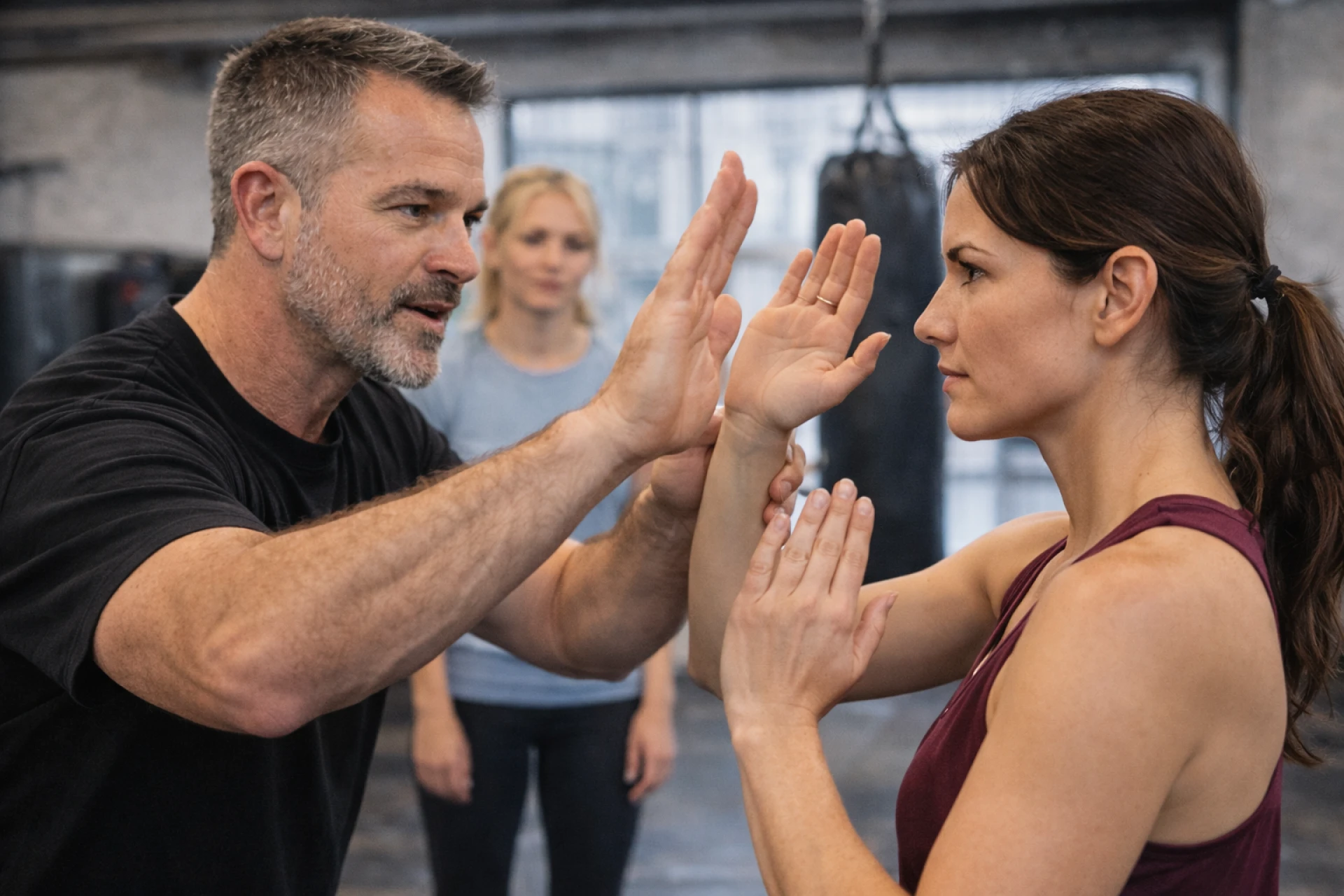

Many adults believe that staying safe depends on reacting at the right moment, but most real situations do not begin with a clear signal that action is required. They develop gradually through small changes in behavior, distance, and communication that are easy to overlook without training.
After teaching thousands of adults in New York City, one pattern appears repeatedly. The situations that later become difficult often start in a way that feels unclear rather than dangerous. A conversation continues longer than expected, someone ignores a social boundary, or the space between people slowly becomes smaller. These early moments are where awareness matters most, and where adult self defense begins to shape how a person understands what is happening in real time.
How risk develops in everyday life
Most uncomfortable situations begin in normal environments such as public transportation, workplaces, or crowded streets. There is rarely a clear point where a situation suddenly becomes unsafe. Instead, there is a gradual shift that creates uncertainty.
This uncertainty leads to hesitation. People often wait for a situation to become obvious before responding, and that delay allows the interaction to continue. As the situation progresses, pressure builds and decision making becomes slower.
Training focuses on recognizing these early changes. Instead of reacting late, students learn to notice when something starts to feel different and respond while the situation is still manageable.
Situational awareness in adult self defense
Situational awareness allows a person to observe changes without becoming overwhelmed by the environment. In a busy city like New York, this means understanding how behavior and movement shift within crowded spaces.
On a subway platform, for example, someone may repeatedly move closer or continue engaging despite minimal response. These are early signals that often appear before any clear escalation. Recognizing them creates the opportunity to adjust position or disengage.
Students who begin attending adult self defense classes often realize that awareness is not automatic. It is developed through repetition, exposure, and understanding how real interactions unfold.
Boundary setting as a safety skill
Once a situation begins to shift, communication becomes the next step. Boundary setting allows a person to interrupt the direction of an interaction before it develops further.
Many adults hesitate at this stage because they are unsure whether the situation justifies a response. That hesitation often allows the interaction to continue. Training addresses this by practicing direct communication that is clear and controlled.
Over time, students learn how to respond without delay. The goal is to manage the situation early rather than waiting for it to escalate into something more difficult to control.
Positioning and distance management
Distance affects how much time and space a person has to respond. When distance is maintained, there are more options. When it is reduced, reactions become more immediate and less controlled.
Training teaches how to adjust position based on the environment. This includes staying in visible areas, maintaining space, and being aware of exits and movement around you. These adjustments are simple, but they play a critical role in preventing situations from progressing.
For those starting training, understanding how to choose the right krav maga class helps ensure that these practical elements are actually part of the program rather than overlooked.
Decision making under stress
As pressure increases, the ability to think clearly becomes more difficult. Breathing changes, attention narrows, and hesitation becomes more likely. This is where many people struggle, even if they understand what they should do.
Training introduces controlled stress so that these reactions can be experienced in a structured environment. Over time, this reduces hesitation and allows decisions to remain more consistent.
The process is gradual, and it reflects how the body adapts through repetition and exposure. This is explained through real science before transformation, where consistent training leads to measurable changes in how people respond under pressure.
How training connects these skills
Structured training connects awareness, communication, positioning, and decision making into one continuous process. Instead of treating them as separate ideas, they are practiced together in a way that reflects real situations.
At Krav Maga Experts in New York City, training is designed around how interactions actually develop in everyday environments. Students are exposed to scenarios that help them understand when to act, how to respond, and how early decisions affect outcomes.
With consistent training, responses become more natural and less dependent on hesitation.
Real life application in New York City
A common situation happens during a late evening commute. Someone stands on a subway platform while another person nearby continues initiating conversation despite limited response and gradually reduces distance.
Without awareness, this interaction may continue until it becomes difficult to manage. With training, the pattern is recognized earlier. A boundary is set, and positioning changes to maintain space or move toward a more visible area.
These decisions take place before the situation escalates, which is where most outcomes are shaped.
Why structured training matters
General safety advice often focuses on reacting to danger, but it does not explain how situations develop or why people hesitate. Adult self defense provides a structured way to recognize early signs, respond without delay, and maintain control in environments where situations are rarely clear.
Adult self defense: how to recognize and respond to risk early becomes practical through training that reflects real life. It allows people to move through everyday environments with a clearer understanding of what is happening and how to respond at the right time.
FAQs
What do adult self defense classes teach first?
Training begins with situational awareness and positioning so early changes can be recognized before pressure builds.
Do you need experience to start adult self defense training?
No. Programs are designed for beginners and build skills progressively through structured practice.
How long does it take to develop self defense skills?
Basic awareness and response skills can improve within a few months of consistent training.
How often should adults train self defense?
Most students train one to two times per week to build consistency and improve decision making.
Is adult self defense useful in everyday life?
Yes. The skills apply directly to public transportation, workplaces, and daily interactions where awareness and early response matter most.




























Sign in to leave a comment.