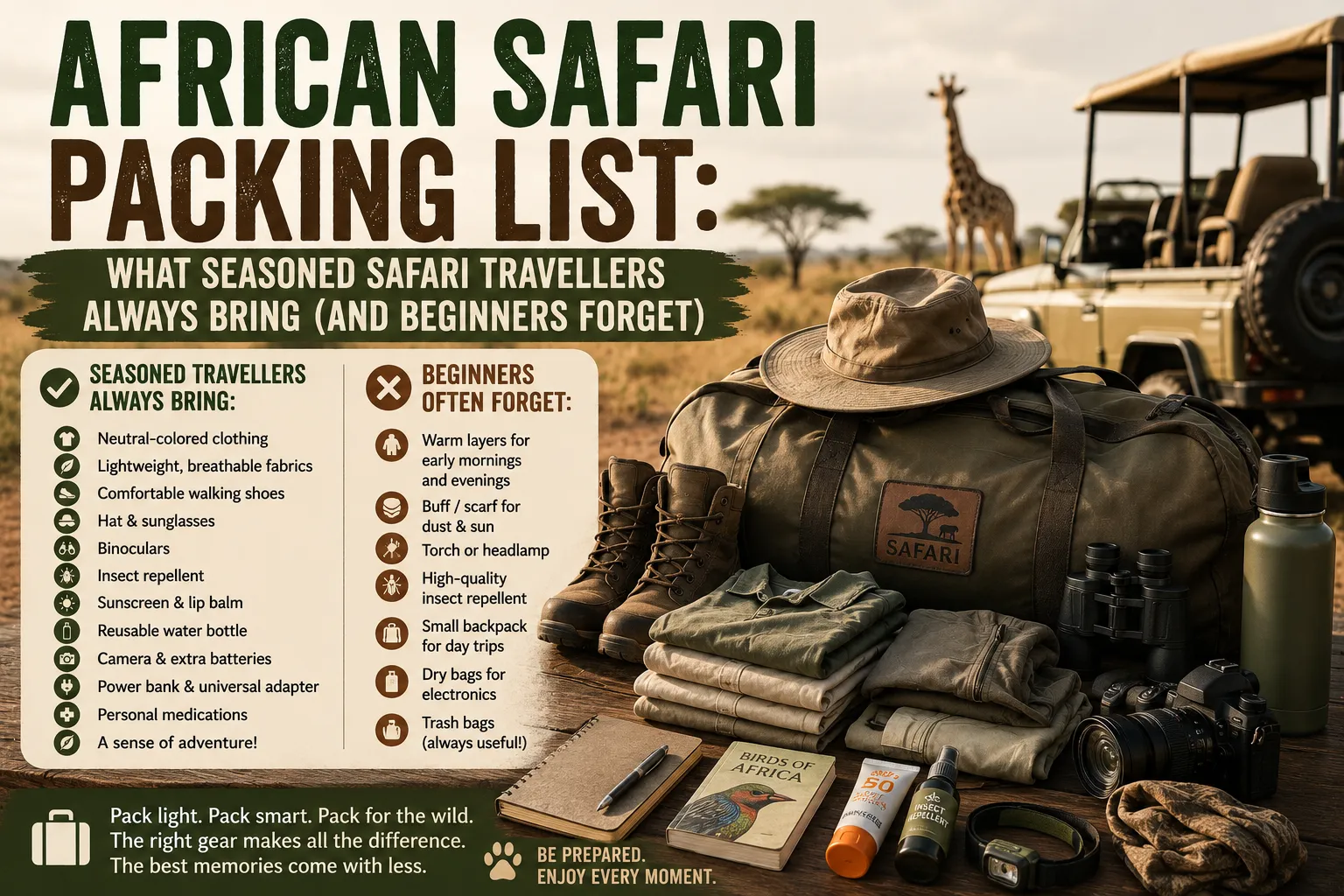

There is a particular type of luggage anxiety that belongs exclusively to first-time safari travellers. It usually arrives about two weeks before departure, when the reality of packing for a remote wilderness in a bag that cannot exceed fifteen kilograms, on a light aircraft with a baggage hold the size of a kitchen cabinet finally becomes concrete.
I have watched people arrive at bush camps with rolling suitcases the size of a small wardrobe. I have watched others step off a charter flight in pristine white linen, look at the red dust of the Kenyan landscape, and understand immediately what they got wrong. And I have watched seasoned travellers unzip a single soft duffel and produce, with quiet efficiency, exactly what they need for ten days in the field.
The difference between those travellers is not money. It is knowledge the kind that accumulates over multiple trips and cannot be fully communicated by a generic African safari packing list. This article is an attempt to close that gap. What follows is what experienced safari travellers actually pack, why each item matters, and what most first-timers leave behind, bring too much of, or simply never think to include.
The Rules Before the List
Before we get into specifics, three non-negotiable packing principles govern everything else.
Soft bags only. Almost every light aircraft used for bush transfers across Kenya, Tanzania, Botswana, and Zimbabwe has a strict policy on luggage: soft-sided bags only, maximum fifteen kilograms, sometimes less. Hard-shell suitcases cannot be compressed into the cargo hold of a Cessna Caravan. If you arrive with one, you will be asked to leave it at the departure airstrip, sometimes without warning. Most lodges can store excess luggage, but the inconvenience is real and avoidable. A soft duffel or a collapsible bag with a carry-on is the correct configuration.
Neutral colours only. This is not an aesthetic preference. Bright colours, particularly white, red, and blue, are visible to wildlife at distances that can affect animal behaviour and, in some cases, safety on walking safaris. Khaki, olive, tan, dark green, and grey are the colours of the bush. Pack accordingly.
Pack less than you think you need. Lodges provide laundry service, usually overnight. You do not need seven changes of clothes for a seven-day safari. You need three or four well-chosen outfits that rotate through a reliable wash cycle. The weight you save is weight you can give to the items that genuinely matter.
Clothing: What Works and What Doesn't
The Layers System
The temperature on safari is not what most people expect. Mornings in the Masai Mara in July can drop to eight degrees Celsius. By ten in the morning, you are in short sleeves. By midday, it is hot enough to wish for shade. By the time the evening drive ends at seven-thirty, the temperature has dropped again sharply.
This range sometimes twenty degrees within a single day means that packing for a single temperature is a mistake. The layers system is the answer.
Base layer: Lightweight, moisture-wicking long-sleeved shirts in neutral colours. These pull double duty — sun protection during the day and warmth under a fleece in the morning. Merino wool is the gold standard because it regulates temperature, resists odour, and feels comfortable against skin for extended periods in a vehicle.
Mid layer: A lightweight fleece or down jacket that compresses small. This goes on for morning drives and comes off by nine. It does not need to be heavy it needs to be packable.
Outer layer: A windproof, water-resistant shell jacket for unexpected rain. Not a full rain suit just enough to cut the wind on an open vehicle in a downpour. This is the item most first-timers skip and most seasoned travellers consider essential.
Bottoms: Convertible trousers that zip off into shorts are genuinely useful on safari in a way they rarely are elsewhere. Two pairs cover most itineraries when laundry is available. Avoid jeans they are heavy, take forever to dry, and provide no particular advantage over purpose-built travel trousers.
What Beginners Always Overpack
Formal wear. Swimwear beyond one set. Multiple pairs of shoes. Evening wear for dinners that are, in reality, held around a campfire in the bush and attended in the same clothes you wore on the afternoon game drive. Most safari lodges are relaxed about dinner attire. One smart-casual outfit is more than sufficient.
Also Read:- How Are Travel Costs Changing for Wildebeest Migration Safaris in 2026?
Footwear: Three Pairs Maximum
Walking boots or trail shoes: For bush walks and activities on uneven terrain. These do not need to be heavy-duty hiking boots unless you are planning serious multi-day walks. A mid-weight trail shoe with ankle support is sufficient for most safari walking activities. Break them in before you go; blisters on a walking safari are miserable.
Sandals or flip-flops: For evenings around camp and moving between the lodge facilities. Essential. Sandals that can double as light walking shoes in dry conditions are worth the small extra weight.
One additional pair at most: Some travellers bring a third pair for specific activities. Most do not need it. Two pairs cover the full range of a standard safari itinerary.
Optics: The Investment That Pays Back Every Hour
This is where many first-timers underinvest and where experienced safari travellers are almost evangelical.
Binoculars: A good pair of binoculars transforms a safari from a good experience into an exceptional one. The ability to pick up a leopard's spots in a distant tree, to watch a lion's expression during a hunt, to identify a bird species from the vehicle none of this is possible without quality optics. The minimum specification for safari use is 8x42 or 10x42. Roof prism binoculars are more compact and durable than porro prism designs. Brands like Nikon Monarch, Vortex Diamondback, and Zeiss Terra consistently perform well in field conditions.
Most first-timers either skip binoculars entirely or bring a cheap pair that fogs, loses focus, or delivers image quality too poor for low-light conditions. Dawn and dusk, the two most productive times for wildlife, are also the lowest-light periods of the day. Your binoculars need to work in those conditions.
Camera and telephoto lens: Safari photography requires reach. A 100–400mm zoom lens on a DSLR or mirrorless body is a reasonable starting point. For those who shoot on smartphones, a clip-on telephoto lens improves results considerably in good light. A beanbag for stabilising a long lens on a vehicle window ledge is a simple, lightweight accessory that experienced photographers consider non-negotiable.
Dust is the enemy of camera equipment in the bush. A zip-lock bag for lens changes, a microfibre cloth for daily cleaning, and a dry bag for storage in the vehicle are small additions that protect expensive equipment.
Health and Medical: The Items Guide Always Notice
Malaria prophylaxis: Non-negotiable for most safari destinations. Consult a travel health professional at least six weeks before departure to determine the appropriate medication for your specific itinerary and health profile. Begin the course as directed, not the day before you fly.
Insect repellent with DEET: High-concentration DEET repellent (at least 30–50%) is effective against the mosquitoes that carry malaria and other vector-borne diseases. Natural alternatives vary in effectiveness and are generally not recommended for high-risk malaria regions. Pack more than you think you need it evaporates quickly in heat and needs reapplication.
Broad-spectrum sunscreen, SPF 50+: The African sun is not comparable to the sun in most travellers' home countries. SPF 30 is insufficient for extended time in an open vehicle. Reapplication every two hours during full-sun game drives is practical guidance, not overcaution.
A comprehensive personal first aid kit: Most lodges have basic medical supplies and access to emergency evacuation services, but personal kits should include: antihistamines for insect bites and allergic reactions, oral rehydration salts for heat exhaustion, blister plasters, antiseptic wipes and cream, anti-diarrhoeal medication, and any prescription medications in quantities that exceed your trip length in case of delays.
Prescription medications in original packaging: With a copy of the prescription. This matters for customs in several African countries and for medical personnel if you need assistance in the field.
Safari Essentials That Beginners Consistently Forget
These are the items that generate the most conversation when experienced travellers compare notes because they are not obvious, they are hard to source once you are in the field, and their absence is disproportionately disruptive.
A headtorch, not a handheld torch: Walking between accommodation tents after dark a nightly reality at most bush camps requires both hands free and a light source pointing where you are looking. A headtorch with a red-light setting (which preserves night vision) is the correct tool. Pack spare batteries.
A power bank: Light aircraft transfers mean extended periods without access to charging points. A high-capacity power bank (20,000mAh minimum) keeps cameras, phones, and GPS devices operational across full days in the field.
Universal travel adapter with USB ports: Power sockets vary across Kenya, Tanzania, South Africa, and Botswana. A universal adapter with multiple USB ports reduces the number of individual chargers required and covers every regional variation.
Zip-lock bags in multiple sizes: For dust protection of electronics, wet swimwear, muddy shoes, snacks, and documentation. Experienced travellers bring ten to fifteen. They disappear quickly and earn their minimal weight every time.
A lightweight dry bag: For camera equipment and valuables during unexpected rain or water-based activities.
Neutral-coloured wide-brimmed hat: Not a baseball cap a full-brimmed hat that protects the neck and ears during extended periods in an open vehicle. The neck sunburn that most first-timers carry home from their first safari is entirely preventable.
Earplugs: Not for noise complaints, but for the lions that call through camp at three in the morning — a genuinely extraordinary sound that is also, at close range, one that prevents sleep without preparation.
Documents and Administration
Make physical and digital copies of every document before departure: passport, travel insurance policy with emergency contact numbers, vaccination certificates (yellow fever is required for entry to several countries), prescriptions, and booking confirmations. Store digital copies in cloud storage accessible without a local SIM card.
Travel insurance that explicitly covers emergency medical evacuation is essential for safari travel, not optional. Medical facilities in remote safari regions are limited. Evacuation to a major city hospital can cost tens of thousands of dollars without coverage.
What to Leave Behind
Anything valuable that is not trip-critical. Jewellery, designer accessories, and items with significant sentimental value have no place on safari. Not because the camps are unsafe most are extremely secure but because the bush environment subjects everything to dust, humidity, and physical wear.
More than one book. Most lodges have small libraries. Most travellers find they read less than expected because the days are full and the evenings short.
Unnecessary toiletries. Almost every lodge of any standard provides high-quality shampoo, conditioner, and body wash. Packing your own full-size bottles is weight spent on something already provided.
The Experienced Traveller's Final Check
The night before departure, most seasoned safari travellers run through the same mental checklist: binoculars, camera charged, malaria medication packed, headtorch and spare batteries confirmed, soft bag under the weight limit.
Everything else, at that point, is detail. The bush will provide the rest.























Sign in to leave a comment.