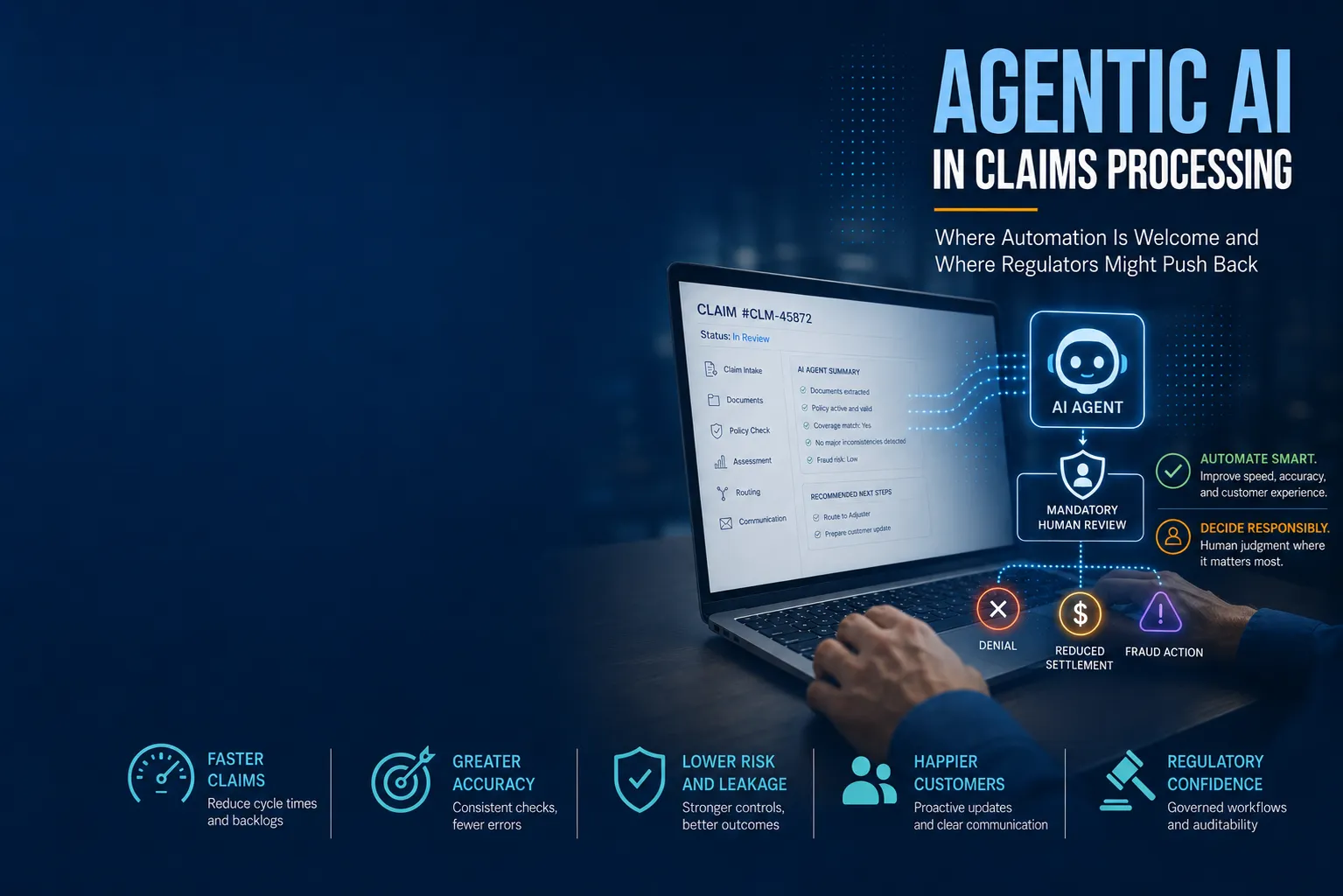

Introduction
In insurance operations, claims processing is often where growth grinds to a halt. Managing a modern claims queue means juggling massive volumes of documents, tedious policy verifications, and constant fraud checks, all while manually pushing data through fragmented settlement workflows. This heavy administrative burden does two things: it slows claim cycle times and makes maintaining consistency nearly impossible at scale. To protect margins and keep pace with customer expectations, insurers must rethink the manual processes holding their teams back.
This is why insurance claims automation is moving beyond simple digitization. AI Agents can now read claim files, extract information, check documents, coordinate workflows, route cases, generate summaries, and recommend next actions. These capabilities can improve processing speed, reduce rework, increase team capacity, and help insurers manage claims with greater operational control.
But claims are not just back-office transactions. They directly affect payouts, customer rights, fraud suspicion, legal exposure, and policyholder trust. J.D. Power’s 2025 U.S. Auto Claims Satisfaction Study reinforces this point, identifying trust as the most important factor shaping the claims experience. The thesis is therefore straightforward: the future of claims processing is not fully autonomous. It is a governed model where AI Agents handle routine work while humans remain accountable for judgment-heavy decisions.
How Claims Processing Used to Work?
Before AI agents entered claims operations, most workflows were built around human review, fixed business rules, and manual coordination between disconnected systems. The process was functional, but slow, resource-heavy, and difficult to scale consistently across high claim volumes.
Manual Claim Intake
Claims traditionally began through forms, emails, phone calls, photos, invoices, medical records, repair estimates, and police reports. Teams reviewed each submission by hand and keyed the details into internal systems. The volume of documents and the variety of formats slowed and made intake error-prone.
Rule-Based Eligibility Checks
Handlers verified whether the policy was active, whether the loss was covered, which exclusions applied, and how deductibles or limits affected the payout. These checks followed fixed rules, but they still depended on a person locating the right information and applying it correctly.
Human-Led Assessment
Adjusters, claims handlers, medical reviewers, fraud investigators, legal teams, and third-party assessors managed the interpretation-heavy parts of the process. Their judgment determined the outcome, and their time set the pace.
Slow Handoffs and Fragmented Systems
The core limitation was not only manual effort. It was the dependence on disconnected systems, repeated handoffs, inconsistent documentation, and slow exception handling. Each transfer between teams added delay, and customers frequently had to repeat information they had already provided. The result was a process that was expensive to run and difficult to make consistent across thousands of files.
What Has Changed With Agentic AI?
Agentic AI changes claims automation from a task-level efficiency tool into a workflow coordination layer. Earlier AI tools helped insurers complete isolated actions, such as optical character recognition, document classification, chatbot responses, and fraud scoring. AI Agents go further. They can read claim files, interpret context, trigger follow-up steps, route work, and prepare decisions across multiple systems.
From Task Automation to Workflow Coordination
Earlier automation and AI tools supported isolated tasks such as optical character recognition, document classification, chatbot responses, and fraud scoring. Agentic AI goes further by coordinating multiple steps across documents, systems, and teams. Instead of assisting with one task at a time, AI Agents can connect policy review, claim file analysis, document validation, customer communication, and workflow routing into a more continuous claims process.
What AI Agents Can Do in Claims Processing?
An AI Agent can:
- → Read claim forms, emails, PDFs, images, and attachments
- → Extract policy numbers, dates, loss details, amounts, and customer information
- → Identify missing documents
- → Compare claim details with policy coverage
- → Flag duplicate claims or inconsistencies
- → Route claims by severity, complexity, or fraud risk
- → Draft customer updates
- → Prepare evidence summaries for claims handlers
- → Recommend the next best action
The Real Shift
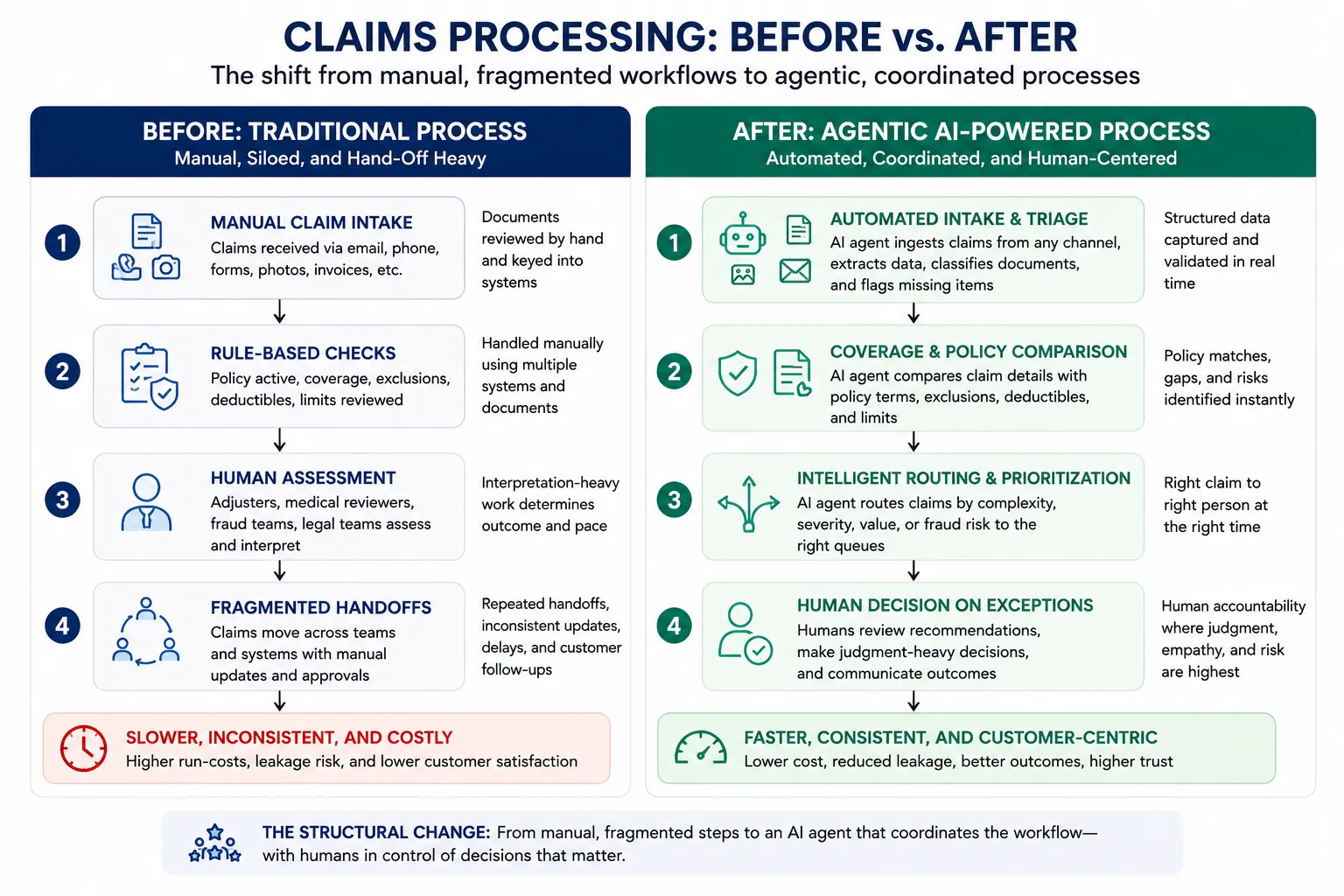
Claims professionals no longer need to process every step by hand. Their role is moving toward exception handling, validation, customer-sensitive decisions, and oversight of AI-assisted workflows.
This is the real operational shift. AI Agents can coordinate routine claims work, but they should not replace professional judgment. A claim may involve policy interpretation, medical context, repair validation, fraud concerns, customer vulnerability, or legal exposure. These areas require human review because the outcome directly affects the policyholder.
For insurers, Agentic AI is valuable when it reduces manual effort without weakening accountability. It can prepare the claim file, surface evidence, flag gaps, and recommend the next action. The claims professional still owns the decision, especially when the result involves denial, reduced payment, fraud escalation, or customer hardship.
Where Automation is Welcome in Claims Processing?
Automation is most defensible in claims processing when it improves speed, consistency, and file completeness without making the final claims decision. Regulators are less likely to object when AI Agents handle administrative, evidence-gathering, and routing tasks because these activities support the claims handler rather than replace judgment. The safer automation zone is therefore clear: use AI to prepare, organize, summarize, and escalate claims, while keeping humans accountable for coverage decisions, payment outcomes, fraud conclusions, and customer-sensitive exceptions.
Claim Intake and Document Triage
AI Agents are well-suited to classifying documents, extracting key fields, flagging missing files, and structuring claim evidence. This is also where insurers are investing first. EY reports that 68% of insurers are adopting automated data entry to streamline these steps. Claims processing automation at this stage removes manual rekeying without touching the decision itself.
Status Updates and Customer Communication
AI Agents can request missing documents, send status updates, explain next steps, and reduce avoidable call center volume. This addresses a measurable gap. Insurers deliver adequate proactive digital updates only 22% of the time, and that 52% of customers who rate their digital claims experience as poor or just OK are likely to leave or not renew. [Source: J.D. Power's 2025 U.S. Claims Digital Experience Study]. Communication is a low-risk, high-value place to apply AI claims automation.
Low-Value, Low-Complexity Claims
Claims with complete documentation, active coverage, no indicators of injury or fraud, and predictable settlement rules are strong candidates for higher automation. These cases follow clear rules and carry limited downside if reviewed on a sampling basis.
Internal Claim Summaries
AI-generated summaries help claims handlers quickly understand case history, evidence, policy context, and open issues. The output supports a human decision rather than replacing it.
Fraud Signal Detection
AI Agents can surface suspicious patterns, duplicate submissions, mismatched information, unusual provider behavior, and inconsistent repair estimates. The scale of the problem justifies the effort. The Coalition Against Insurance Fraud estimates that insurance fraud costs the United States $308.6 billion each year, and EY found that 78% of insurers are investing in real-time fraud detection. The important boundary is simple: a fraud flag should trigger review, not an automatic denial.
Where Regulators Might Push Back: Areas That Still Need Human Judgment?
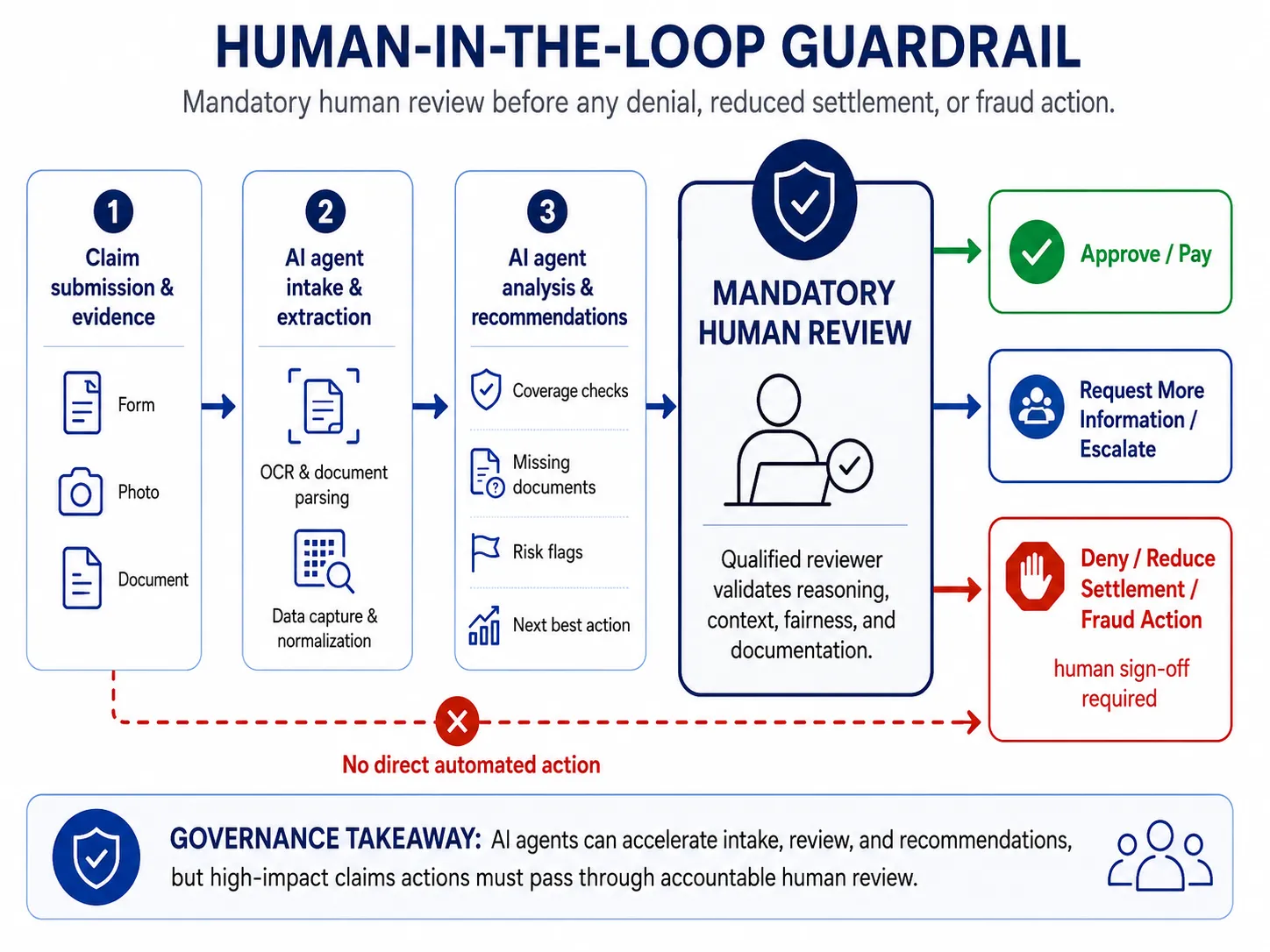
Automation is welcome where it speeds routine work. Regulators concentrate on the decisions that affect customer rights and financial outcomes, and this is where Agentic AI in insurance claims faces the most scrutiny.
Automated Claim Denials
Denials directly affect customer rights and financial outcomes. Regulators increasingly expect clear reasoning, documentation, appeal pathways, and human review before a denial is issued. The pressure is concrete. Florida’s 2026 HB 527 shows where regulatory thinking is headed. The bill would have barred insurers from using AI or machine learning as the sole basis for denying or reducing a claim, and it passed the Florida House unanimously before getting denied in the Senate. Even though it did not become a law, it reflects a broader policy concern: final claim denials and payment reductions need accountable human review.
Reduced or Partial Settlement Recommendations
If an AI Agent recommends a lower payout, the insurer must be able to explain why. Human judgment is needed to weigh context, policy language, evidence quality, and fairness before a reduced settlement is communicated to a customer.
Fraud Scoring and Suspicious Claim Flags
Fraud detection is valuable, but a fraud flag can delay payment, increase scrutiny, and damage customer trust. Human review should precede any decision to treat a claim as suspicious.
High-Value, Injury, or Litigation-Prone Claims
Claims involving bodily injury, large financial exposure, legal risk, medical records, or liability disputes should remain human-led with AI Agent support. The cost of an automated error rises sharply with the stakes of the claim.
Coverage Disputes and Policy Interpretation
Policy interpretation often requires legal, contextual, and contractual judgment. AI Agents can summarize documents and surface relevant clauses, but humans should decide disputed coverage questions.
Use of External or Alternative Data
Regulators may challenge the use of third-party data, behavioral signals, social media indicators, location data, or inferred customer attributes when governance is weak. The concern is unfair discrimination and decisions that customers cannot understand or contest.
Vulnerable or Sensitive Customers
Claims involving elderly customers, health events, disability, death, disaster loss, or financial distress require empathy, discretion, and careful human handling. These cases carry reputational and regulatory risk that automation alone cannot manage.
These expectations are not abstract. By 2025, roughly 24 states and the District of Columbia had adopted the NAIC Model Bulletin (a set of operational standards) on insurers' use of AI systems (AIS), which requires governance, documentation, and audit procedures and is enforced through existing unfair claims settlement practice laws.
The Safe Operating Model: Human-Governed Agentic AI
A safe claims automation model starts with clear limits on AI agent autonomy. Insurers need to define where agents can act, where they can recommend, and where human review is mandatory.
Use a Risk-Tiered Automation Model
Automation should not be applied evenly across all claims. The right level of AI Agent autonomy depends on claim value, complexity, documentation quality, coverage clarity, fraud risk, and customer sensitivity. As claim risk increases, automation should move from execution to recommendation, then to support, and finally to summary-only assistance.
| Claim Tier | Automation Level | Human Role | Best-Fit Claims |
| Tier 1: Low risk, low complexity | High automation | Sample review and exception monitoring | Routine auto physical damage claims, low-value property claims, and straightforward reimbursement claims |
| Tier 2: Moderate risk, moderate complexity | Assisted automation | Humans validate AI recommendations before approval | Claims with partial documentation, routine bodily injury claims, and moderate coverage questions |
| Tier 3: High risk, high complexity | Low automation | Human-led decision with AI support | High-value property claims, serious injury claims, hospitalization, liability complexity, fraud indicators |
| Tier 4: Very high risk, critical impact | Restricted automation | Mandatory human review and final decision | Claims likely to be denied or reduced, fraud-suspected claims, disputed claims, litigation-prone claims, and vulnerable customers |
Build Auditability into Every Workflow
Auditability should be treated as a design requirement, not a post-deployment fix. In claims workflows, this often requires claims teams, compliance teams, and AI experts to define how every automated action is logged, reviewed, and explained.
Every AI-agent action should be traceable. The insurer should know what data was used, what checks were performed, what recommendation was made, who reviewed it, and why the final decision was taken. This is also what regulators now expect, since the NAIC Model Bulletin asks insurers to maintain documentation and audit trails for AI used in regulated processes.
Keep AI Agents in a Governed Support Role
AI Agents should reduce repetitive work, improve documentation, and support claims handlers. They should not become unchecked decision makers for denial, settlement, fraud escalation, or sensitive customer treatment. AI for insurance operations works best when it accelerates the work around the decision and leaves accountability with a named human.
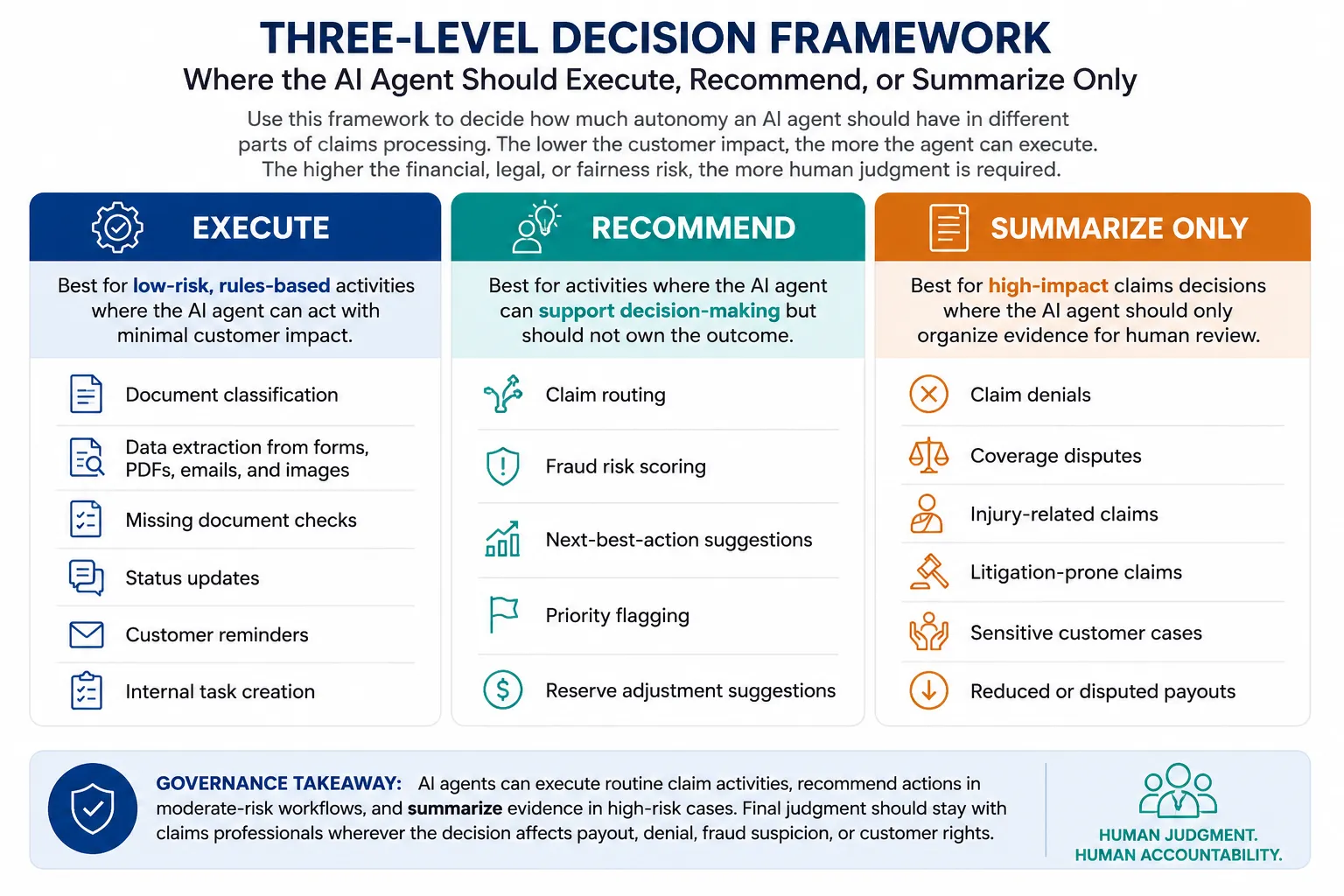
The issue is not whether insurers should use AI Agents in claims processing. The real question is where the AI Agent should act independently, where it should make recommendations, and where it should only summarize for human review. Dividing claim activities into three levels gives the organization a clear decision framework.
The Future is Governed Insurance Claims Automation
Agentic AI will reshape claims processing, but not by removing human accountability. Its strongest role is in faster intake, cleaner documentation, better routing, fraud signal detection, and decision support. Regulators may accept automation where it improves accuracy and the customer experience, but they will scrutinize its use in denials, reduced settlements, fraud actions, and the treatment of sensitive customers.
The harder part for insurers is building these systems responsibly. AI Agents for claims processing require knowledge of claims workflows, policy-rule mapping, system integration, governance controls, audit trails, and human-in-the-loop design. This makes implementation a cross-functional effort involving claims leaders, compliance teams, technology teams, and AI Agent experts with hands-on experience in regulated workflow design. Ultimately, those who benefit the most will know exactly where automation should stop and human judgment should begin.



























Sign in to leave a comment.