

In today’s connected world, identity is the new currency. From unlocking our phones to passing through airports and logging into online services, confirming who we are has become essential. Among the many technologies making this possible, AI Face Recognition stands out for its real-world impact. By combining artificial intelligence and computer vision, it can identify and verify people through their unique facial features. But its role goes far beyond security it’s improving convenience, personalizing experiences, and changing how we interact with technology every day.
Understanding AI Face Recognition
At its core, AI Face Recognition is a system that can detect and identify human faces using advanced machine learning algorithms. Unlike traditional ID-based or password-driven verification, this technology analyzes key features such as the distance between eyes, nose shape, jawline, and other facial markers to create a unique facial signature.
- Detection : The system scans an image or video to locate a human face.
- Alignment & Analysis : It aligns the face with reference points and analyzes facial landmarks.
- Feature Extraction : Key facial features are converted into numerical data points.
- Matching & Verification : The AI compares these data points to stored templates to confirm identity.
Modern AI Face Recognition systems use advanced deep learning models that improve over time. They learn from large and diverse datasets, becoming smarter with every interaction.
The Rise of AI Face Recognition Across Industries
What began as a futuristic concept in science fiction is now a practical tool driving transformation across industries. Businesses and governments alike are leveraging AI Face Recognition to strengthen security, streamline operations, and enhance customer experiences.
1. Security and Law Enforcement
One of the earliest and most widespread applications of AI Face Recognition is in public safety. Law enforcement agencies use it for surveillance, identifying suspects, and preventing crime in real-time. By scanning faces from security footage and comparing them against criminal databases, police departments can respond faster and more accurately.
2. Banking and Financial Services
Banks are integrating AI Face Recognition into mobile apps and ATMs to replace passwords and PINs with biometric authentication. This not only enhances convenience but also reduces fraud and identity theft. Customers can verify transactions, open accounts, and access services securely with a quick scan.
3. Retail and Hospitality
Retailers are using AI Face Recognition to personalize customer experiences. For instance, stores can identify returning customers and tailor offers based on their preferences. In hospitality, hotels are adopting facial recognition for contactless check-ins and keyless room access, creating a smoother guest experience.
4. Healthcare
Hospitals are applying AI Face Recognition for patient identification, access control, and telemedicine verification. This ensures data privacy, prevents duplication of medical records, and enhances overall operational efficiency.
5. Education and Workplaces
Universities use facial recognition to record attendance and ensure exam integrity, while organizations employ it for secure building access and remote workforce authentication. It’s a modern replacement for outdated ID cards and manual sign-ins.
Key Benefits of AI Face Recognition
1. Enhanced Security
AI Face Recognition adds a critical layer of protection that’s difficult to replicate or bypass. Since every face is unique, it offers higher accuracy than passwords or ID cards, which can be lost or stolen.
2. Seamless User Experience
From unlocking phones to boarding flights, facial recognition eliminates friction. It’s quick, contactless, and effortless qualities that users value in today’s digital-first environment.
3. Fraud Prevention
In sectors like banking and e-commerce, AI Face Recognition helps verify real users during onboarding or transactions, preventing impersonation and reducing financial fraud.
4. Operational Efficiency
By automating verification processes, businesses can save time and reduce administrative overhead. For example, airports use facial recognition to speed up passenger boarding, cutting queues and improving service efficiency.
5. Data-Driven Insights
When integrated with analytics, AI Face Recognition can offer insights into customer behavior, preferences, and engagement patterns helping organizations make informed decisions and improve services.
Challenges and Ethical Considerations
While the benefits are significant, AI Face Recognition also raises important questions about privacy, bias, and accountability. Responsible adoption is key to ensuring trust and fairness.
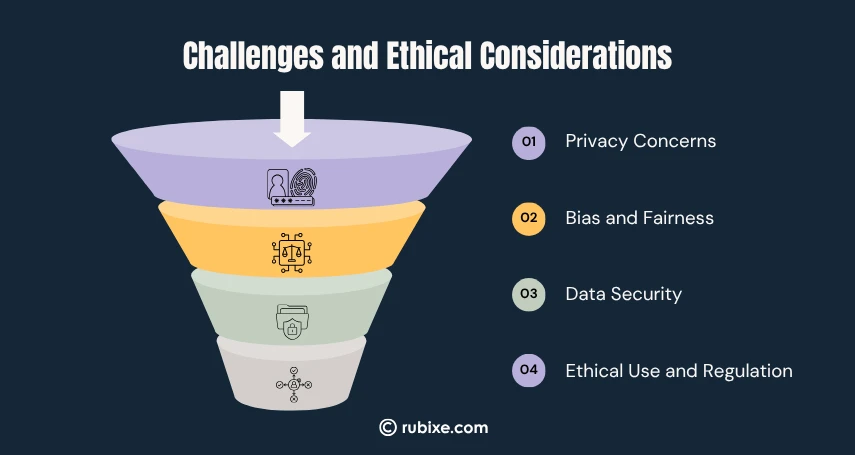
1. Privacy Concerns
The technology relies on capturing and storing facial data, which can be sensitive. If mishandled, it could lead to surveillance overreach or misuse of personal information. Businesses must comply with data protection regulations such as GDPR to maintain transparency and consent.
2. Bias and Fairness
AI algorithms are only as unbiased as the data they are trained on. If datasets lack diversity, recognition systems may show inaccuracies across different genders, ethnicities, or age groups. Continuous model training and audit processes are essential to eliminate such biases.
3. Data Security
Stored biometric data must be encrypted and protected. Since facial data cannot be changed like passwords, breaches can have lasting consequences. Organizations must invest in robust encryption and secure storage solutions.
4. Ethical Use and Regulation
Governments and industry leaders are working to establish ethical frameworks for AI Face Recognition. Responsible AI practices like anonymization, clear consent, and human oversight help ensure technology serves societal good.
Real-World Examples of AI Face Recognition in Action
1. Airports and Travel
Airports such as Changi (Singapore) and Atlanta (U.S.) use AI Face Recognition for passport verification and boarding. Passengers can walk through security gates without presenting physical documents, significantly reducing waiting times.
2. Smartphones and Consumer Electronics
Facial recognition has become a mainstream feature in smartphones, laptops, and even smart home devices. It ensures secure, user-friendly access while learning from the user’s facial variations over time.
3. Smart Cities
Urban planners are using AI Face Recognition for traffic management and public safety monitoring. Cameras equipped with AI can detect anomalies, missing persons, or suspicious activities quickly and alert authorities.
4. Banking and Fintech
Several fintech firms have integrated facial recognition into their digital onboarding processes to verify identities remotely, ensuring compliance with Know Your Customer (KYC) norms.
What Lies Ahead for AI Face Recognition
The future of AI Face Recognition is evolving toward smarter, faster, and more responsible solutions. As technology advances, we’ll see facial recognition systems become even more accurate and context-aware.
- Edge AI : Processing facial recognition directly on devices (rather than cloud servers) will improve speed and data privacy.
- Multi-Modal Biometrics : Combining face, voice, and behavior recognition will enhance identity verification.
- Emotion and Sentiment Analysis : Future systems will interpret human emotions, opening opportunities in healthcare, retail, and entertainment.
- Regulated and Ethical AI : Governments and tech companies will collaborate to standardize ethical frameworks ensuring transparency and accountability.
Best Practices for Implementing AI Face Recognition
For organizations looking to integrate AI Face Recognition, success depends on responsible deployment and strong governance. Here’s what to keep in mind:
- Prioritize Privacy : Obtain user consent, anonymize data where possible, and follow global data protection standards.
- Use Diverse Training Data : Ensure inclusivity in datasets to minimize bias and improve accuracy.
- Invest in Encryption and Security : Protect facial data at every stage—capture, transfer, and storage.
- Monitor and Update Regularly : Continuously audit algorithms to ensure reliability and fairness.
- Communicate Transparently : Educate users on how facial data is collected, used, and protected.
The rise of AI Face Recognition marks a defining moment in digital transformation. Its ability to combine security, speed, and personalization is revolutionizing industries and reshaping everyday experiences. Yet, as with any powerful technology, the focus must remain on using it responsibly.






























Sign in to leave a comment.