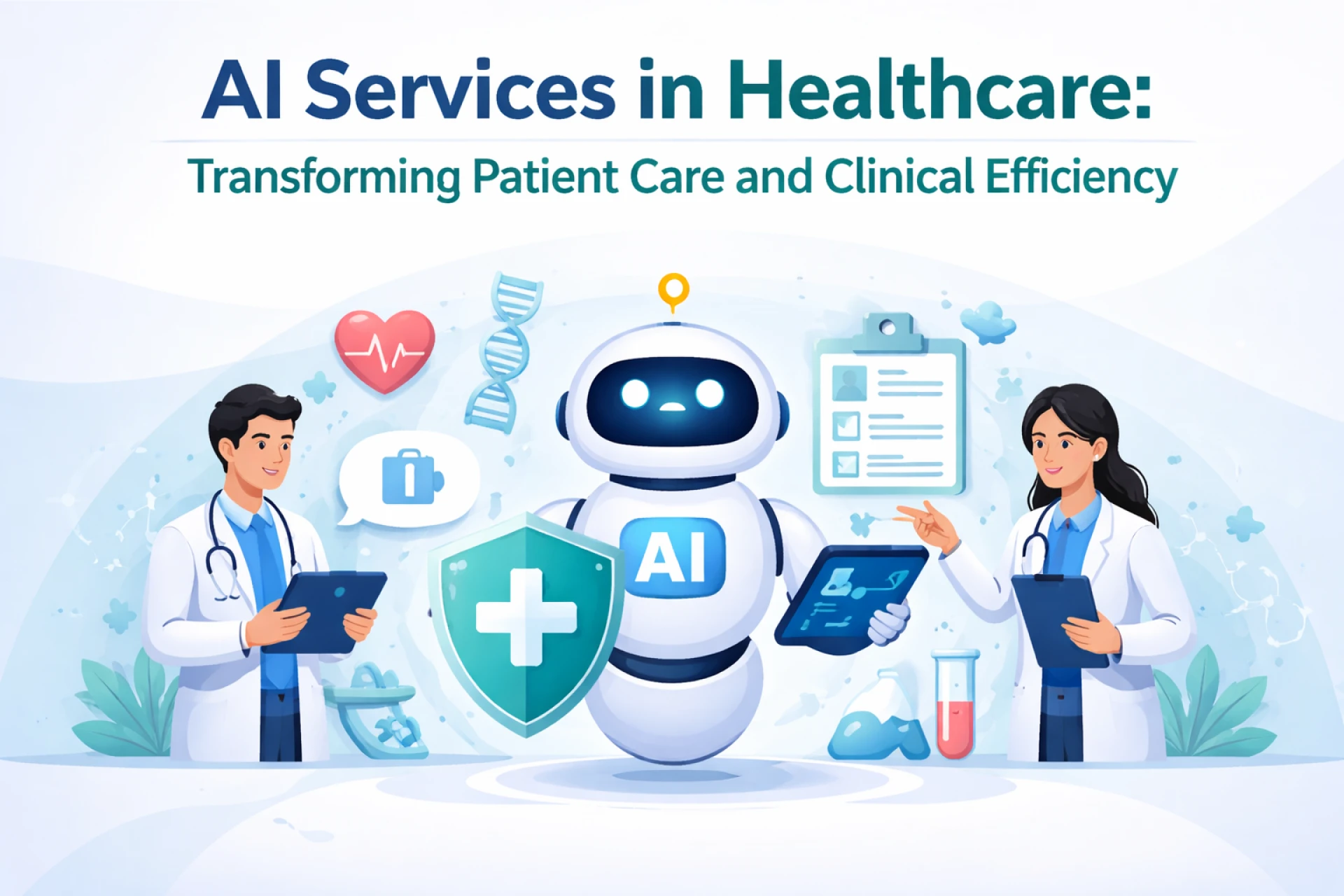

Healthcare systems worldwide are under increasing pressure. Rising patient volumes, clinician burnout, administrative overload, and the demand for more accurate diagnoses are reshaping how care is delivered. In response, artificial intelligence (AI) has emerged as one of the most transformative technologies in modern medicine.
From predictive diagnostics to automated administrative workflows, AI Services in Healthcare are redefining how providers deliver care and how patients experience it. When implemented strategically by the Best AI development company, these solutions not only enhance clinical accuracy but also significantly improve operational efficiency.
This article explores how AI is revolutionising patient care and streamlining healthcare operations across the ecosystem.
The Growing Role of AI in Modern Healthcare
AI in healthcare is not about replacing doctors it’s about empowering them. By processing vast amounts of medical data quickly and accurately, AI systems support clinicians in making informed decisions.
Healthcare organisations generate enormous volumes of structured and unstructured data daily, including:
- Electronic health records (EHRs)
- Diagnostic imaging
- Lab reports
- Clinical notes
- Patient monitoring data
AI models can analyse this data at scale, uncover patterns invisible to the human eye, and deliver actionable insights in real time.
Institutions such as Mayo Clinic and Cleveland Clinic have already integrated AI-driven tools into diagnostics and research workflows, demonstrating measurable improvements in efficiency and patient outcomes.
Enhancing Diagnostic Accuracy
One of the most impactful applications of AI lies in diagnostics. Machine learning algorithms trained on large datasets can detect abnormalities in medical images with remarkable precision.
For example, AI systems assist radiologists by analysing:
- X-rays
- MRIs
- CT scans
- Mammograms
These systems highlight potential issues, enabling clinicians to focus on high-risk areas. In fields such as oncology and cardiology, early detection can significantly improve survival rates.
AI-powered diagnostic support tools reduce human error, speed up reporting times, and ensure more consistent evaluations ultimately leading to better patient care.
Predictive Analytics for Proactive Care
Traditional healthcare often reacts to symptoms. AI shifts the model toward proactive and preventive care.
Predictive analytics tools analyse patient history, genetic data, lifestyle factors, and real-time monitoring information to identify individuals at risk of developing chronic conditions. This allows healthcare providers to intervene early.
For example, AI can predict:
- Risk of hospital readmission
- Likelihood of disease progression
- Potential complications after surgery
- Deterioration in ICU patients
By identifying risks before they escalate, healthcare providers can reduce emergency visits, lower treatment costs, and improve patient outcomes.
AI Agents Transforming Clinical Workflows
Administrative tasks consume a significant portion of clinicians’ time. Documentation, appointment scheduling, insurance verification, and follow-up coordination often reduce the time available for patient interaction.
This is where AI Agent Development Services play a critical role.
AI-powered virtual agents can:
- Automate appointment bookings
- Send medication reminders
- Handle patient queries
- Manage billing processes
- Update electronic health records
These intelligent agents operate 24/7, ensuring seamless communication between patients and healthcare providers. By automating repetitive processes, healthcare organisations free up valuable clinical time and reduce burnout among medical professionals.
Personalised Treatment Plans
No two patients are alike. AI enables precision medicine by analysing genetic profiles, medical history, and treatment responses to design individualised care plans.
For instance, AI systems can evaluate how different patients respond to certain medications and suggest optimised dosage levels or alternative therapies. This approach is particularly impactful in oncology, where personalised treatment strategies can significantly improve outcomes.
Companies like IBM Watson Health have pioneered AI-driven clinical decision support tools that assist physicians in identifying tailored treatment options.
The result is more effective care, fewer adverse reactions, and improved patient satisfaction.
Accelerating Drug Discovery
Developing new medications is traditionally a lengthy and expensive process. AI accelerates drug discovery by analysing biological data, predicting molecule interactions, and identifying promising compounds.
Machine learning models can simulate clinical trials, predict drug efficacy, and reduce research timelines dramatically. This not only speeds up innovation but also lowers development costs.
Pharmaceutical leaders such as Pfizer increasingly leverage AI-driven platforms to optimise research and development pipelines.
Faster drug discovery means quicker access to life-saving treatments for patients worldwide.
Remote Monitoring and Telehealth Optimisation
The expansion of telemedicine has reshaped healthcare accessibility. AI enhances telehealth platforms by enabling real-time patient monitoring and intelligent data interpretation.
Wearable devices collect continuous data on:
- Heart rate
- Blood pressure
- Glucose levels
- Oxygen saturation
AI algorithms analyse these metrics and alert providers when abnormalities arise. This ensures timely intervention without requiring constant in-person visits.
Remote AI monitoring is particularly beneficial for elderly patients and individuals managing chronic illnesses, improving both convenience and safety.
Improving Operational Efficiency
Beyond clinical applications, AI Services in Healthcare significantly enhance operational performance.
Hospitals and clinics use AI to:
- Optimise staff scheduling
- Predict patient admission rates
- Manage supply chain logistics
- Reduce wait times
- Improve bed allocation
By analyzing historical and real-time data, AI systems ensure resources are allocated efficiently. This reduces costs while maintaining high-quality care delivery.
Operational efficiency directly impacts patient satisfaction. Shorter wait times and smoother processes create a more positive healthcare experience.
Strengthening Data Security and Compliance
Healthcare data is highly sensitive and heavily regulated. AI enhances cybersecurity by detecting unusual access patterns and potential threats in real time.
Machine learning models continuously monitor systems for anomalies, reducing the risk of data breaches. Automated compliance monitoring tools also help healthcare organizations adhere to regulatory standards.
With patient trust at stake, AI-driven security measures are essential in modern healthcare infrastructures.
Why Partnering with the Best AI Development Company Matters
Implementing AI in healthcare is complex. It requires deep expertise in machine learning, regulatory compliance, healthcare data standards, and system integration.
Choosing the Best AI development company ensures:
- Custom AI models tailored to healthcare needs
- Seamless integration with existing EHR systems
- Compliance with healthcare regulations
- Scalable, secure infrastructure
- Ongoing optimization and maintenance
A skilled development partner understands both technology and the nuances of clinical workflows. They design AI solutions that enhance not disrupt medical practice.
Strategic implementation ensures that AI Agent Development Services and intelligent healthcare platforms deliver measurable improvements in patient care and operational efficiency.
The Future of AI in Healthcare
AI adoption in healthcare is accelerating rapidly. Future innovations may include:
- Emotion-aware AI assistants for mental health support
- Fully automated triage systems
- Advanced robotic surgery integration
- Real-time global disease surveillance
As AI models become more sophisticated, the focus will remain on augmenting human expertise rather than replacing it.
Healthcare will continue evolving toward a data-driven, patient-centric ecosystem powered by intelligent technologies.
Conclusion
AI is transforming healthcare at every level from diagnosis and treatment to administration and security. By leveraging advanced analytics, intelligent automation, and predictive modeling, AI Services in Healthcare are improving patient outcomes while enhancing clinical efficiency.
However, the success of AI implementation depends on expertise and strategic execution. Partnering with the Best AI development company ensures that healthcare providers can harness the full potential of AI safely, effectively, and sustainably.
As the industry moves toward more personalised and proactive care models, AI will remain a cornerstone of innovation empowering clinicians, optimising operations, and ultimately transforming the patient experience for the better.





















Sign in to leave a comment.