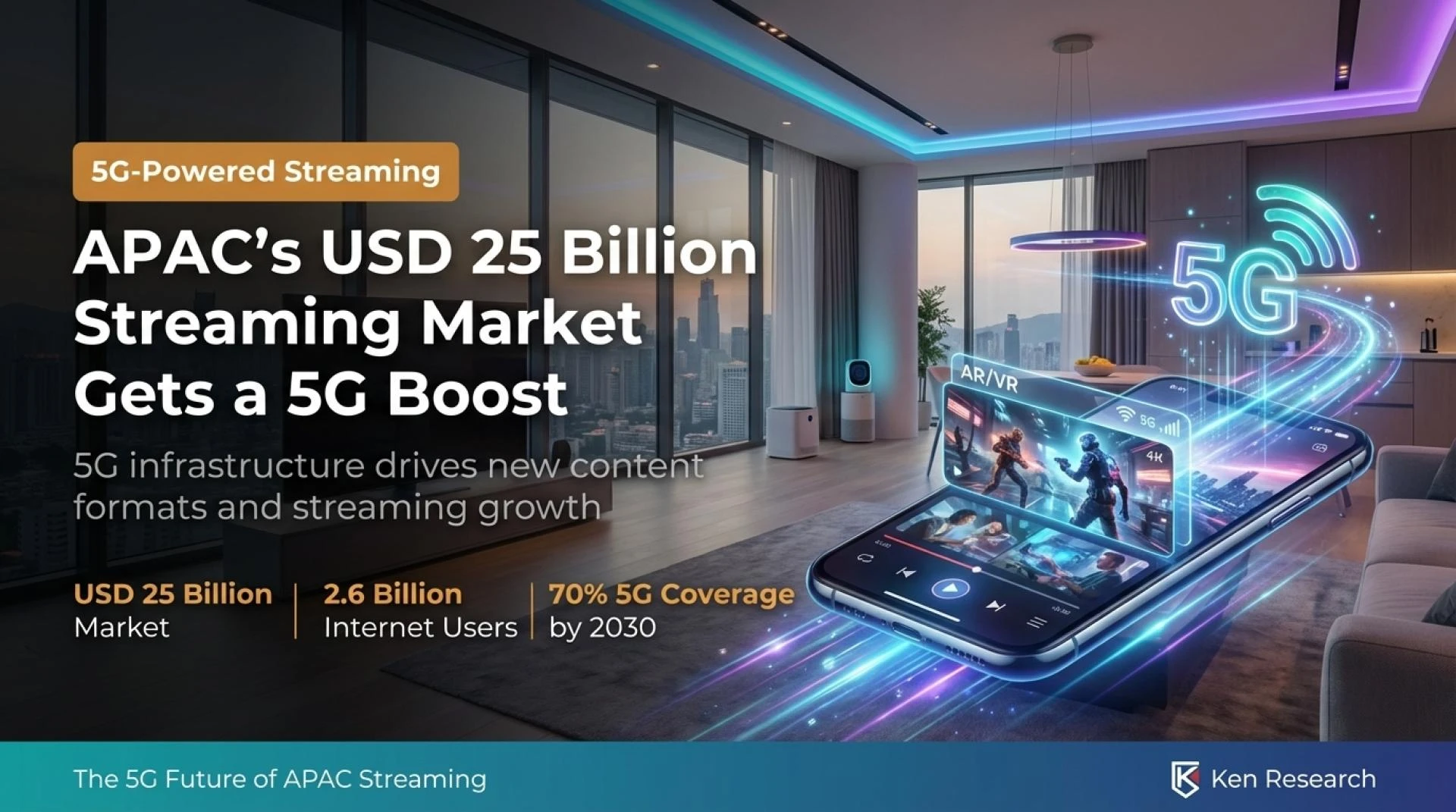

The timing is not coincidental. 5G networks are rolling out across Asia Pacific at the precise moment that the region's internet streaming market is hitting its demand inflection point a USD 25 billion market, per Ken Research, built on 2.6 billion internet users who are consuming more content, at higher resolutions, on more devices, more frequently than any prior period. South Korea had over 20 million 5G subscribers in 2023 already enhancing 4K and HD content streaming experiences. Japan's enterprise and consumer 5G deployments are expanding rapidly. China's 5G network is the world's largest. The infrastructure tailwind arriving underneath APAC's streaming demand surge is a structural growth multiplier not for the market's current state but for the content formats, user engagement levels, and monetisation models it makes possible.
As documented in the Asia Pacific Internet Streaming Market Outlook by Ken Research, the expansion of 5G networks is identified as a primary future growth opportunity enabling immersive content formats, eliminating buffering constraints, and unlocking streaming experiences that 4G infrastructure cannot reliably support. Ken Research provides the full segment, country, and competitive analysis this blog draws from.
What 5G Actually Changes for Streaming and Why Timing in APAC Matters
5G's impact on streaming is not simply faster buffering. It enables a qualitatively different content consumption experience and unlocks content formats that were commercially impractical on 4G infrastructure.
4K, HDR, and the Resolution Upgrade Cycle
4K streaming requires sustained download speeds of 25 Mbps or higher a threshold that 4G networks in APAC deliver inconsistently, particularly in dense urban environments where network congestion is a daily reality. 5G's higher bandwidth and lower latency deliver the consistent throughput that 4K and HDR content requires, upgrading the baseline streaming quality for subscribers in covered areas. South Korea's 20 million 5G subscribers are already accessing this experience. As Japan, China, Australia, and India's 5G coverage expands toward projected 70% regional coverage by 2030, a proportionally larger share of APAC's streaming subscriber base will shift to higher-resolution consumption driving both content investment in premium formats and platform investment in delivery infrastructure. As Ken Research highlights, 5G network expansion is a primary opportunity driving the APAC internet streaming market CAGR through 2030.
AR/VR Interactive Content and the Immersive Streaming Opportunity
Beyond resolution, 5G enables the low-latency, high-bandwidth data transfer that AR/VR streaming and interactive content require. China's AR/VR market was valued at over USD 8 billion in 2023 signalling strong consumer appetite for immersive experiences that 5G is the infrastructure prerequisite for delivering at scale on mobile. Streaming platforms that are investing in interactive content, live event AR overlays, and VR original programming are doing so in anticipation of 5G coverage making these formats viable for a mass APAC audience rather than an early-adopter niche. The related Asia Pacific Video Streaming Market analysis by Ken Research, valued at USD 27 billion, maps the video content consumption trajectory that 5G-enabled immersive formats are positioned to extend.
Country-by-Country 5G Streaming Impact Where the Tailwind Is Already Active
5G's impact on APAC streaming is not uniform it is sequenced by the maturity of each country's network rollout, and the streaming market implications differ accordingly.
South Korea and Japan 5G Early Movers Setting the Content Standard
South Korea's 5G infrastructure combined with its globally dominant K-drama and K-pop content production is creating a preview of what 5G-enabled streaming looks like at full deployment. Mobile streaming of live concerts, sports events, and K-drama premieres in high definition is already normalised for South Korean subscribers. Japan's 5G rollout is enabling enterprise streaming applications from remote manufacturing monitoring to AR-enhanced retail experiences that are expanding the definition of what streaming means beyond entertainment content. As documented in the Asia Pacific internet streaming competitive landscape by Ken Research, these markets are setting platform and content standards that other APAC markets will progressively follow as 5G coverage expands.
Subscription Growth, Live Streaming, and What 5G Unlocks for Revenue Models
5G's infrastructure upgrade does not just improve existing streaming it expands the revenue model possibilities for the platforms operating in the APAC market.
Live Streaming at Scale: Live events sports, concerts, esports tournaments are the highest-engagement, highest-monetisation streaming format. 5G's low latency and high throughput enable live streaming at broadcast quality to mobile devices simultaneously for millions of concurrent viewers. The APAC esports market alone attracted over 100 million unique viewers for the League of Legends World Championship in China in 2024 an event that drove concurrent streaming demand that 5G infrastructure handles reliably where 4G cannot. As Ken Research identifies, live streaming is a high-growth content trend within the APAC internet streaming market that 5G coverage is directly accelerating.
Premium Subscription Tier Justification: Higher resolution and immersive content enabled by 5G give streaming platforms a credible basis for introducing premium subscription tiers at higher price points than current APAC market norms support. When 4K streaming, spatial audio, and interactive features are reliably accessible on mobile, the value proposition for premium pricing strengthens increasing average revenue per user (ARPU) without requiring new subscriber acquisition. The Asia Pacific Music Streaming Market analysis by Ken Research, valued at USD 9.5 billion, demonstrates the same premium tier dynamic playing out in audio streaming as 5G-enabled audio quality upgrades create subscription upgrade incentives.
Cross-Market Strategic Partnerships: 5G network operators and streaming platforms are entering bundled service agreements where 5G subscribers receive streaming subscriptions as part of their data plan that accelerate subscriber acquisition for platforms while driving data consumption for telcos. Netflix's partnerships with global telecom providers in 2024 resulted in a 15% increase in new APAC subscribers through bundle arrangements. These partnerships are structurally dependent on 5G network quality being sufficient to deliver the streaming experience that justifies the bundle premium.
If you are evaluating platform strategy, content investment, or competitive positioning in the APAC internet streaming market through 2030, speak to a strategic consultant to develop a data-backed market strategy.
Conclusion
5G is arriving in APAC at the right time and for the right market. The region's USD 25 billion internet streaming market is not limited by demand it is limited by the infrastructure ceiling that 4G imposes on resolution, latency, and immersive content formats. As 5G coverage expands toward 70% of the region by 2030, that ceiling lifts progressively across the most populated and highest-ARPU markets in the world. The platforms investing now in 4K content libraries, AR/VR interactive formats, and live event streaming infrastructure are positioning for a market that 5G is actively enlarging not just connecting faster.
The full analysis 5G opportunity sizing, platform competitive dynamics, country-level streaming data, and the APAC internet streaming market competitive landscape across Netflix, Disney+, Tencent Video, and iQIYI is documented in the Asia Pacific Internet Streaming Market Outlook to 2030 by Ken Research.
Frequently Asked Questions
How does 5G affect the Asia Pacific internet streaming market?
According to Ken Research, 5G enables 4K and HDR streaming at consistent quality on mobile devices, unlocks AR/VR interactive content formats requiring low latency, and supports live streaming of high-concurrent-viewer events expanding the content formats, user engagement levels, and premium subscription tiers that APAC streaming platforms can commercially sustain through 2030.
Which APAC countries are furthest ahead in 5G streaming adoption?
Ken Research highlights that South Korea leads with over 20 million 5G subscribers in 2023 already accessing HD and 4K mobile streaming at scale. Japan and China follow with extensive 5G deployments enabling both entertainment and enterprise streaming applications. India and Southeast Asia represent the next wave of 5G-driven streaming growth as network rollout expands.
What is the AR/VR streaming opportunity in Asia Pacific?
As per the Asia Pacific Internet Streaming Market Outlook by Ken Research, AR/VR interactive content is identified as a primary streaming market opportunity supported by China's USD 8 billion AR/VR market in 2023 signalling strong consumer demand for immersive experiences. 5G infrastructure is the prerequisite for delivering AR/VR streaming at mass-market scale on mobile devices across the region.
How are telecom providers and streaming platforms partnering in APAC?
Ken Research's competitive analysis reveals that 5G network operators and streaming platforms are entering bundled service agreements where streaming subscriptions are included with 5G data plans. Netflix's 2024 telecom partnerships generated a 15% increase in new APAC subscribers through bundle arrangements a model that 5G network quality makes commercially sustainable and that is expected to accelerate across APAC through 2030.

























Sign in to leave a comment.