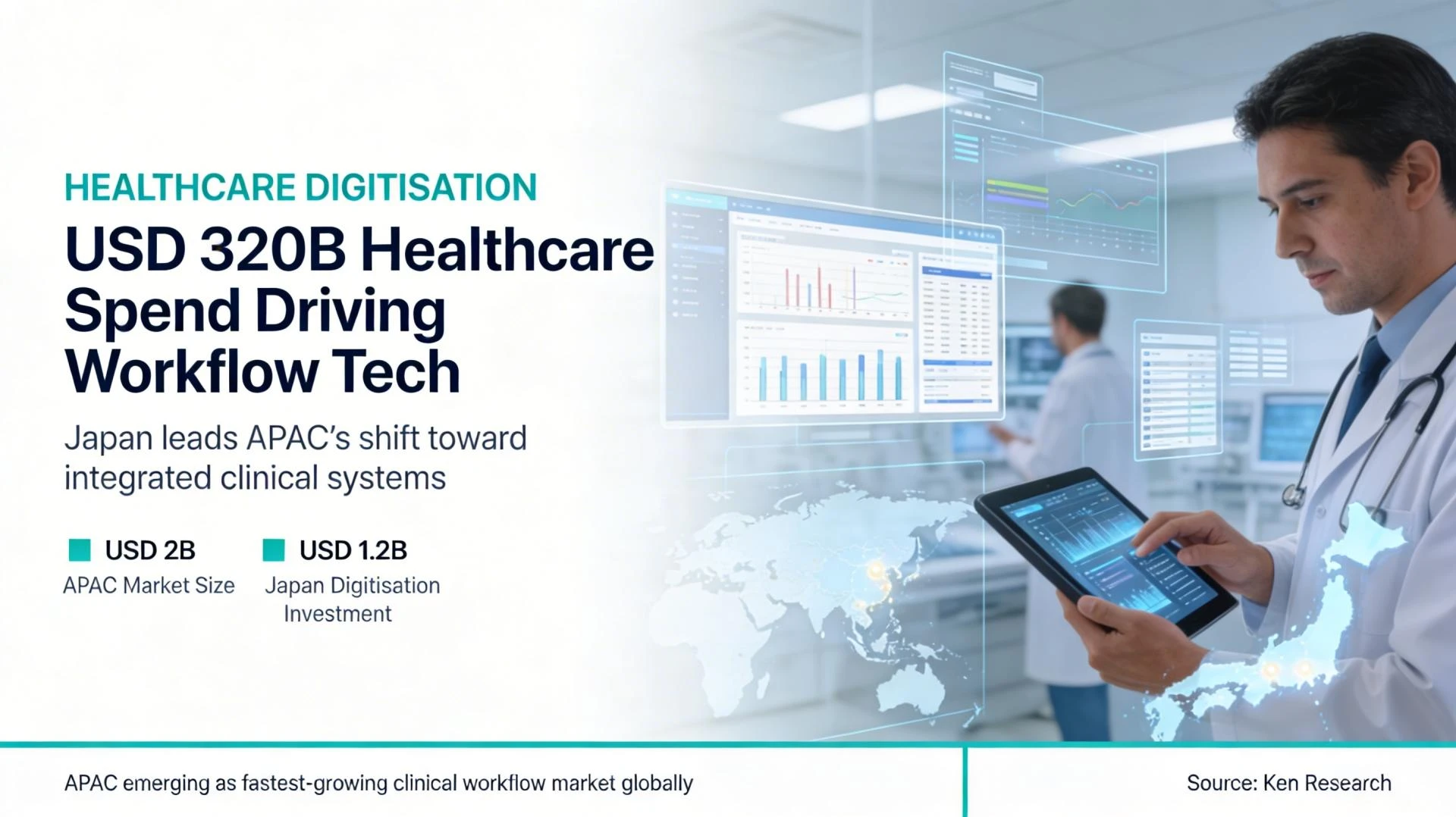

Japan's healthcare spending for FY2023 reached approximately 47.3 trillion yen (USD 320 billion) - a figure that does not just signal the scale of Japan's healthcare system but explains why the Asia Pacific Clinical Workflow Solutions Market is valued at USD 2 billion and growing. Within that spending envelope, Japan specifically allocated USD 1.2 billion to digitise its healthcare systems in 2023, with a direct focus on clinical workflow solutions including EHR integration, hospital information systems, and administrative automation. This is not discretionary investment - Japan's Ministry of Health, Labour and Welfare is driving a structural digitisation mandate in response to an aging population, chronic physician shortages, and the operational unsustainability of managing high patient volumes through manual and fragmented clinical processes.
The Asia Pacific Clinical Workflow Solutions Market Outlook by Ken Research documents this market in full - product type, end-user, competitive landscape, and country-level demand across China, Japan, and India through 2030. Ken Research maps how Japan's policy-driven digitisation, China's large urban hospital modernisation push, and India's growing healthcare infrastructure investment are collectively building APAC into the fastest-growing region for clinical workflow technology adoption globally.
Why Is Japan Investing USD 1.2 Billion Specifically in Clinical Workflow Digitisation?
Japan's clinical workflow investment is not technology-driven - it is crisis-driven. Japan has one of the world's most advanced healthcare systems measured by outcomes, but also one of the most administratively burdened. Physicians in Japanese hospitals spend a disproportionate share of their working hours on documentation, patient data entry, and coordination tasks that clinical workflow solutions are specifically designed to automate. At the same time, Japan's data protection framework was updated in 2024 with new penalties for healthcare data breaches - creating a compliance imperative alongside the operational one. Every hospital that digitises its clinical workflows must now also ensure those workflows meet the updated Ministry of Health, Labour and Welfare privacy mandates.
As Ken Research highlights in its market analysis, integrated solutions hold the dominant product type share in the APAC clinical workflow solutions market - precisely because Japan's hospital digitisation programs are prioritising seamless interoperability from EMR and EHR systems through to patient engagement tools, rather than deploying isolated standalone systems that create new data silos. The Global Electronic Health Records Market, valued at USD 30 billion by Ken Research, sits directly upstream of this clinical workflow investment - EHR adoption is the infrastructure that clinical workflow solutions layer on top of, and Japan's USD 1.2 billion digitisation commitment is accelerating EHR deployment as the foundation for the broader workflow transformation.
How Are China and India Contributing to the APAC Clinical Workflow Market Beyond Japan?
China and India are APAC's two other dominant clinical workflow markets, but they are driving demand through structurally different mechanisms than Japan. Understanding each country's specific demand driver is what separates a country-level market strategy from a generic regional one.
China's urban hospital modernisation as the volume driver
China's emphasis on healthcare digitalisation is concentrated in large urban hospitals where patient throughput volumes are among the highest in the world. According to Ken Research's market analysis, China has increased adoption of clinical workflow solutions especially in metropolitan hospital settings, driven by the need to handle enormous patient data volumes efficiently and to reduce the administrative burden on clinical staff managing high daily patient counts. The scale of China's urban hospital system - hundreds of tertiary hospitals each processing thousands of patients daily - creates procurement volumes for integrated workflow solutions that no other single APAC country can match. China's government-backed healthcare infrastructure investment is directing capital toward hospital information systems that centralise patient data, support real-time clinical decision-making, and enable the kind of coordinated care delivery that fragmented paper-based systems cannot.
India's infrastructure expansion as the emerging growth engine
India's clinical workflow solutions demand is driven less by existing hospital modernisation and more by the expansion of healthcare infrastructure itself. As new hospitals, ambulatory care centres, and specialty clinics are commissioned across India's Tier-2 and Tier-3 cities, they are being built with digital workflow integration from inception rather than retrofitting legacy systems. This greenfield advantage means India's clinical workflow adoption is faster and less expensive per facility than China's or Japan's, where legacy system migration is a significant component of implementation cost and complexity. The Asia Pacific Digital Health Market, valued at USD 58 billion by Ken Research, maps the full digital health investment context within which clinical workflow solutions are scaling in India - telemedicine expansion, mobile health adoption, and digital health infrastructure investment are all creating the connectivity layer that clinical workflow platforms require to function at scale in India's geographically dispersed healthcare market.
If you want the full country-level demand breakdown, product type segmentation, end-user analysis, and competitive player profiling through 2030, download free sample for a detailed preview of the full market analysis.
Conclusion
Japan's USD 320 billion healthcare spend in FY2023 and its USD 1.2 billion clinical workflow digitisation commitment are not isolated policy decisions - they are the most visible expression of a structural digitisation imperative that China and India are driving toward through different mechanisms. The USD 2 billion APAC Clinical Workflow Solutions Market is growing because all three dominant country markets have independent, self-reinforcing demand drivers that compound rather than compete for the same budget cycle.
For the complete country-level analysis, product type breakdown, end-user segmentation, competitive player profiling, and 2030 projections, the Asia Pacific Clinical Workflow Solutions Market Outlook by Ken Research delivers the verified intelligence healthcare IT providers, hospital technology investors, and market strategists need to position with precision.
Frequently Asked Questions
Q1: What is the size of the Asia Pacific Clinical Workflow Solutions Market?
According to Ken Research, the Asia Pacific Clinical Workflow Solutions Market is valued at USD 2 billion in 2023, driven by digital adoption in healthcare, substantial infrastructure investments, and government initiatives. Japan allocated USD 1.2 billion specifically for clinical workflow digitisation in 2023 and recorded total healthcare spending of 47.3 trillion yen (USD 320 billion) in FY2023, reflecting the scale of investment supporting market growth.
Q2: Which product type dominates the APAC clinical workflow solutions market?
Ken Research highlights that integrated solutions hold the dominant market share in the Asia Pacific Clinical Workflow Solutions Market. Their dominance reflects the preference for seamless interoperability across EMR and EHR systems, patient engagement tools, and hospital information platforms - reducing the need for multiple standalone systems and simplifying data management across hospitals and ambulatory care centres in urban healthcare settings.
Q3: What are the growth drivers of clinical workflow solutions in Asia Pacific?
As per the Ken Research Asia Pacific Clinical Workflow Solutions Market analysis, key growth drivers include digital transformation mandates - exemplified by Japan's USD 1.2 billion digitisation allocation in 2023 - rising healthcare expenditure across emerging markets, growing EHR and EMR integration demand, telemedicine expansion, AI and machine learning integration into workflow systems, and regulatory updates including Japan's 2024 data protection law penalties for healthcare data breaches.
Q4: Who are the key players in the Asia Pacific Clinical Workflow Solutions Market?
Ken Research's competitive analysis identifies Allscripts Healthcare Solutions, GE Healthcare, and Philips Healthcare as major players in the Asia Pacific Clinical Workflow Solutions Market, alongside global healthcare IT companies competing across integrated solution deployment, EHR integration, and real-time clinical communication platforms. South Korea's Personal Information Protection Commission fines on non-compliant hospitals are also shaping how players design and certify their data security architecture for APAC markets.




























Sign in to leave a comment.