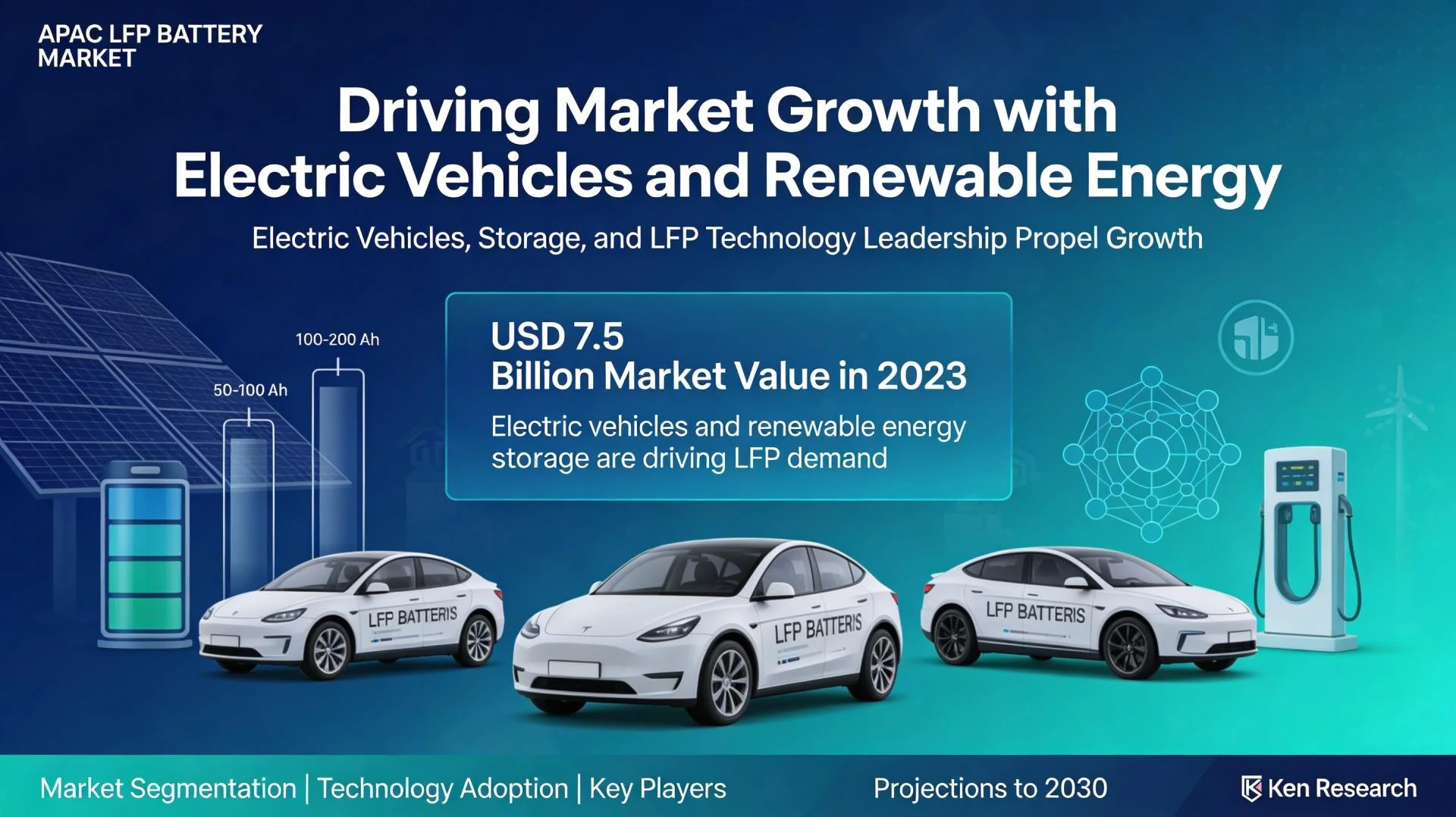

The APAC lithium iron phosphate battery market is valued at USD 7.5 billion based on a five-year historical analysis, driven by surging electric vehicle adoption, rapid renewable energy storage deployment, and a decisive technology advantage that LFP chemistry holds over competing battery types in safety, lifecycle, and cost-effectiveness. Electric vehicles hold the dominant application share, the 50-100 Ah capacity range has gained the most commercial traction, and China and India anchor the regional demand base - China through its established battery supply chain and EV scale, India through rising EV adoption and renewable energy project expansion. Understanding how the market segments and who controls each segment is where market positioning and investment decisions begin.
The complete segmentation breakdown, competitive landscape, and 2030 projections are covered in the APAC Lithium Iron Phosphate Battery Market report by Ken Research, profiling all application segments, capacity ranges, end-user categories, sales channels, and five key country markets.
How the APAC LFP Battery Market Breaks Down by Application, Capacity and End User
The APAC LFP battery market segments across four dimensions - application, capacity range, end user, and sales channel. Each dimension carries distinct procurement dynamics, performance specifications, and competitive intensity. The application and capacity dimensions are the most commercially significant because they determine which battery configurations manufacturers prioritize and which customer relationships create long-term recurring revenue.
Application segmentation - EVs lead, energy storage is accelerating
Electric vehicles hold the dominant application share, driven by government subsidies, EV mandates, and the safety and longevity advantages that make LFP the preferred chemistry for mass-market EV manufacturers across the region. China recorded 8.1 million EV registrations in 2023, a 35% increase year-on-year - a single-country volume that by itself creates procurement demand at a scale that shapes the entire APAC LFP supply chain. Automakers are integrating LFP batteries into their models specifically because of the chemistry's thermal stability and extended cycle life, which reduce warranty exposure and operational cost for fleet operators.
Energy storage systems are the second major application and growing in strategic importance. China's total installed solar capacity exceeded 490 GW in 2023, and the integration of that renewable generation into stable grid supply requires battery storage that can handle daily cycling at scale without degrading over time - precisely the LFP value proposition. Industrial applications covering backup power and material handling equipment represent a third significant segment, while consumer electronics occupy the smallest but still commercially relevant share of the APAC LFP battery market.
Capacity range - 50-100 Ah as the commercial sweet spot
The 50-100 Ah capacity range has gained the most significant commercial traction by offering a balanced compromise between energy capacity and cost that mid-sized EV manufacturers and energy storage integrators find optimal. Below 50 Ah serves consumer electronics and smaller industrial devices where compactness and weight are primary considerations. Above 100 Ah serves heavy-duty EV platforms, grid-scale energy storage installations, and large industrial backup power systems where maximum energy capacity justifies the higher unit cost. The 50-100 Ah band captures the broadest application base - mid-range EVs, residential energy storage, telecom tower backup, and mid-scale industrial use - making it the highest-volume and most competitively contested capacity segment in the market.
End-user and sales channel split
By end user, the automotive sector leads in volume, reflecting EV application dominance. Renewable energy follows as the second end-user category, driven by grid and off-grid storage installations across China, India, and Southeast Asia. Industrial manufacturing and telecommunications round out the end-user base - telecoms in particular represent a growing segment as 5G network rollout increases per-tower energy requirements across the region. On the sales channel dimension, OEM accounts dominate because the majority of LFP battery volume moves through direct relationships with EV manufacturers, energy storage integrators, and industrial equipment producers rather than through aftermarket distribution.
Who Controls the APAC LFP Battery Market - Players and Their Competitive Position
The APAC LFP battery market is dominated by Chinese manufacturers at the global supply chain level, with Japanese and South Korean players maintaining competitive positions in specific high-performance and specialized segments. Competition centers on R&D investment, production capacity, strategic partnerships with automakers, and vertical integration into raw material supply - not pricing alone.
Leading players and what they compete on
CATL and BYD define the top tier of the APAC LFP battery market, and their competitive positions are structurally different from every other player in the market. CATL leads through production scale, patent portfolio depth, and strategic alliances with major automakers across China and internationally - competing on technology leadership and supply reliability rather than price alone. BYD holds a unique position that no other manufacturer replicates: it is simultaneously one of the world's largest LFP battery producers and one of the world's largest EV manufacturers, giving it captive battery demand from its own vehicle lineup that creates production scale advantages independent of third-party customer acquisition.
CALB Group has emerged as one of China's fastest-growing LFP producers, competing aggressively for EV and energy storage contracts outside the CATL-BYD duopoly. Its strategy centers on expanding production capacity to capture demand from domestic automakers seeking supply chain diversification, and from energy storage project developers who benefit from having a third credible large-scale supplier in contract negotiations. LG Chem brings South Korean manufacturing precision and deep global automaker relationships to the APAC market, competing across both LFP and NCM chemistries - a flexibility that pure-LFP manufacturers cannot offer to customers evaluating chemistry options across their product range.
Panasonic occupies a differentiated position through Japanese manufacturing quality and its established EV battery supply relationships, primarily competing in high-performance segments where precision engineering commands a premium over China's cost-optimised production model. BAK Battery and A123 Systems compete in specialized industrial and telecom applications where reliability, customization depth, and long-term service support create defensible niches outside the high-volume EV and grid-storage segments dominated by the top three. The broader competitive dynamics across the APAC battery supply chain - including how gigafactory locations, raw material sourcing, and government incentives interact with each manufacturer's positioning - are covered in the APAC Electric Vehicle Market report, which maps EV adoption trajectories and battery demand by country across the same markets where LFP volume is being deployed at scale.
If you want the full segmentation data, player benchmarking across R&D investment, production capacity, and strategic partnerships, and 2030 projections across all application and capacity segments, download free sample for a detailed preview of the full market analysis.
Conclusion
The APAC LFP battery market's USD 7.5 billion valuation is built on a segmentation structure where EVs drive application dominance, the 50-100 Ah capacity range captures the broadest commercial demand, automotive and renewable energy end users anchor the volume base, and CATL and BYD hold structural advantages through vertical integration and production scale that no other player currently matches. The market is consolidating around players with gigafactory-level production, deep automaker relationships, and raw material supply chain control - creating clear competitive barriers that will shape market structure through 2030.
For the complete application breakdown, capacity range projections, competitive player profiling, and country-level analysis, the APAC Lithium Iron Phosphate Battery Market report by Ken Research delivers the verified intelligence manufacturers, investors, and energy technology strategists need to position with precision.
Frequently Asked Questions
Q1: What is the value of the APAC Lithium Iron Phosphate Battery Market?
The APAC LFP battery market is valued at USD 7.5 billion, driven by EV adoption, renewable energy storage deployment, and LFP's superior safety and lifecycle advantages over competing battery chemistries. China and India dominate demand through large-scale EV manufacturing, government green energy incentives, and gigafactory investment that has made APAC the world's primary LFP production hub.
Q2: Which application segment dominates the APAC LFP battery market?
Electric vehicles hold the dominant application share, with China recording 8.1 million EV registrations in 2023 - a 35% year-on-year increase that makes EV procurement the single largest demand driver for LFP batteries in the region. Energy storage systems are the second major application, growing rapidly as China's 490 GW solar installed base requires grid-scale battery storage to manage intermittent renewable supply.
Q3: Which capacity range is most commercially significant in the APAC LFP market?
The 50-100 Ah capacity range has gained the most commercial traction, offering a balanced compromise between energy capacity and cost for mid-sized EVs, residential energy storage, telecom tower backup, and industrial applications. It captures the broadest application base and is the highest-volume, most competitively contested capacity segment in the APAC market.
Q4: Who are the leading players in the APAC LFP battery market?
CATL and BYD are the dominant players - CATL through production scale and patent leadership, BYD through unique vertical integration as both manufacturer and EV producer. CALB, LG Chem, Panasonic, BAK Battery, and A123 Systems compete across specialized segments. Competition centers on R&D investment, gigafactory capacity, automaker partnerships, and vertical integration into raw material supply chains.











Sign in to leave a comment.