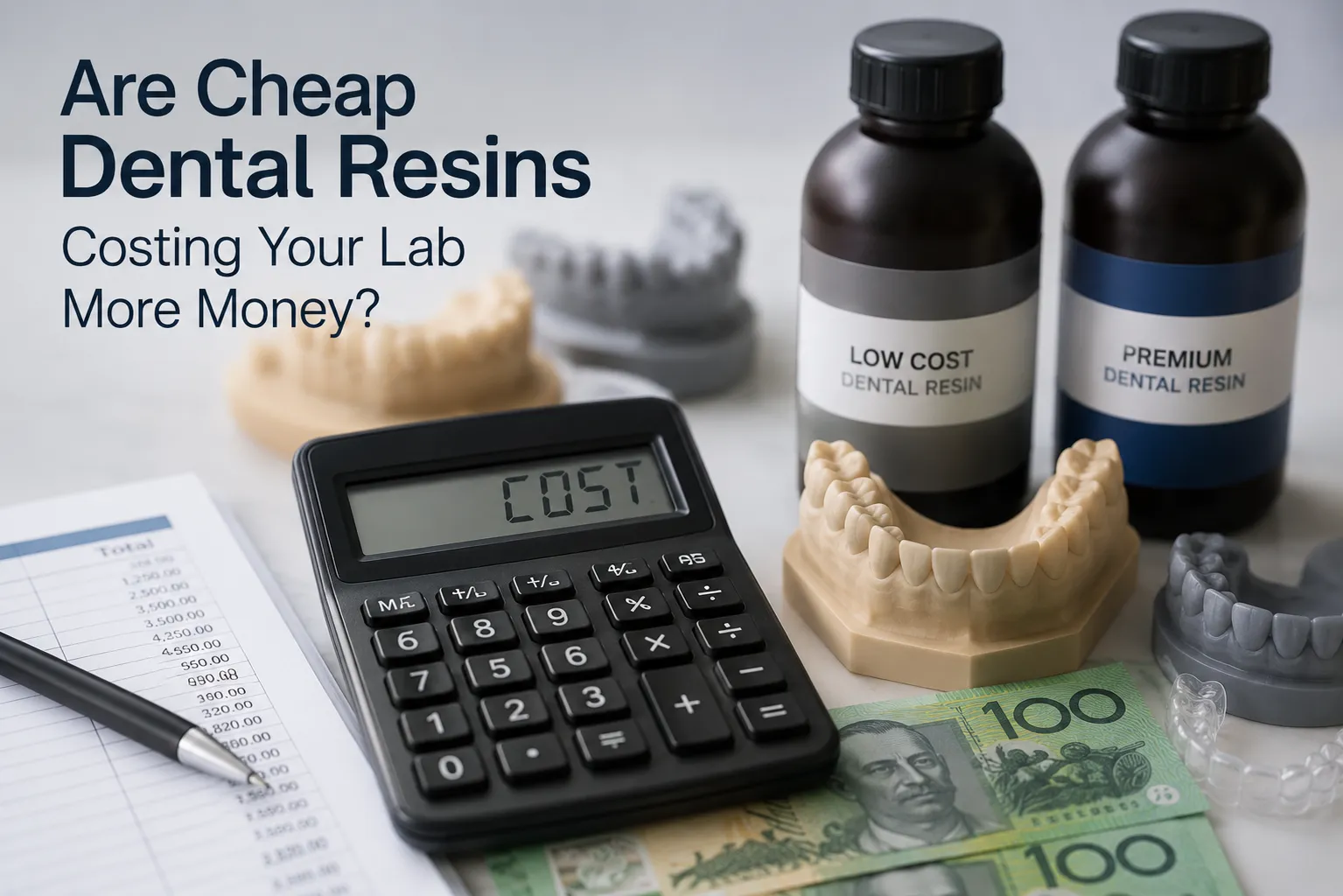

Running a successful dental laboratory requires a careful balance between quality, efficiency, and cost control. With the growing use of 3D printing in dentistry, resin selection has become an important purchasing decision for labs of all sizes. While low-cost dental resins may seem attractive from a budgeting perspective, the initial savings do not always translate into lower operating costs.
Many laboratory owners focus on the purchase price of resin without considering its impact on print quality, production time, labour requirements, and material waste. In reality, choosing a cheaper resin can sometimes result in higher expenses over time.
The Hidden Cost of Failed Prints
One of the most common issues associated with lower-quality dental resins is print failure. Dental models, surgical guides, splints, and other printed applications require a high level of accuracy. When resin performance is inconsistent, failures can occur during printing or post-processing.
Every failed print represents more than wasted material. It also means:
- Additional machine time
- Increased labour costs
- Delayed case delivery
- Higher electricity consumption
- Reduced production capacity
If a technician needs to print the same model multiple times, the savings achieved from purchasing a cheaper resin can disappear quickly.
Accuracy Matters in Dental Applications
Dental laboratories operate in a field where precision is essential. Even small dimensional inaccuracies can affect the fit of aligners, crowns, surgical guides, and other dental appliances.
Some budget resins may produce models that appear acceptable at first glance but show inconsistencies when measured closely. Variations in shrinkage, curing behaviour, or layer adhesion can impact final outcomes.
When a dental model requires adjustment or complete reproduction due to accuracy issues, the associated labour costs often exceed the price difference between premium and budget resin options.
Increased Post-Processing Time
Post-processing is a significant part of the dental 3D printing workflow. Washing, curing, support removal, and finishing all require technician time.
Lower-cost resins can sometimes create additional challenges such as:
- Difficult support removal
- Surface imperfections
- Excessive residue after washing
- Increased sanding or finishing requirements
Even a few extra minutes spent on every printed case can have a noticeable impact over weeks and months. For busy laboratories handling dozens of prints daily, those additional labour hours can become a substantial operational expense.
Material Waste Adds Up Quickly
Waste is another factor often overlooked when comparing resin prices.
A resin that produces inconsistent results may lead to:
- More failed builds
- Higher support material usage
- Additional calibration prints
- Frequent reprints
Although the resin itself may cost less per litre, the amount actually consumed per successful case can be significantly higher.
Many laboratories find that a reliable resin with a slightly higher purchase price delivers better value because more of the material contributes to successful production outcomes.
Customer Satisfaction and Reputation
Dental laboratories rely heavily on trust and long-term professional relationships. Dentists expect consistent quality, reliable turnaround times, and accurate restorations.
When print quality issues result in delayed deliveries or remakes, customer confidence can be affected. A single problematic case may not seem significant, but repeated issues can impact a laboratory's reputation.
Investing in dependable materials helps maintain consistency and supports positive relationships with dental practices.
Machine Efficiency Is Equally Important
3D printers represent a significant investment for any laboratory. Every hour spent reprinting failed jobs reduces the productivity of that equipment.
High-performing resins often provide:
- Better print reliability
- Consistent curing characteristics
- Improved dimensional stability
- Reduced troubleshooting time
By keeping printers operating efficiently, laboratories can maximise output without increasing equipment costs.
Looking Beyond the Purchase Price
The true cost of dental resin extends beyond the label price. A comprehensive evaluation should include:
- Print success rates
- Accuracy and consistency
- Labour requirements
- Post-processing efficiency
- Material waste
- Customer satisfaction
- Production throughput
When these factors are considered together, the lowest-priced resin is not always the most economical choice.
Many Australian dental laboratories are moving towards trusted materials that offer predictable performance and dependable results. Choosing a proven option such as Monocure dental resin can help reduce reprints, improve workflow efficiency, and support consistent production standards.
Final Thoughts
Cheap dental resins may appear to lower operating costs, but the long-term financial impact can tell a different story. Failed prints, wasted material, additional labour, and production delays can quickly outweigh the initial savings.
For dental laboratories focused on quality, efficiency, and sustainable growth, resin selection should be viewed as an investment rather than simply a purchasing decision. A reliable resin contributes to smoother workflows, better outcomes, and stronger client relationships, ultimately helping laboratories maintain profitability while delivering consistent results.



























Sign in to leave a comment.