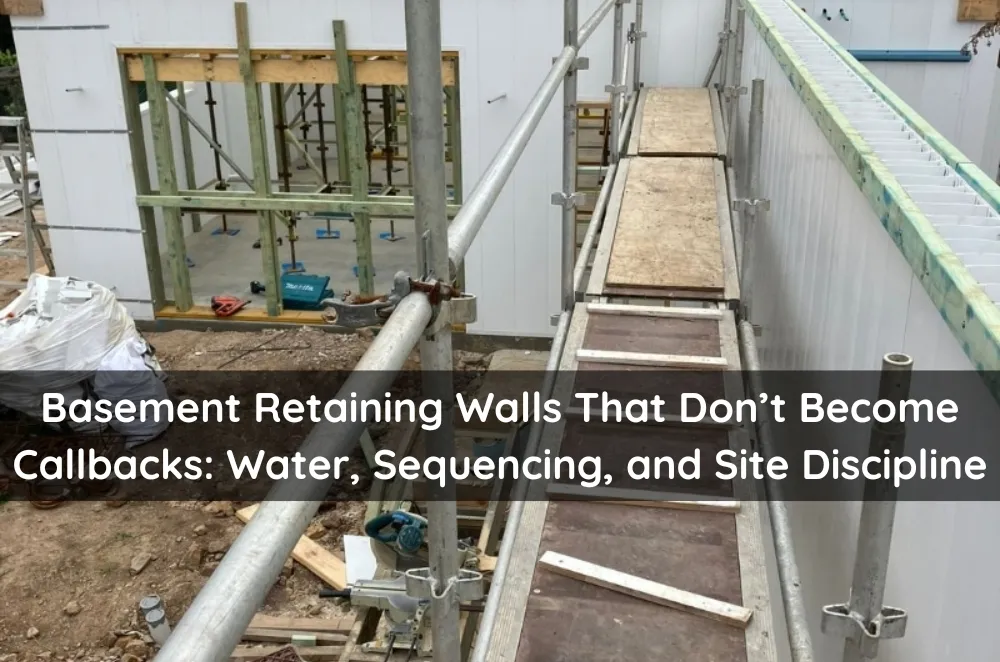

Basement retaining walls are one of the few parts of a build where “we’ll fix it later” is usually a fantasy.
Once a wall is buried, access is expensive, disruptive, and often politically messy between trades, consultants, and owners.
Most long-term headaches don’t start with a catastrophic failure.
They start with small shortcuts that stack: a rushed penetration detail, a drainage layer damaged during backfill, a membrane that looked continuous until it met a corner, or a sequencing decision made to “keep the programme moving.”
Whether you’re building in Australia or the United States, the fundamentals don’t change.
Water finds the weakest point, soil pressure punishes early loading, and minor defects become major because you can’t see them once the wall system is closed in.
This article keeps things practical: what usually causes basement retaining wall callouts, what to check at the moment it’s still cheap to fix, and how to choose a wall/form approach your crew can execute reliably.
Why basement retaining walls fail in the real world
A basement retaining wall isn’t just concrete resisting lateral load.
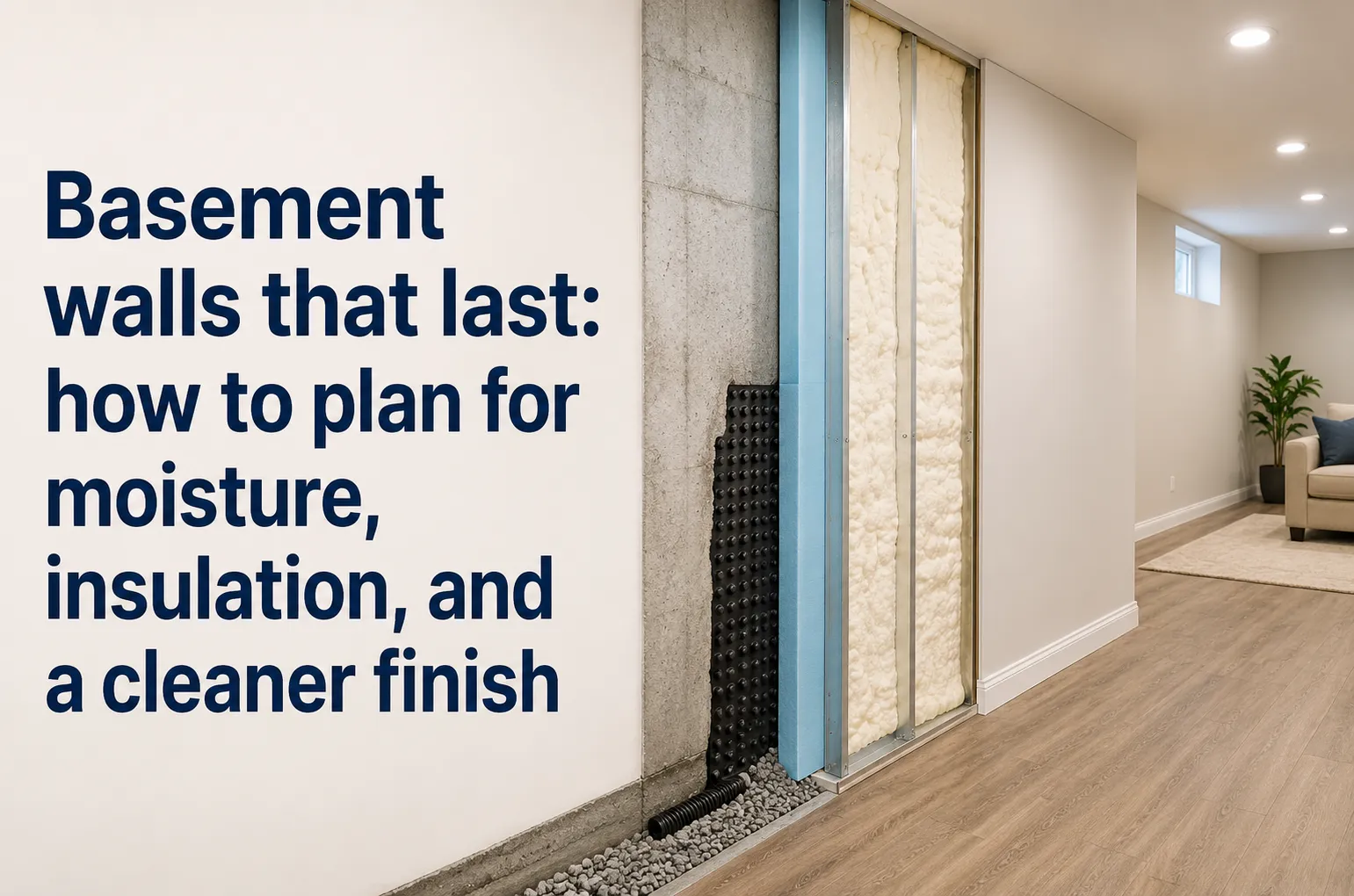
It’s a system: structure, waterproofing, protection, drainage, and sequencing—working together under ground conditions you don’t fully control.
When walls underperform, it’s usually one (or more) of these buckets:
- Water strategy gaps: drainage is underdone, membranes aren’t continuous at transitions, or protection is treated as optional.
- Detailing gaps: penetrations, joints, and corners are improvised on site.
- Sequencing gaps: backfill, compaction, and bracing removal happen before the wall system is ready.
A wall can be “strong” and still become a warranty headache if the water management and protection systems are weak.
Most owners remember the leak, not the compressive strength.
Common mistakes that create leaks, disputes, and rework
Mistake 1: Treating waterproofing as a product purchase instead of a system design.
Membrane choice matters, but continuity, protection, and drainage pathways matter more.
Mistake 2: Letting penetrations happen “wherever the trades need them.”
Unplanned penetrations invite rushed detailing, which is where leaks love to start.
Mistake 3: Assuming the wall is finished after the pour.
Until the membrane, protection, drainage layer, and backfill plan are complete, the wall system isn’t finished.
Mistake 4: Rushing backfill because the excavator is available.
Backfill timing and compaction can stress the wall and damage protection layers at the exact moment the system is most vulnerable.
Mistake 5: Missing a pre-backfill inspection checkpoint.
If nobody verifies continuity and protection before soil goes in, the project is relying on luck.
Mistake 6: Overloading “site judgment.”
If key details aren’t documented, the site will invent solutions under time pressure.
Decision factors when choosing a wall or formwork approach
The “best” approach is the one that suits your project constraints and the team that has to build it.
These decision factors help you choose without getting lost in marketing claims.
Repeatability under real conditions
A dependable system is one that an ordinary crew can install consistently.
If a method relies on specialist labour, perfect weather windows, or heroic supervision, it may be “high performance” but low reliability.
Tolerance control and alignment
Plumb and straight matter for more than aesthetics.
They affect membrane contact, drainage layer performance, and how later trades interface with the wall.
If the system makes straightness hard to achieve, it increases the risk of membrane bridging, voids, and inconsistent protection.
Those problems typically show up later as moisture ingress, not as visible structural distress.
Waterproofing and drainage integration
Ask a blunt question: Does the wall/form approach make waterproofing simpler or more complex?
Systems that create awkward edges, discontinuities, or hard-to-protect interfaces tend to create recurring detailing failures.
Repairability and inspection access
Nobody plans a defect, but planning for inspection and repair access is a maturity signal.
If a system makes it impossible to inspect critical transitions before backfill, you’re increasing your future risk profile.
Crew fit and supervision reality
Choose a method that fits your supervision bandwidth.
A system that is “easy when done perfectly” but hard to supervise will drift out of spec as schedules tighten.
The three checkpoints that prevent most basement wall problems
The best basement wall builds aren’t the ones with the most meetings.
They’re the ones with the right checks at the right moments.
Checkpoint 1: Before the pour
This is where errors are cheap to fix.
The goal is to confirm the wall is buildable as documented, with penetrations, joints, and transitions understood.
High-level checks that pay off:
- penetrations are located, coordinated, and detailed
- joints and transitions are planned (no “we’ll figure it out on pour day”)
- alignment and bracing are adequate for the conditions
- the crew understands the “stop” conditions (what must be fixed before concrete)
Checkpoint 2: After the pour, before waterproofing goes on
This is where you can still see the wall as-built.
It’s the moment to identify areas that will be impossible to inspect once membranes and protection are installed.
A practical question at this stage: What would we regret not fixing right now?
Checkpoint 3: Before backfill
Backfill is where a lot of good work gets damaged.
Before soil goes in, confirm continuity of waterproofing, protection layers, drainage elements, and the compaction/sequence plan.
If the pre-backfill check is skipped, any issue becomes a buried issue.
Buried issues are the ones that become disputes.
Penetrations, joints, and transitions: the predictable weak points
Most basement leakage stories start at a penetration, a joint, or a transition.
These aren’t edge cases—they’re the main event.
A disciplined approach is boring on purpose:
- Penetrations: plan early, keep routing tidy, detail consistently, and avoid last-minute relocations.
- Joints: decide the approach up front and treat joints as part of the water strategy, not a concrete-only conversation.
- Transitions: slab edges, steps, ledgers, and changes in thickness should have continuity of waterproofing and protection clearly shown.
If site teams are improvising these details, the documentation isn’t doing its job.
And improvisation is where “dependable” becomes “unpredictable.”
Shortlist systems and compare documentation
Once you’ve settled on a general approach, compare systems on the details that drive outcomes: corners, penetrations, and waterproofing assumptions.
This is also where you separate “product” from “system.”
Compare:
- what the system includes versus what must be specified separately
- how corners and transitions are treated
- what the approach assumes about waterproofing and drainage responsibility
- what sequencing is required before backfill
- what can be inspected and when
Once the scope is clear, compare wall details, penetrations, and waterproofing assumptions side by side—resources like the dependable basement retaining wall construction support can help confirm what the system covers versus what must be specified on site.
Operator Experience Moment
On many builds, the biggest blow-ups happen at handover points: formwork to concrete, concrete to waterproofing, waterproofing to backfill.
Each handover creates a moment where someone assumes “the next trade will handle that detail.”
The most dependable projects remove that assumption by making responsibilities and checkpoints explicit before anyone races the schedule.
Local SMB Mini-Walkthrough
A small builder takes on a project with a basement-level garage and storage area and a tight programme.
They list every penetration early and lock locations before formwork is finalised.
They hold a pre-pour check focused on penetrations, transitions, and alignment—not just “are we ready to pour.”
They define what “ready for backfill” means and who signs it off.
They protect membranes during backfill and treat compaction as part of the wall system.
They finish with fewer surprises because the sequence was owned end-to-end.
Practical Opinions
If the detail isn’t documented, the site will invent it under pressure.
If backfill is rushed, repairs later are almost always worse than the delay now.
If waterproofing is treated as “someone else’s trade,” it becomes everyone’s problem.
A simple 7–14 day first-action plan
- Days 1–2: Identify the top site water risks, map drainage pathways, and list every penetration and transition so nothing is “discovered” on pour day.
- Days 3–5: Shortlist two wall/form approaches and compare documentation for corners, penetrations, and waterproofing assumptions; flag any detail that relies on “site judgement.”
- Days 6–10: Lock your three checkpoints (pre-pour, post-pour/pre-membrane, pre-backfill) and assign one accountable owner for each sign-off.
- Days 11–14: Finalise the backfill sequencing and protection plan, and confirm who supplies/installs each element (membrane, protection, drainage) so handovers don’t blur.
Key Takeaways
- Basement retaining walls perform as a system: structure, waterproofing, protection, drainage, and sequencing.
- Most callbacks come from penetrations, transitions, and rushed backfill, not from the concrete itself.
- Three checkpoints—pre-pour, post-pour, pre-backfill—catch defects while they’re still fixable.
- Choose a method that your crew can execute repeatably under real site constraints.
Common questions we hear from businesses in Australia and the United States
Q1) How do we know if a wall system is “dependable” for our crew?
Usually, it comes down to repeatability and clarity of details; a practical next step is to review corner/penetration documentation and walk through the sequence with the supervisor who will actually run the job. In most cases in Australia and the US, labour variability is real, so systems that tolerate small execution differences tend to perform better.
Q2) What’s the most common “silent” cause of basement moisture issues?
In most cases, it’s a break in continuity at transitions or penetrations, not the main wall field; a practical next step is to enforce a pre-backfill inspection that specifically checks continuity and protection at those points. Usually, local ground conditions differ (wet seasons in parts of Australia, freeze-thaw in many US regions), but transitions remain the weak link everywhere.
Q3) When should we bring in an engineer or specialist consultant?
It depends on soil uncertainty, unusual loads, complex geometry, or high water pressure risk; a practical next step is to identify those risk flags early and get advice before locking the method and sequencing. In most cases across Australia and the US, early input prevents expensive redesign once the project is underway.
Q4) Should we standardise one system across all projects?
Usually, standardisation helps training, spares, and repeatability, but it depends on site variety; a practical next step is to standardise within similar project types and only vary when there’s a clear, documented reason. In most cases, fewer variants reduce site improvisation—especially when schedules tighten.




























Sign in to leave a comment.