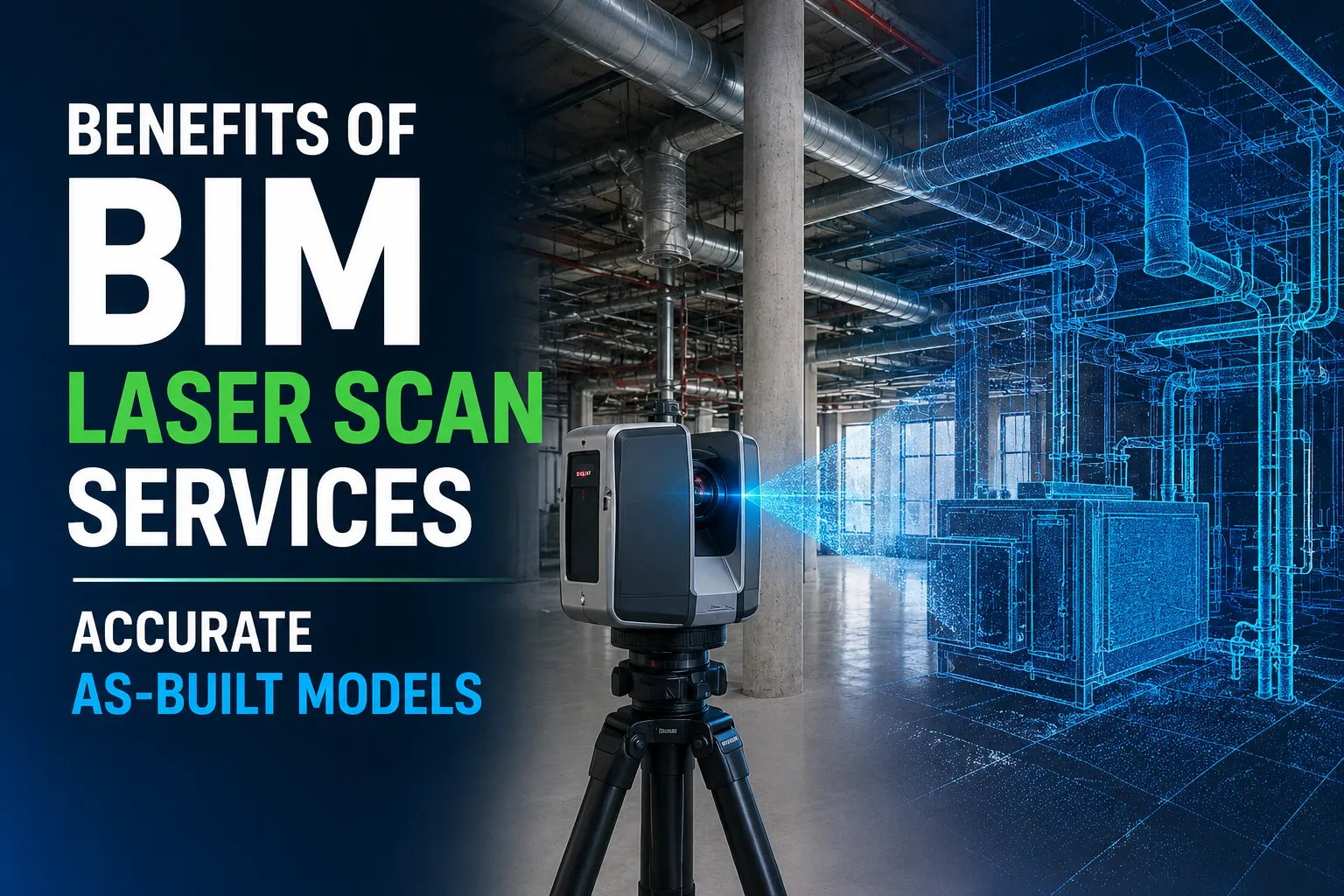

BIM laser scan services capture a building's exact dimensions using laser scanners, then convert that data into precise 3D as-built models. The result? Higher accuracy, faster timelines, lower costs, and fewer costly errors compared to manual measuring methods.
Every successful renovation, retrofit, or facility upgrade starts with one thing: knowing exactly what you're working with.
Yet for decades, contractors and architects have relied on tape measures, outdated blueprints, and a fair bit of guesswork to document existing conditions. That approach leaves room for errors—and errors get expensive fast.
Laser scanning changes the game. By pairing high-precision data capture with Building Information Modeling (BIM), teams can produce as-built models that reflect reality down to the millimeter.
This blog explains how bim laser scan services in texas and beyond are transforming the way projects get documented, planned, and delivered. You'll learn how the process works, the benefits it offers, and what to look for when choosing a provider.
What Is BIM and How Does Laser Scanning Fit In?
Building Information Modeling, or BIM, is a digital process for creating and managing detailed 3D models of a building. These models hold more than just geometry—they store data about materials, systems, and components that teams use across a project's entire lifecycle.
Laser scanning is a data capture method that uses laser beams to measure distances between the scanner and surrounding surfaces. In seconds, a single scan collects millions of data points, mapping the exact shape and position of walls, ceilings, pipes, and structural elements.
When you combine the two, you get an accurate as-built model: a digital twin of a structure as it currently exists. Accurate as-built models matter because they give every stakeholder a reliable foundation for planning, designing, and building. Without them, teams make decisions based on assumptions—and those assumptions often lead to rework.
Traditional Methods vs. Laser Scanning for As-Built Models
Manual measurement and 2D drawings have served the construction industry for generations, but they come with real limitations.
Hand measurements take time, require multiple site visits, and leave plenty of room for human error. Complex geometries—curved walls, intricate ductwork, irregular facades—are nearly impossible to document accurately by hand.
Laser scanning solves these problems.
A scanner captures an entire room in minutes, recording every detail with millimeter-level precision. There's no need to revisit the site to grab a forgotten measurement, because the point cloud already contains it. For projects where accuracy and speed both matter, laser scanning consistently outperforms manual methods.
Key Benefits of BIM Laser Scan Services
Accuracy and Detail
Laser scanners capture complex geometries that traditional tools simply can't. From ornate historical moldings to dense mechanical rooms, every surface gets documented precisely. This level of detail reduces guesswork and gives design teams a dependable starting point.
Time and Cost Savings
Because scanning captures complete data in a single visit, teams spend less time measuring and more time building. Accurate models also reduce rework—one of the biggest budget killers in construction. Fewer surprises during construction mean faster project timelines and lower overall costs.
Improved Collaboration
A BIM model built from scan data becomes a shared source of truth. Architects, engineers, contractors, and owners all work from the same accurate information. This shared visibility cuts down on miscommunication and keeps everyone aligned throughout the project.
Risk Mitigation
Clash detection is one of the most valuable benefits of working in BIM. By identifying conflicts—such as a duct running through a beam—before construction begins, teams avoid expensive on-site fixes. Catching errors early protects both the budget and the schedule.
Lifecycle Management
An accurate as-built model doesn't lose its value once construction wraps up. Facility managers use it for maintenance, space planning, and future renovations. The model becomes a long-term asset that supports the building throughout its entire life.
How Laser Scanning Creates Accurate As-Built Models
The process follows three main stages:
- Scanning the site. Technicians position a laser scanner at multiple locations throughout the building. Each scan captures millions of measurement points, covering every visible surface from floor to ceiling.
Generating the point cloud. The individual scans are stitched together into a single dataset called a point cloud. This cloud is a dense, 3D representation of the space, with each point holding precise spatial coordinates.
- Converting to a BIM-ready model. Skilled modelers use the point cloud as a reference to build an intelligent 3D BIM model. This step translates raw data into usable geometry—walls, doors, windows, MEP systems—ready for design and analysis.
The final model reflects the real-world conditions of the building, giving teams confidence in every decision that follows.
Applications of Accurate As-Built Models
Renovation and retrofit projects: Accurate models let designers plan around existing conditions, reducing surprises during demolition and construction.
Facility management and maintenance: Building owners use as-built models to locate systems, plan upgrades, and streamline ongoing maintenance.
Quality control and verification: Teams compare scan data against design intent to confirm that construction matches the plans.
Historical preservation: Laser scanning documents heritage structures in fine detail, preserving them digitally for restoration and study.
How to Choose the Right BIM Laser Scan Service Provider
Not every provider delivers the same quality. Keep these factors in mind when selecting a partner:
- Expertise and experience. Look for a team with a strong track record across project types similar to yours. Experience with complex sites is a major plus.
- Technology and equipment. The best results come from modern scanners and proven software. Ask about the hardware and workflows a provider uses.
- Deliverables and support. Clarify what you'll receive—point clouds, BIM models, level of detail—and what kind of ongoing support is included.
Companies like Archdraw Outsourcing offer specialized BIM and laser scanning solutions, helping clients turn raw scan data into accurate, project-ready models.
Build on a Foundation of Accuracy
As-built accuracy is no longer a nice-to-have—it's a competitive advantage. BIM laser scan services give project teams precise, reliable data that saves time, cuts costs, and reduces risk at every stage. As scanning technology grows more affordable and BIM adoption continues to climb, these services will become standard practice across the construction industry.
If you're planning a renovation, retrofit, or new facility, accurate as-built models are the smartest place to start. Partnering with an experienced provider ensures you get data you can trust—and a project that runs smoothly from start to finish.
Frequently Asked Questions
How much do BIM laser scan services cost?
Costs vary based on building size, complexity, and the level of detail required. Larger or more intricate sites take more time to scan and model, which raises the price. The best way to get an accurate quote is to share your project scope with a provider for a tailored estimate.
How long does the laser scanning process take?
On-site scanning is fast—often just hours or a few days, depending on the building's size. Processing the point cloud and converting it into a BIM model takes additional time, typically ranging from a few days to several weeks based on complexity.
How accurate are laser scans for as-built models?
Modern laser scanners achieve millimeter-level accuracy, far surpassing manual measurement. This precision makes them ideal for projects where exact existing conditions are critical.
Who benefits most from BIM laser scan services?
Architects, engineers, contractors, and facility managers all benefit. These services are especially valuable for renovation projects, retrofits, quality control, and managing complex buildings with detailed systems.
What's the difference between a point cloud and a BIM model?
A point cloud is raw scan data—millions of measured points representing surfaces. A BIM model is an intelligent 3D model built from that data, containing organized geometry and information teams can actually use for design and planning.






















Sign in to leave a comment.